The free COSHH audit asks 43 questions, and 6 of them are about one folder. Most people searching for a COSHH data sheet want a safety data sheet, the document a supplier has to hand over. The sharper question is whether staff can reach a current one on any shift.
COSHH stands for the Control of Substances Hazardous to Health. That folder is the spine of an assessment, a spill procedure and an induction, so it is worth getting right.
The sheet comes from your supplier
The legal name is safety data sheet. Under the retained REACH Regulation, a supplier must give the recipient one where the product meets the criteria for classification as hazardous.
It follows a fixed set of headings and carries a date. It is supplied in English. Suppliers must update it without delay in the cases the Regulation sets out.
So you never write one. You collect it, keep it current and put it where people work. The full text of article 31 on safety data sheet requirements covers the supply side.
Every audit in the library is free to run, with scoring, actions and a report. No card needed.
Create a free accountWhere the sheet feeds your COSHH assessment
The duty to use the sheet sits in the Control of Substances Hazardous to Health Regulations 2002. No work that is liable to expose staff may go ahead until a suitable and sufficient assessment has been made and the steps taken.
Regulation 6 then lists what the assessment must weigh. One line names the sheet itself. It asks for the health effects the supplier gave you, including any relevant safety data sheet.
That single line is why a COSHH assessment downloaded from a template site fails. It was written without the sheet for the product in your cupboard.
Review the assessment regularly, and at once where there is reason to think it no longer holds or the work has changed significantly. Where you employ five or more people, record the significant findings and the control steps you took.
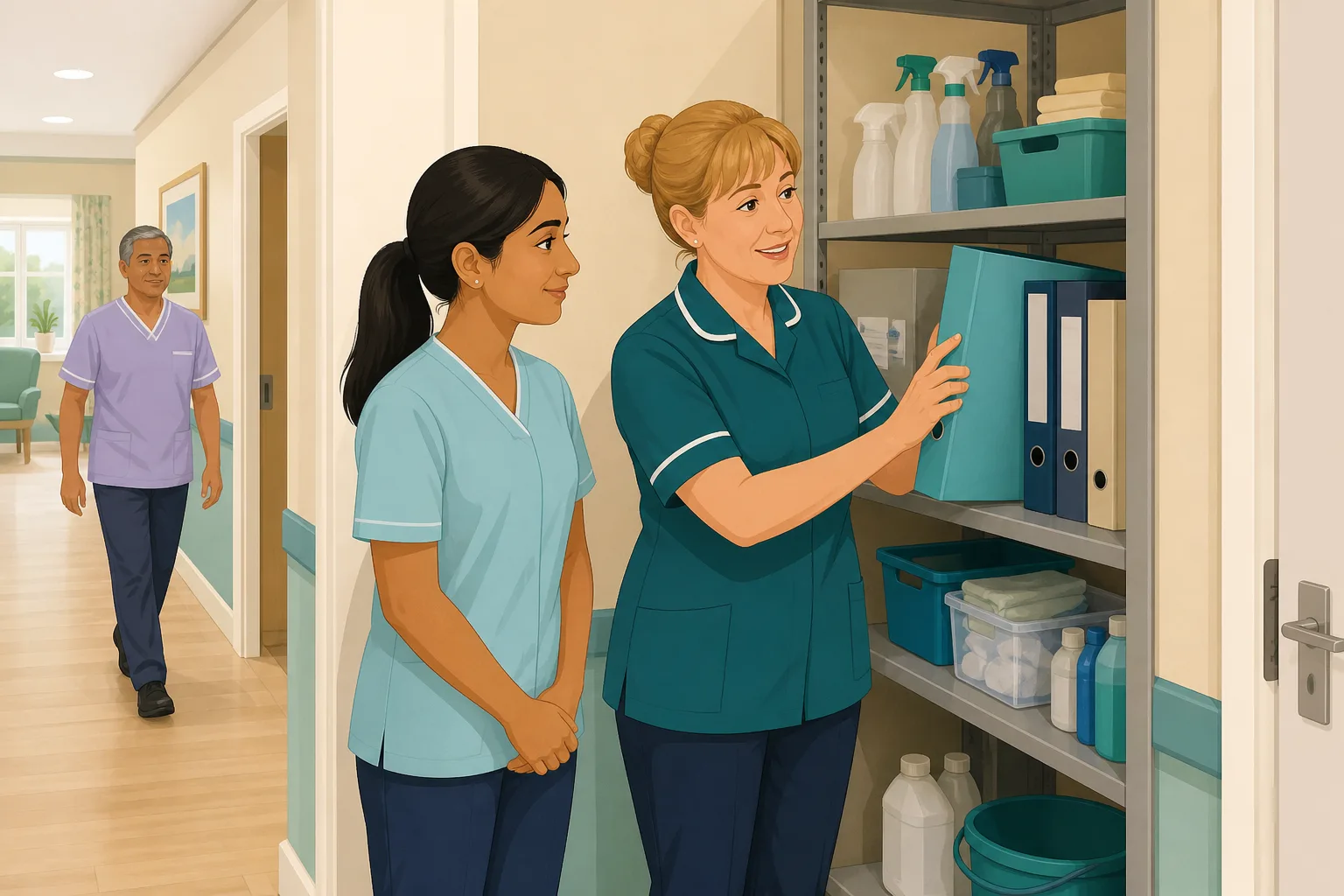
Figure: the induction question is not whether the folder exists, but whether a new starter can find it unaided.
The 6 checks we run on a data sheet file
The COSHH audit in CareStream gives safety data sheets and labelling a section of its own. These are the checks, in the order you meet them on a walk round.
- A current sheet is held for every product on the register.
- Staff can reach the sheets on every shift without asking a manager.
- The sheets match the product and supplier in use, not an old version.
- Every container is in its original labelled packaging.
- Diluted or decanted containers carry the product name and hazard.
- An assessment covers that practice.
- Any unlabelled or damaged container found is recorded, with its location.
The second check is the one that catches good services. The file exists, it is current, and it lives in a locked office that the night staff cannot open.
Decanting, and the containers that cause trouble
Spray bottles filled from a five litre drum are where most care services slip. The Regulations deal with this plainly.
Where containers are not marked under the relevant labelling law, the employer must make sure the contents, their nature and the hazards attached are clearly identifiable. A handwritten name on tape is better than nothing, but it is not enough on its own.
The assessment has to cover the dilution as used, not the concentrate as sold. Those are different exposures and the sheet will say so.
What staff have to be told, and when
Regulation 12 asks for suitable and sufficient information, instruction and training for anyone liable to be exposed. It then spells out the content.
- The names of the substances and the risks they present.
- Any relevant workplace exposure limit.
- Access to any relevant safety data sheet.
- The significant findings of your assessment.
- The precautions and actions each person should take.
Two details are easy to miss. The training has to be adapted when the work or the methods change significantly. And it must suit the level, type and duration of exposure your assessment identified.
A COSHH risk assessment training session that never opens a data sheet is a talk, not training. The duty also reaches beyond your payroll: anyone carrying out work connected with these duties needs the same information, employee or not.
Pick an audit, assign it, score it on a phone and close the actions. Create a free account to start.
Create a free accountThe spill procedure the sheet is meant to drive
Regulation 13 asks for procedures ready to use when something goes wrong. It names first aid facilities. It names safety drills, tested at regular intervals.
Information on the emergency arrangements has to be available, including the hazards likely to arise. Warning and communication systems have to let people respond properly.
The sheet is where the content comes from. Skin contact, eye contact, swallowing and inhalation each have their own answer, and those answers differ by product.

Figure: a two minute read at handover does more for recall than a yearly session nobody remembers.
Keeping the file current without a yearly trawl
Tie the file to ordering rather than to a review date. When a product is ordered or the supplier changes, the sheet is pulled at the same time.
Then hold one rule: no new product goes into use until it has an assessment. That stops the gap opening in the first place.
The Care Quality Commission arrives at the same cupboard from another direction. Under the Health and Social Care Act 2008 (Regulated Activities) Regulations 2014, safe care and treatment covers assessing and reducing risk to the people you support. A bottle left within reach in a shared lounge is one of those risks.
The Single Assessment Framework pushes the same question at you. How do you know this is controlled? A dated file and a closed action list answer that better than a policy does.
Our longer piece on the COSHH regulations and the evidence behind them covers the wider duties.
Benefits of CareStream for your COSHH data sheet file
The check and the training sit together on a free account.
In CareStream the COSHH audit runs to 43 checks across 6 sections, set to quarterly. Each answer is scored. Anything marked No can raise a finding that lands on a named person with a date.
The next run shows last time's actions, so repeat gaps stay visible. That matters here, because the same three products tend to go missing from a file each quarter.
Every member of staff can take the COSHH course at no cost, in English, and the certificate carries the CPD Certified mark. It covers handling, storing and recording hazardous products. Assign it to the people the audit flagged rather than to the whole team.
Read every check on the free COSHH audit for care services before you sign up. The free COSHH course for care staff sits beside it.
What to do with your file before the next audit
Five jobs, in order.
- Print the register and walk the stores with it, marking every product you cannot match to a sheet.
- Ask one night worker to find a sheet without help, and time it.
- Pull current sheets for the gaps, straight from the supplier rather than a search engine.
- Check every decanted container against its assessment, and relabel or empty the ones that fail.
- Put the spill answers for your three most used products somewhere staff already look.
Then run the audit once and let the scores tell you which section to fix first. Most services find the sheets exist and the access does not.
Keep the result. A second run in CareStream three months later shows whether the fix held, which is the part an inspector asks about.
Sources
- Article 31, requirements for safety data sheets, Regulation (EC) No 1907/2006 as retained in UK law · legislation.gov.uk
- Regulation 6, assessment of the risk to health, Control of Substances Hazardous to Health Regulations 2002 · legislation.gov.uk
- Regulation 12, information, instruction and training, Control of Substances Hazardous to Health Regulations 2002 · legislation.gov.uk
- Regulation 13, arrangements for accidents, incidents and emergencies, Control of Substances Hazardous to Health Regulations 2002 · legislation.gov.uk
- Regulation 12, safe care and treatment, Health and Social Care Act 2008 (Regulated Activities) Regulations 2014 · legislation.gov.uk
Frequently asked