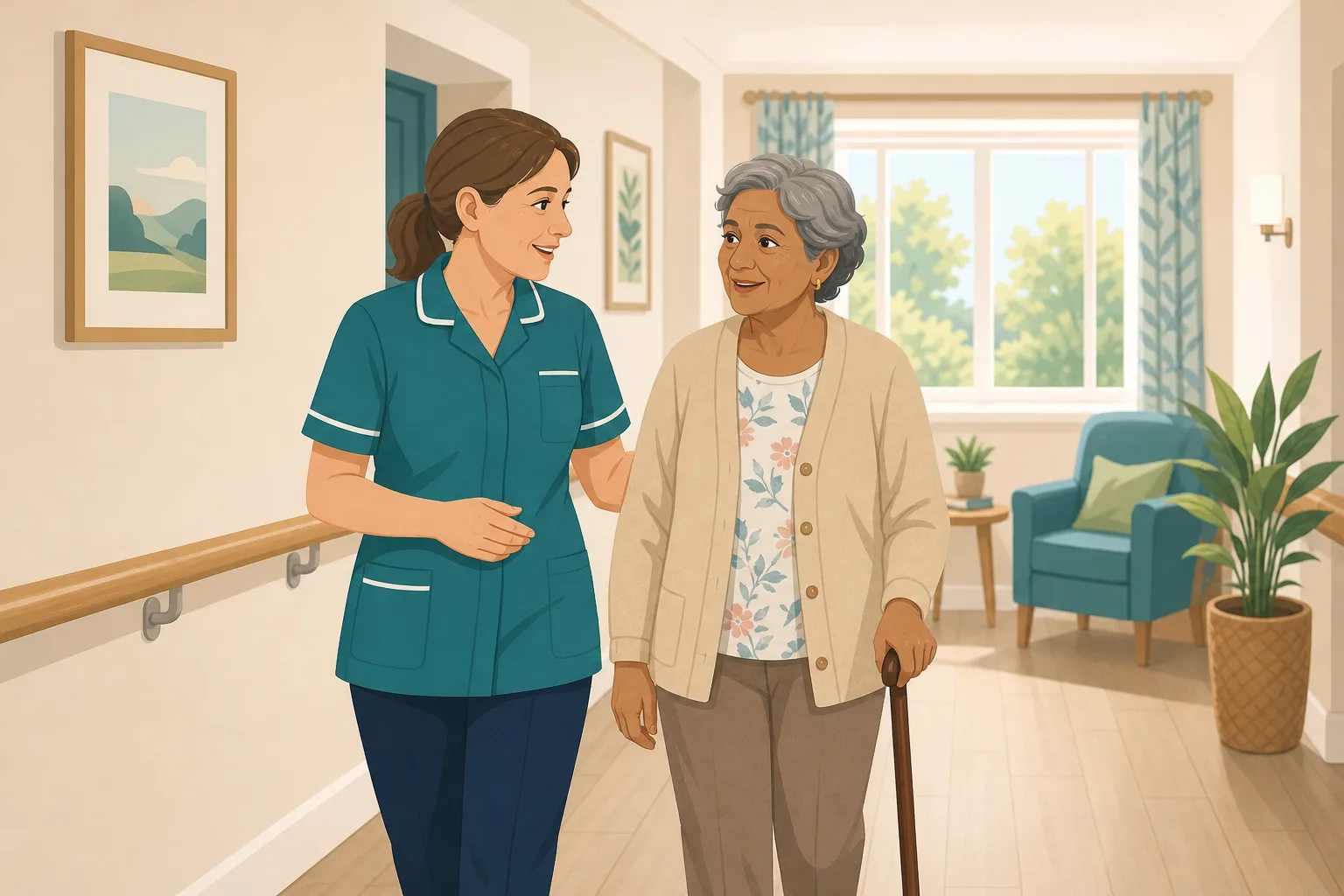
A dementia friendly environment is not a set of signs. Signs help, and most services start there, because signs can be bought.
The harder part is what a person sees standing in the corridor looking for the toilet. A door the same colour as every other door. A shiny floor that reads as water. This dementia friendly environment checklist walks a building room by room, in the order you would walk it.
What the building is being asked to do
One test runs through all of it. Can a person find what they need without asking anybody?
That is not a kindness, it is independence. It is also what the regulator looks for. The Care Quality Commission, in its provider guidance on premises and equipment, expects people to enter and leave premises and find their way around easily and independently.
Where they cannot, reasonable adjustments must be made under the Equality Act 2010.
The duty behind that sits in law. Read the published wording of Regulation 15 on premises and equipment and you will find the words suitable and properly maintained.
Every audit in the library is free to run, with scoring, actions and a report. No card needed.
Create a free accountThe entrance hall
Stand at the front door and look the way a new resident would.
- Is there one obvious route in, or three doors that look the same?
- Is there a place to sit within sight of the entrance?
- Is the lighting even, or does the hall go dark where the sun does not reach?
- Can a person see into the lounge, so they know where other people are?
Glass doors and dark mats both cause trouble. A dark mat on a pale floor can read as a hole, so a person steps around it or refuses the threshold.
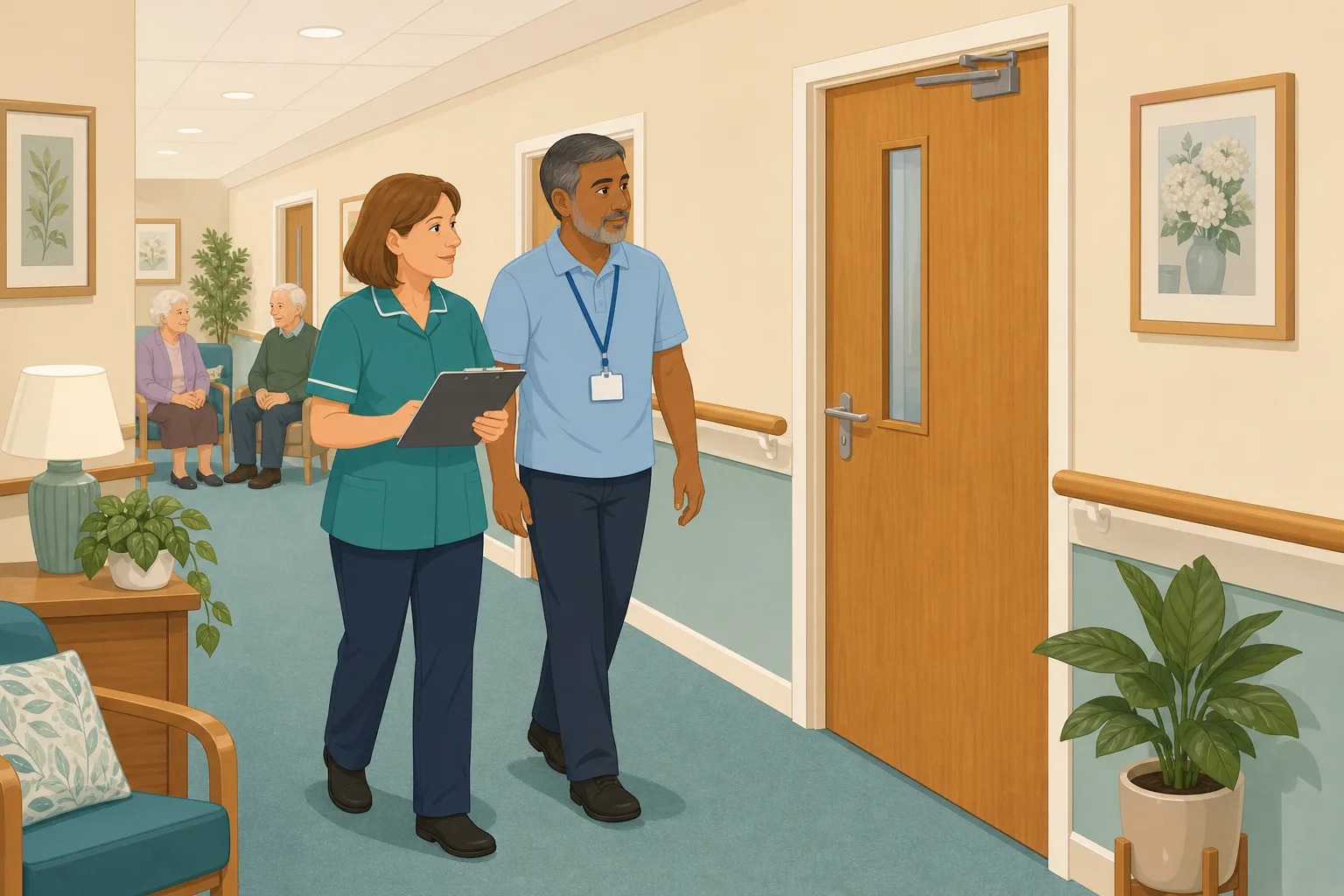
Corridors, and finding the way back
Corridors are where people get lost in a dementia care home, because every stretch looks like the last one.
- Handrails along the length, in a colour that stands out from the wall.
- Something different to look at at each end, so one direction is not the other.
- Daylight somewhere along the run.
- Signs with a picture and a word, at eye level rather than above the door.
A sign at the height a door closer sits is a sign for the building, not for the person. Eye level is the whole trick, and moving one down the wall by a foot and a half costs nothing but the time it takes. Try it on one door.
The lounge and the dining room
Noise is the thing most services underestimate. A television nobody is watching, a vacuum in the next room, two voices at the serving hatch.
Put them together and the room stops working for anyone who finds listening hard. In most lounges, that is most people.
Check seating next. Chairs in a long row against the wall make conversation impossible, while small groups of three or four change how a room gets used within a week.
In the dining room, look at contrast on the table. A white plate on a white cloth is harder to see than it sounds. Change the plate.
Bathrooms, toilets and door contrast
This is where the checklist earns its keep, because continence and dignity both sit here.
- The toilet door a different colour from the wall and from the other doors.
- A sign on it with a picture and a word.
- The toilet seat a contrasting colour from the pan and the floor.
- Nothing stored in the bathroom that turns it into a cupboard.
If a person cannot see the toilet from the doorway, an unlocked door is not much use. Colour does the work.
Light, flooring and noise
These three run through every room, and they are the three a quick walk round misses.
Light: even, without dark corners or strong shadows. The NICE guideline on dementia assessment, management and support names daylight as part of a sleep plan. A chair by a window is doing real work.
Flooring: no strong patterns, no shiny stretches that could read as a step or a puddle. A change of floor colour at a doorway can stop someone crossing it.
Noise: check it when it is worst, not when you happen to be passing. Teatime, usually.
Bedroom doors and what says whose room it is
A number is not recognition. A personal object at the door, chosen by the person or their family, does more than any label. Photographs work well.
Clocks and calendars belong here too, and the check is simply whether they are right. A clock showing the wrong time in a dementia unit is worse than no clock, because people use it and act on it.
Pick an audit, assign it, score it on a phone and close the actions. Create a free account to start.
Create a free accountOutdoor space, and walking about
Walking is not a symptom to be stopped. Where a person walks a great deal, safe outdoor space they can use freely is the first thing to look at, long before anyone discusses doors.
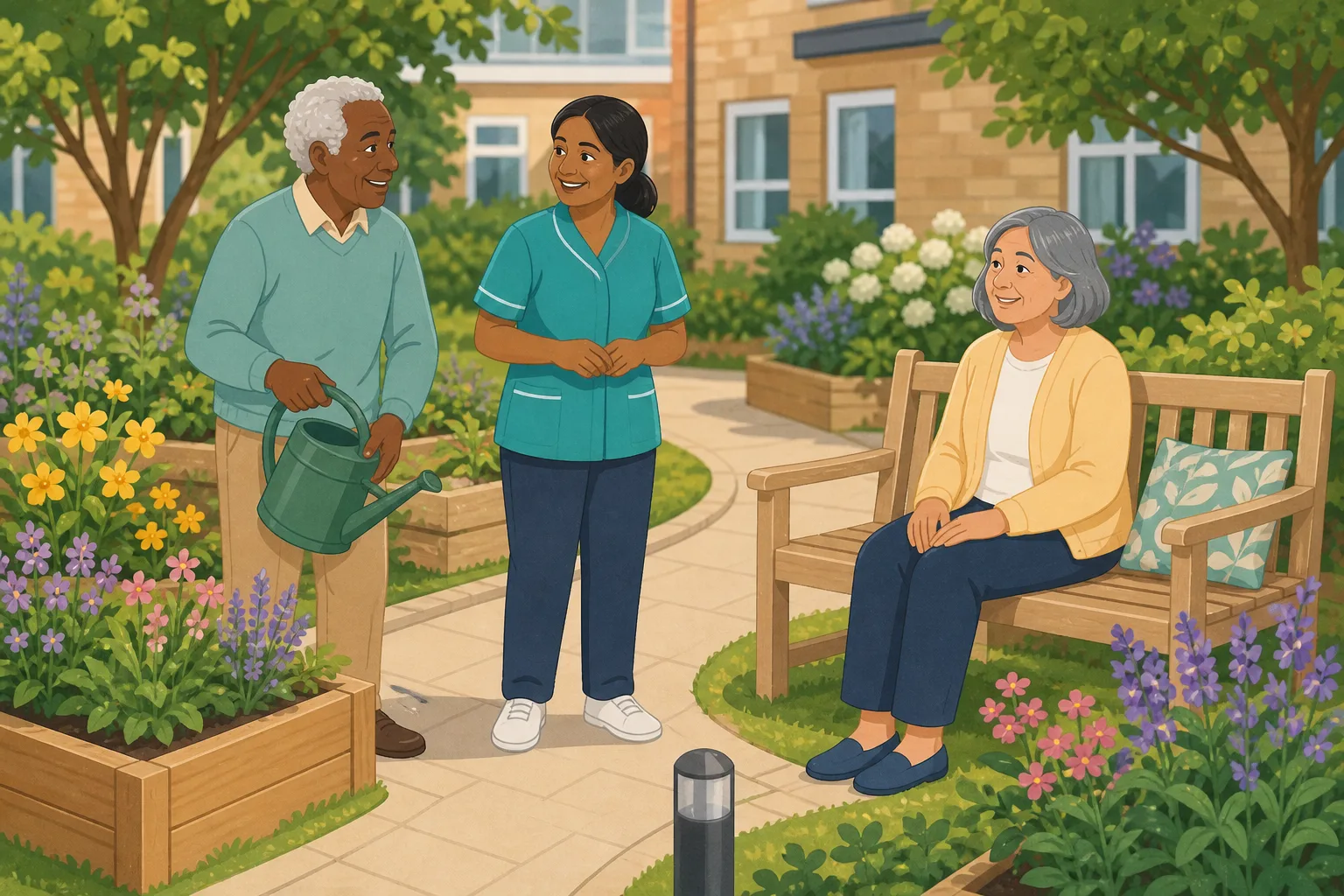
Figure: a looped path with benches lets someone walk as long as they want and still arrive back.
A path that loops back beats one that ends at a fence, because an end point is where a walk becomes an obstacle. Benches matter as much as the path.
Where the building meets the person
The environment and the person centred care plan are the same conversation. What a person did for a living, which room they settle in, what time of day is hardest, and what they walk towards.
That belongs in the plan, and it has to reach the people on shift. Dementia care training covers how staff approach somebody, at eye level and from the front. The building covers whether the approach happens in a room where anyone can hear.
The NICE guideline asks services to look for causes in the surroundings before treating distress. It also puts changes to those surroundings in the first line of management. That is the best argument for walking the building often.
Benefits of CareStream for a dementia friendly environment checklist
The Dementia Care Environment audit is free on a free CareStream account. It holds 13 checks in three sections: Orientation and signage, Environment, and Daily experience.
Between them the checks cover the ground this page walks:
- Signs with pictures and words at eye level.
- Toilet and bathroom doors that contrast and are signed.
- Clocks and calendars showing the right time and date.
- Bedroom doors personalised for the person behind them.
- Even lighting, and flooring without patterns or shine.
- Safe outdoor space residents can use freely.
- Noise in communal areas, with what caused it.
Scores sit against each section. A check you mark down turns into a job with a name beside it.
What to write down as you go
A walk round that produces no record changes nothing. Note the room, what you saw, and what you would do about it, in that order.
Photographs help more than words here. A picture of a corridor at four in the afternoon settles an argument about light that a sentence never will.
In CareStream you can attach a photograph to the question it belongs to. The picture and the finding then stay together, rather than drifting into a folder of their own.
Give each item an owner. Some are a ten minute job, like moving a sign down to eye level. Others are a decorating budget, and those need a date rather than good intentions.
Where to start, one room at a time
Pick one room and fix one thing in it. A single contrasting toilet door teaches more than a full survey that nobody has time to act on.
Then set the rhythm: run the dementia care environment audit free each quarter, at a different time of day each time.
The written dementia care policy sets out the person centred side of this, and our dementia training collection covers what staff need alongside the building.
Sources
- Regulation 15 (Premises and equipment), Health and Social Care Act 2008 (Regulated Activities) Regulations 2014 · legislation.gov.uk
- Care Quality Commission guidance for providers on Regulation 15: Premises and equipment · cqc.org.uk
- NICE guideline NG97: Dementia, assessment, management and support for people living with dementia and their carers · nice.org.uk
- Care Quality Commission assessment framework: key questions and quality statements · cqc.org.uk
Frequently asked