
Policy collection
Safer Recruitment Policy for Care Services: Six Documents
A safer recruitment policy is judged on what sits in the file. Proof of identity with a photograph. A criminal record check where one is needed. References somebody read.
A safer recruitment policy nobody follows leaves a gap. An inspector finds it quickly. The file is the evidence, and the document is only the instruction for building it.
Six written policies sit behind this page, and together they follow a member of staff from the application form all the way to the last day. Hiring and checks come first. Conduct, supervision, training and working hours follow.
Each one is written from answers about your own service. Each names your own role holders, so nobody has to guess who does what. A second file travels with it, listing the law the wording answers.
Every price is shown before you buy. You can check what you already hold first, and pay only where there is a gap.

Fit and proper persons, DBS checks, references and ongoing suitability under Regulation 19.

Fair, ACAS-aligned disciplinary and grievance procedures.

Regular supervision and annual appraisal under Regulation 18, with frequencies and records.

Induction, mandatory training and refreshers, mapped to the Care Certificate.

Hours, rest breaks, night work and opt-outs under the Working Time Regulations.

The conduct expected of every member of staff, on shift and online.
What the law asks for before somebody starts
Two regulations do most of the work. One is about who you take on. The other is about what you do with them afterwards.
What the fit and proper persons rule actually says
Regulation 19 requires that people employed in a regulated activity are of good character. They must have the skills and experience the work needs.
They must also be able to do the job by reason of their health, once reasonable adjustments are made.
Then comes the part most services skip. Recruitment procedures must be set up and operated effectively. Set information must also be held for every person you employ.
Operated effectively is the phrase that matters. A good document and an empty file fail the same test. The regulator can read the policy in a minute, then spend an hour in the files.
That is the gap this collection is built to close. The wording tells your team what to collect. The register holds what they collected.
What has to be in the file, item by item
The list sits in Schedule 3 of the 2014 Regulations, which names the information required for each person employed. It is shorter than most people expect. It is also stricter.
- Proof of identity, including a recent photograph.
- The criminal record certificate for that role, with barring information where it applies.
- Evidence of conduct in previous health or social care work.
- Why a previous relevant post ended, checked so far as is reasonably practicable.
- Proof of any qualification relevant to the duties.
- A full employment history, with a written explanation of any gaps.
- Health information relevant to doing the job, after reasonable adjustments.
One definition decides the lot. Satisfactory means satisfactory in the opinion of the Commission, not in yours.
Most services do not need a separate DBS policy. The level of check and the handling rules sit inside the hiring document. Our guide to how often a DBS check should be renewed in care covers the part people argue over.
Where recruitment stops and supervision starts
Appointing somebody is the start. Regulation 18 requires appropriate support, training, development, supervision and appraisal for the people you employ.
That is why the set runs to six. A recruitment policy care home managers can rely on says who checks what. It then hands over cleanly to supervision and training.
Conduct sits across both halves. One paper sets out what is expected on shift and in public. Another sets out what happens when that expectation is not met.
Keeping them separate but consistent is the point, because near duplicates drift apart over the years without anyone deciding that they should. Staff then follow whichever page they open first.
The six policies, what they cost and what is included
Each is bought on its own. There is no plan to join. Nothing renews without you.
What one policy gives you, and what each one costs
Safer Recruitment and DBS is £69. Disciplinary and Grievance is the same. Supervision and Appraisal and Training and Development are £59 each. Working Time and Professional Standards are £49.
You answer a short question set once. It takes about three minutes. Your company details then carry over to everything else you buy.
Your registered manager and nominated individual are named in all six. The hiring and disciplinary papers also name your recruitment contact. Your training lead is named in the training one.
Tell us once when somebody changes role. Every policy that names them is then updated.
Nothing goes out until somebody has read it through. It lands inside two working days. Anything that does not fit is refunded in full within fourteen days.
Check the recruitment policy you already hold, free
Most services have something. The question is whether it still matches the rules, and the way you actually hire.
Upload what you have. The first five are read at no cost, and each rule that applies comes back marked covered, partly covered or a gap.
It flags wording that has been overtaken. It also shows where two of your own papers disagree with each other.
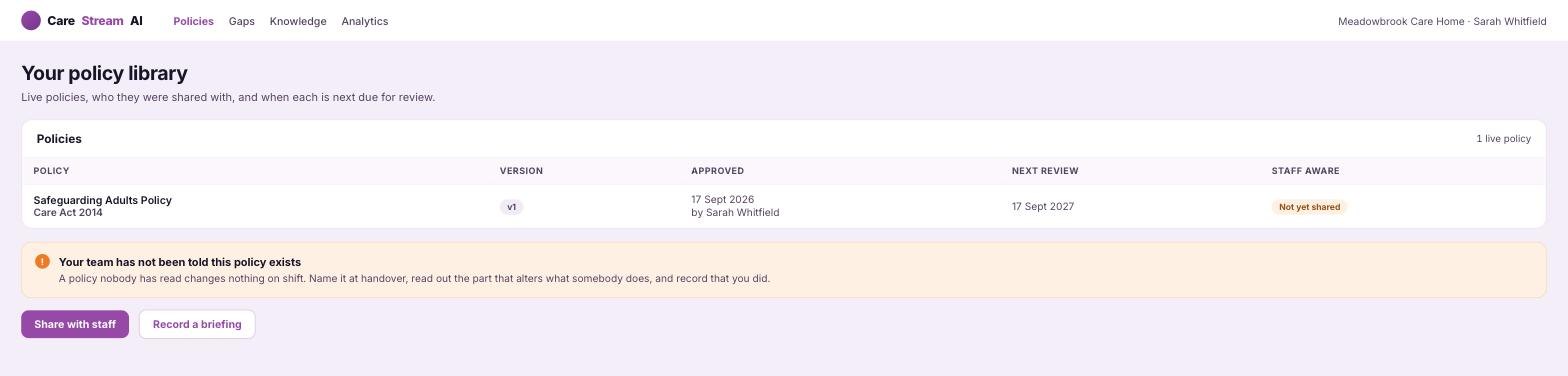
Figure: the policy library, where each live policy shows its version, approval, next review and whether staff have been told it exists.
Spend money only where a real gap shows up. Everything else can stay as it is.
Who this collection is perfect for
It suits a registered manager or owner who hires in small numbers. It suits anyone with no human resources team behind them. It suits a nominated individual who has inherited a file nobody can date.
Three moments send people looking.
- A new registration, where the set has to hold together from the first appointment.
- A recruitment round, especially one involving sponsorship or overseas applicants.
- An inspection where files were sampled, and a reference turned out to say almost nothing.
Home care and supported living services feel it most sharply. Staff reach somebody's front door alone, so the checks you ran before that first visit carry a weight they would not carry in a staffed building.
Why CareStream suits a small service better than a template bundle
The usual routes are a downloaded bundle, an employment law subscription, or a consultant brought in for a rewrite. Bundles are quick. Subscriptions bring breadth. A consultant brings judgement.
What they rarely do is name your people. A template leaves a blank where your recruitment contact belongs. A blank is what an inspector notices.
A CareStream policy starts from what you told us about your own service. Somebody reads it through, and the price was on the page before you ordered.
We make no claim about an inspection outcome. The regulator judges the files, and the practice behind them.
To keep the evidence together, the workforce register that tracks DBS, right to work and registration holds what each policy asks your team to collect.
Benefits of CareStream for a safer recruitment policy you can evidence
- Six policies covering hiring, conduct, supervision, training and hours, bought one at a time.
- Written from answers about your service, with your own role holders on the page.
- The law behind the wording, listed in a second file you keep.
- Five policies you already hold read free, so spending starts at the gap.
- Fourteen days to say it does not fit your service, and your money comes back.
If identity and eligibility are the part that worries you, read our guide to how an employer carries out a right to work check.
Safer Recruitment Policy for Care Services: Six Documents FAQs
What is a safer recruitment policy?
It is the document that sets out how your service decides somebody is fit to work with the people you support. It covers advertising, shortlisting, interviews, identity and right to work, criminal record checks, references, employment history and the decision itself, and it names who does each step.
Is a safer recruitment policy a legal requirement?
No regulation names the document. Regulation 19 of the 2014 Regulations does require that recruitment procedures are established and operated effectively, and that specified information is held for every person employed. A written policy is how most services show what those procedures are.
What has to be on file for each member of staff?
Schedule 3 lists it. Proof of identity with a recent photograph, the relevant criminal record certificate where one is required, evidence of conduct in previous care work, verification of why a relevant post ended, proof of qualifications, a full employment history with gaps explained, and health information relevant to the role.
Who decides whether a file is satisfactory?
The Schedule answers this directly. Satisfactory means satisfactory in the opinion of the Commission. That is worth knowing before you accept a reference that says only that somebody worked somewhere between two dates.
Do we need a separate DBS policy?
Most services do not. The checks, the level of check for each role and the rules on handling the certificate sit inside the recruitment document. Keeping them in one place stops two documents giving staff different instructions.
Which six policies are in this collection?
Safer Recruitment and DBS, Disciplinary and Grievance, Supervision and Appraisal, Training and Development, Working Time, and Professional Standards and Conduct. Together they cover a member of staff from application to the end of employment.
What does each policy cost?
Safer Recruitment and DBS and Disciplinary and Grievance are £69 each. Supervision and Appraisal and Training and Development are £59. Working Time and Professional Standards are £49. Each is a one off payment with the first year of updates included.
How quickly is a policy delivered?
Within two working days of your answers. The question set takes about three minutes, and your company details carry over to every other policy you buy, so the next one is faster.
Whose names appear in the documents?
Your registered manager and your nominated individual appear in all six. The recruitment and the disciplinary documents also name your human resources or recruitment contact, and the training document names your training lead.
Can I check the recruitment policy I already have?
Yes. A free account checks your first 5 policies against the regulations that apply to your service, rates each as covered, partly covered or a gap, and flags wording that refers to law or frameworks that have moved on.
Does supervision belong in a recruitment policy?
No, and that is why there are six documents. Recruitment ends when somebody is appointed. Regulation 18 then requires appropriate support, training, professional development, supervision and appraisal, which the supervision and training documents carry.
What if the policy does not suit my service?
Tell us within fourteen days and we refund it in full. Every document is read by a person before it carries your name, and that review catches most mismatches before delivery.
What happens after the first year?
Updates for the first year are included. After that a policy stays current for £12 a year, and you are told what changed and why. You can stop whenever you like and keep what you hold.
Will these policies make us compliant?
No. They set out arrangements. The regulator looks at files, asks staff what they do and checks whether practice matches the document, so recruitment records and supervision notes matter as much as the policy.
Do home care agencies need the same set?
Yes, and often more urgently. Staff work alone in other people's homes, so the checks before a first visit carry more weight, and the supervision document has to say how competence is seen when nobody else is in the room.
More on care policies
Guides and collections that go with this page, and the full libraries.
Policies are one part of it.
CareStream is the compliance system underneath: your policies, your staff training, your audits and your evidence, kept current and ready for the day somebody asks to see them.
- Policies written and kept updated for you
- Staff training that records itself against the standard
- Gap analysis showing what you are missing before an inspector does
- Everything in one place, for one price