
Policy collection
Care Home Policies and Procedures: Five Free Checks, Then Only the Gaps
A common mistake with care home policies and procedures is buying a full set before finding out what is wrong with the one you already hold. Our free check reads five of your care home policies and procedures against the regulations, with no card needed. Spend money only where it finds a gap.
Pick the five an inspector is most likely to ask for first, because the free check covers only your first five. Safeguarding, infection prevention and control, medicines, complaints and governance make a sensible start. Each one comes back rated as covered, partly covered or a gap.
This collection shows what the check reads, which regulation stands behind each core policy and what a written policy costs. It is written for registered managers, owners and nominated individuals who have no compliance department. They still need to show an inspector that the whole set hangs together. No two documents should give staff different instructions.

How the service is directed and held to account: leadership, oversight and reporting lines.

How the service tracks the fundamental standards and prepares for inspection.

Which events must be notified to CQC, by whom, and how fast.

Your audit calendar, how findings become actions, and how improvement is evidenced under Regulation 17.

Your registered Statement of Purpose under the 2009 Registration Regulations, ready to file with CQC.

Being open and honest when things go wrong, under Regulation 20.
What the check reads, and what it hands back
Most managers do not need a new policy file. They need to know what is wrong with the one they hold. That is why the care home policy check sits first.
Three things it tests
CareStream reads the wording you upload and compares it with the regulations that apply to your service. It then reports on three things.
- Coverage: every applicable regulation is rated covered, partly covered or a gap, and the check names the policy that evidences it.
- Out of date content: references to retired frameworks, pandemic era instructions, superseded law or a template placeholder nobody filled in.
- Consistency: one document gives staff a four hour escalation route and another says same day.
Near duplicates drift apart, and staff follow whichever page they find first. A contradiction matters on the floor as much as on paper.
The Care Quality Commission (CQC) asks five key questions of every service. The check is built around the regulations behind them. The CQC assessment framework and its five key questions set these out.
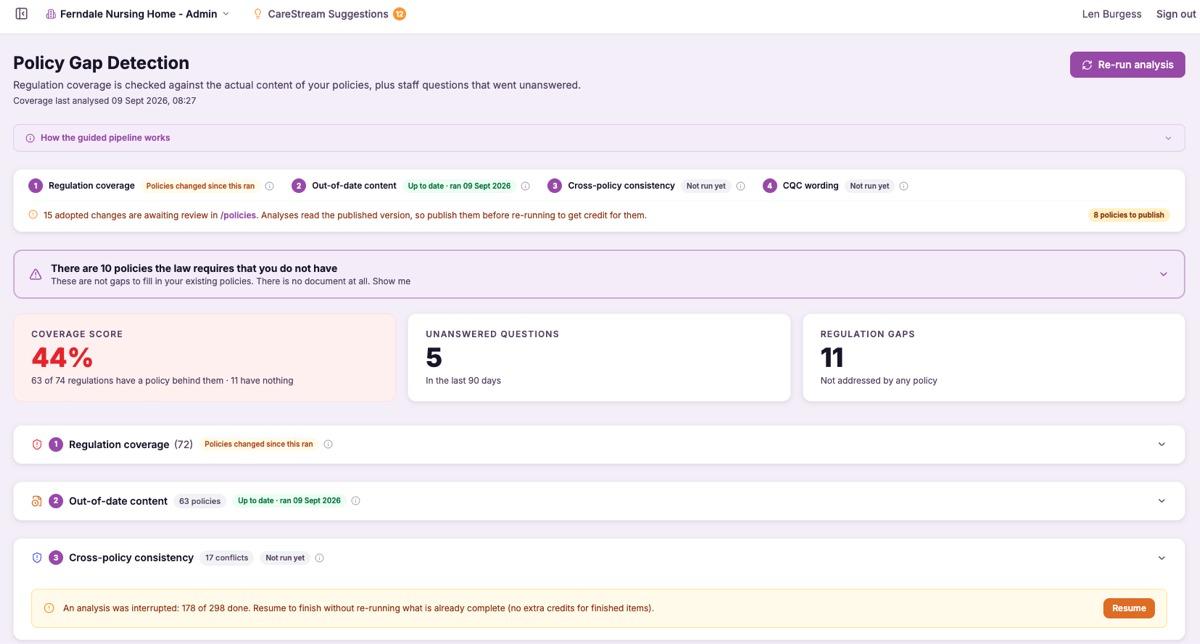
Figure: the summary view, with a coverage score, unanswered staff questions and the four analysis stages.
What the free plan shows and what paid plans add
You get a verdict per regulation, a coverage score and the name of the policy behind each requirement. Every out of date flag shows what changed, what the wording should say now and a link to the source. Contradictions sit side by side. You decide which document wins.
Paid plans add example wording for every gap and more than five policies. They start with Starter at £85 a month. The 14 day trial is the point where a card is asked for, and anything you have checked stays in your account when you move up.
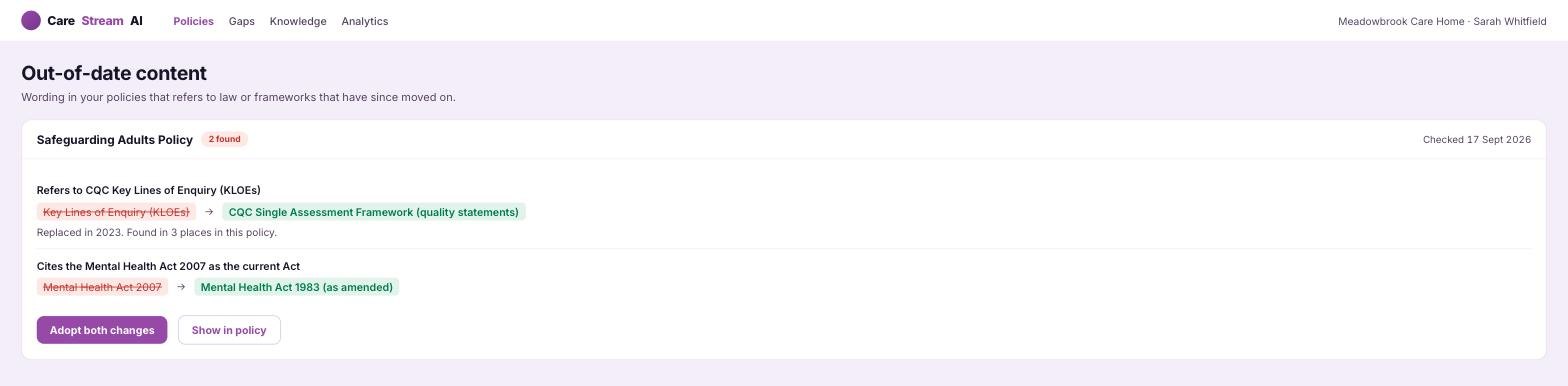
Figure: an out of date finding, with the old wording and the current wording beside it.
Which policy answers which regulation
Managers often ask for a list of mandatory policies. The law works differently. Knowing how helps you judge what to hold.
What the 2014 Regulations ask for
The Health and Social Care Act 2008 (Regulated Activities) Regulations 2014 set the fundamental standards for every registered service.
Regulation 17 is the duty of good governance. Providers must set up systems and run them well to ensure compliance. The systems must let the registered person assess, monitor and improve quality and safety.
Policies are rarely named, so cqc policies and procedures are best read as written proof of those systems. The Regulations ask for systems, arrangements and records. A written policy shows an inspector what the arrangements are.
Our guide to the policies the Care Quality Commission expects a care home to hold gives the full list.
The core set, regulation by regulation
Each core policy answers one or more regulations.
- Safeguarding adults: regulation 13, the duty to protect people from abuse and improper treatment.
- Safe care and treatment, medicines, infection prevention and control, incident reporting: regulation 12, which covers medicines and the control of infections.
- Consent and mental capacity: regulation 11, the need for consent.
- Deprivation of liberty: regulation 13, which bars it without lawful authority.
- Care planning and person centred care: regulation 9.
- Dignity and respect: regulation 10.
- Nutrition, hydration and food safety: regulation 14.
- Premises and equipment: regulation 15.
- Safe premises and equipment: regulation 12 also requires them.
- Fire and water safety: we suggest these sit with premises.
- Complaints: regulation 16.
- Duty of candour: regulation 20.
- Safer recruitment, supervision, training and staffing: regulations 18 and 19.
- Governance, quality assurance, records and notifications: regulation 17.
Citing the right regulation is only a start. The policy must also say who does what, when, and where it is recorded.
Residential and nursing homes
Homes that give bed and personal or nursing care need the widest set of policies for care homes. Everything above applies. In our view nursing homes also need clinical governance and clinical procedure policies.
Both types of home provide the building as well as the care. For that reason we suggest premises, fire and water safety policies.
Providers must have regard to the infection prevention and control Code of practice when deciding how they meet the regulations. We suggest a named lead and a plan for outbreaks.
Homes supporting people with dementia or a learning disability may need more. Examples are restraint, least restrictive practice and behaviour support. Every policy needs a named owner, a review date and a plain route for staff to ask questions.
Domiciliary care, supported living and hospices
Personal care is a regulated activity. A service that gives it must register with CQC, as the CQC guidance on personal care explains. The same rules apply. Safeguarding, medicines and complaints all stay, as do consent and training.
For an agency the emphasis shifts. It needs:
- a firm lone working policy
- a rule for entering and securing someone's home
- a plan for missed or late visits.
Premises duties are lighter because the service does not run the building. Equipment it supplies must still be safe.
In our view hospices and services giving nursing care should add clinical governance, end of life and palliative care, and controlled drugs. Lone working, evacuation and first aid matter everywhere.
Buy written policies, with every price shown
If the check shows a gap, or you hold nothing on a subject, you can buy a policy written for your service. The prices below are the live ones.
Single policies
Singles run from £39 to £79.
- The four flagships at £79: safeguarding adults, medicines management, mental capacity with the deprivation of liberty safeguards, and health and safety.
- Most clinical, governance and statutory policies at £59 or £69, including infection prevention and control, complaints, duty of candour and consent to care.
- Lighter ones at £49, such as COSHH, first aid and lone working.
- The accessible information policy at £39.
Each is written from your answers and read by a person before it carries your name. Delivery is within two working days of your answers. You receive a dashboard version and a print ready PDF on your own letterhead, with a sign off and version block.
The first year of updates is included, then £12 a year per policy.
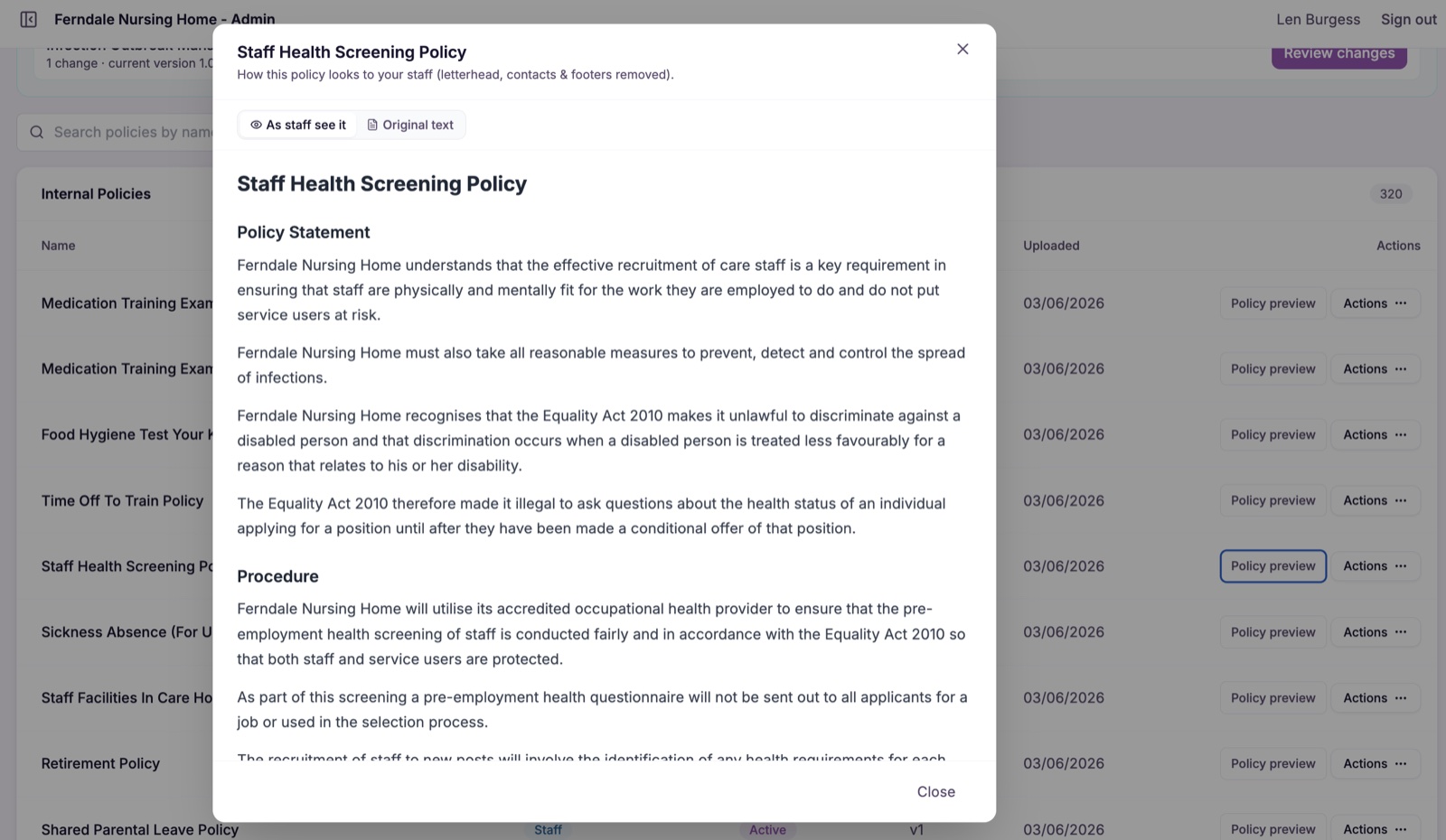
Figure: a policy preview, as staff would read it, with letterhead and footers removed.
Packs
Packs suit a new registration or a full rewrite.
- HR and Workforce is £249.
- Clinical Care is £349.
- Health and Safety and Governance and Data are £295 each.
- The Statutory Starter Pack is £495 for the twenty policies every registered service is expected to hold.
- The Complete Policy Library is £1,495 for all 66.
Policies written together refer to each other correctly and name the same role holders. Need only two or three documents? Singles usually cost less, so add up your gaps from the check before you choose a pack.
A pack makes most sense when your registration is new and no existing document needs keeping. Nothing then has to be reconciled with older wording.
How a written policy is made
You answer questions on your registered name, address, CQC numbers and role holders. You also say how you run the service. Those answers feed every policy you buy.
Where you gave a fact, the policy states it. Where you did not, it describes the action required. It never claims something your service does not do. Each policy carries the version, owner and sign off details an inspector looks for.
You cannot edit a delivered policy yourself. Changes go through us and are checked again, so the wording you hold is the wording a person approved.
A policy supports your governance. Training, supervision and audit are where staff practice is evidenced.
Who gets the most from this
Who this suits
It suits a manager who inherited a policy file and cannot tell how current it is. It suits a provider preparing for registration, and anyone who bought templates and found two of them disagree.
Domiciliary and supported living providers will notice the difference most, because policy advice is usually written for residential homes.
Hold a full, reviewed set already? Run the check as a second opinion and spend nothing more. Hold nothing? A pack gives you one consistent starting set, and no one will ask you to speak to sales first.
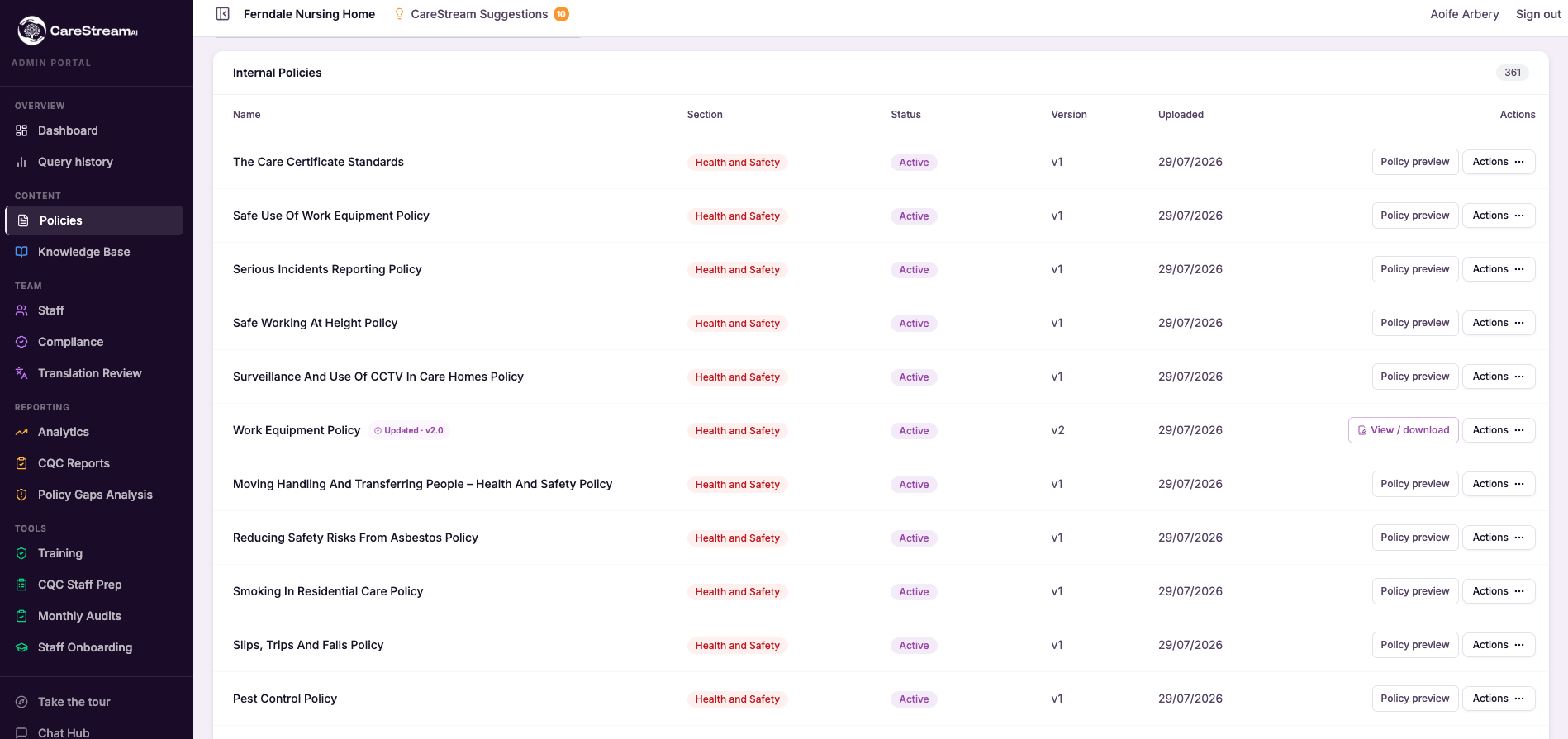
Figure: the policy list, where each entry shows its status and version so you can see what is live.
Why a small service might choose this route
The usual options are template packs, a consultant at a day rate or a large subscription from a compliance publisher. Templates are quick. Consultants bring judgement. Subscriptions bring volume.
What they rarely do is read what you already hold. CareStream starts there, then writes a service specific policy only where a gap shows.
You pay per policy rather than a monthly licence, see the price first and can stop updates whenever you like. We do not promise a rating and we never call a policy compliant.
The aim is a plain comparison of what your documents say and what the regulations require.
Benefits of CareStream's free policy gap check for care home policies and procedures
- You upload up to five policies and the check reads them against the 2014 Regulations, with no card needed.
- It flags out of date wording and places where two of your documents disagree.
- You buy a written policy only for a gap the check shows, at the price listed above.
- A person reads each written policy before it carries your name.
The free policy gap check for up to five policies costs nothing and does not call any policy compliant.
Get started with the free check
Create a free account, upload up to five policies and read the results. The free policy gap check page lists exactly what is tested.
To keep a whole set current, read our guide to keeping a full policy set up to date and organised. It covers review cycles and version control.
When a gap needs a written policy, browse the written policies for care services. Every price is shown.
Care Home Policies and Procedures: Five Free Checks, Then Only the Gaps FAQs
What policies and procedures does a care home need?
The Health and Social Care Act 2008 (Regulated Activities) Regulations 2014 rarely name a policy. They require systems and processes, and a written policy is how a service shows them. In practice an inspector expects policies covering safeguarding, safe care and treatment, medicines, infection prevention and control, consent and capacity, complaints, duty of candour, recruitment, staffing and training, premises and fire safety, and governance and records. The twenty policy Statutory Starter Pack at £495 groups the core set.
What is the care home policy check and what does it cost?
It is a free check of policies you already hold. You upload up to five and it rates each applicable regulation as covered, partly covered or a gap, flags out of date wording and finds contradictions between documents. It costs nothing and needs no card.
Does the free check cover all my policies?
No. The free account checks your first five policies. Checking more than five policies, and example wording for every gap, are part of the paid plans.
Do I need a card to start?
No. The free account needs no card. The paid plans, from Starter at £85 a month, start with a 14 day free trial that does need a card.
How long does the policy check take?
You upload your documents and the results appear in your account. The time depends on how many pages the five policies run to, and we do not quote a fixed figure. Reading the results and deciding what to change is the part that takes a manager's time.
Will the check tell me I am CQC compliant?
No. A check reads the wording of your policies against the regulations and reports gaps, out of date content and contradictions. It cannot see what staff do on the floor, and no policy, check or audit can promise a rating. Compliance is judged by the Care Quality Commission on what it sees and hears.
What happens if I find a gap?
You decide. You can edit your own policy, or buy a written policy for that subject. Single policies cost £39 to £79 each and are written for your service, read by a person before delivery and delivered within two working days of your answers.
How much does a written policy cost?
Single policies are £39 to £79 each. Policy packs cost £249 for HR and Workforce, £295 for Health and Safety, £295 for Governance and Data, £349 for Clinical Care, £495 for the twenty policy Statutory Starter Pack and £1,495 for the Complete Policy Library of 66 policies.
How is a written policy different from a template?
A template is a generic document you adapt. A written policy starts from your answers: your registered name, CQC numbers, role holders and how you run the service. Where you have given information, the policy states it as fact. Where you have not, it describes the action required. A person reads it before it carries your name.
How long does a written policy take to arrive?
Within two working days of your answers.
What if the policy is not right for my service?
The written policy product page says that if a policy is not right for your service, you tell us within fourteen days and we refund it in full.
Can I edit a policy I have bought?
The product page says you cannot edit a delivered policy yourself. Changes go through us, and each change is checked again. You receive a dashboard version and a print ready PDF with a sign off and version block.
What happens after the first year?
The first year of updates is included. After that a single policy is £12 a year, and you can stop at any time. When the law changes you are told what changed and why.
What are the five main care standards the Care Quality Commission uses?
The Care Quality Commission asks five key questions of every service: is it safe, effective, caring, responsive and well led. These sit alongside the fundamental standards in the 2014 Regulations, such as regulation 12 safe care and treatment and regulation 17 good governance.
How often should care home policies be reviewed?
No regulation sets a fixed interval. Many services review core policies yearly and review any policy sooner when the law or guidance changes, after a serious incident or when a complaint shows a gap. Whatever you choose, record each review and how staff were told.
More on care policies
Guides and collections that go with this page, and the full libraries.
Policies are one part of it.
CareStream is the compliance system underneath: your policies, your staff training, your audits and your evidence, kept current and ready for the day somebody asks to see them.
- Policies written and kept updated for you
- Staff training that records itself against the standard
- Gap analysis showing what you are missing before an inspector does
- Everything in one place, for one price




