Person-centred rewording suggestions (in your policy voice)
Care has moved on from the language a lot of older policies were written in. Documents that talk about people as cases or tasks, or describe procedures in cold, institutional terms, sit badly against the person-centred practice inspectors now expect to see reflected on the page. Yet rewriting every policy from scratch to fix the tone is a job few managers ever have time to start.
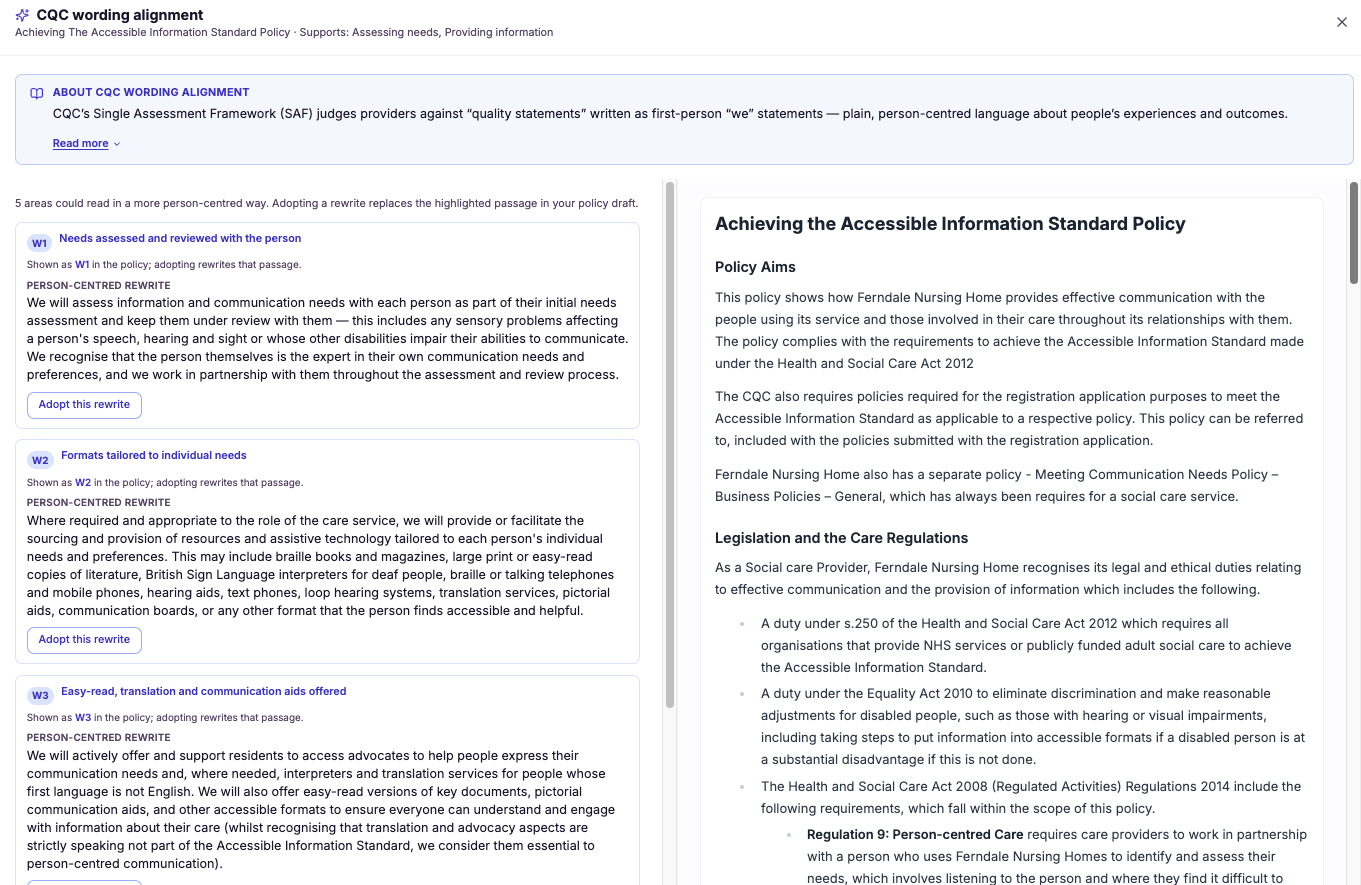
Warmer, more person-centred, still unmistakably yours.
Many tools would happily replace your policy with a polished generic version, and in doing so strip out the voice that makes your documents feel like they belong to your service. That is a poor trade: you gain tidiness but lose ownership, and staff notice when a policy suddenly reads like it came from somewhere else.
CareStream takes a different approach. It suggests person-centred rewording that works within your existing voice and house style, improving how people are described and how procedures read while leaving the character of the document intact. This matters because person-centred care should show through in your policies, and it lands far better when the improvement sounds like your service speaking, not a template imposed from outside.
CareStream suggests person-centred rewording that keeps your policy's own voice and house style intact. It improves how residents and the people you support are described, and how procedures read, without rewriting the document from scratch or dropping generic templated language over the top of your own. Your policies still sound like yours, only warmer, clearer and more clearly person-centred.
Registered managers and quality leads who want their policies to reflect person-centred care in any service, without losing the voice their documents are written in.
Because your policies describe people and procedures in genuinely person-centred language, your documents reflect the practice inspectors expect, in your own authentic voice.
The difference it makes day to day
- Residents and the people you support are described in warmer, more person-centred terms.
- Procedures read more clearly and respectfully without losing their meaning.
- Your policies keep their own voice and house style rather than sounding templated.
- The person-centred values in your practice start to show through on the page.
- You improve tone across your documents without rewriting any of them from scratch.
- Staff still recognise the policies as their service's own, so changes are readily accepted.
How person-centred rewording works.
CareStream reads how your policy already speaks, taking account of its tone, its terminology and the house style running through your documents. It does not start from a blank template or a house style of its own.
Working from that, it suggests rewording that lifts the language to be more person-centred and clearer, targeted at how people are described and how procedures read, while staying true to the voice you already use. You review each suggestion and choose what to adopt.
Read your voice
CareStream takes account of your policy's existing tone, terminology and house style.
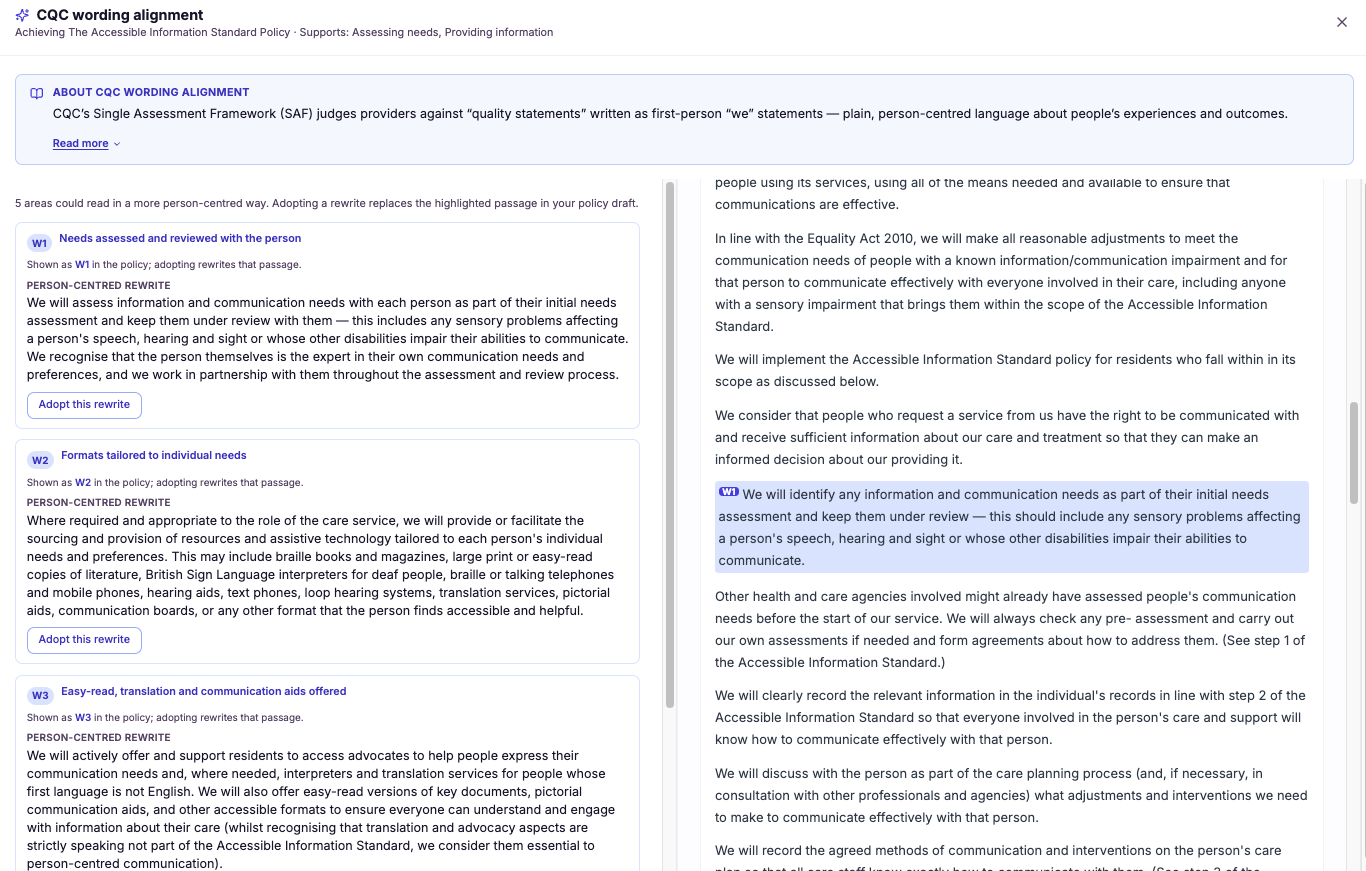
Spot the language
It identifies wording that describes people or procedures in ways that could be more person-centred.
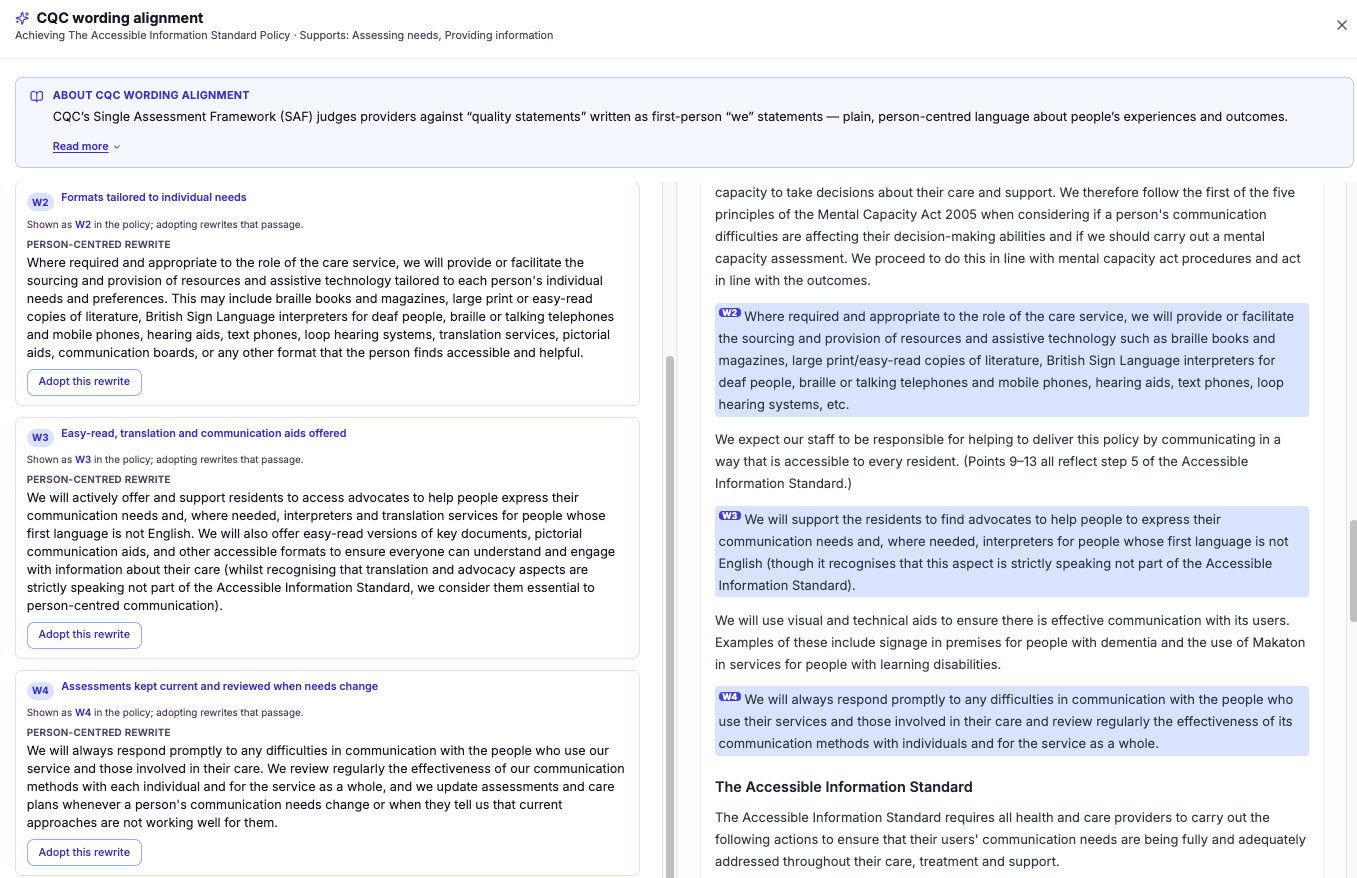
Suggest in your style
Rewording is proposed that improves the tone while matching the voice you already use.
The suggestions refine how something reads without changing what the procedure actually requires.
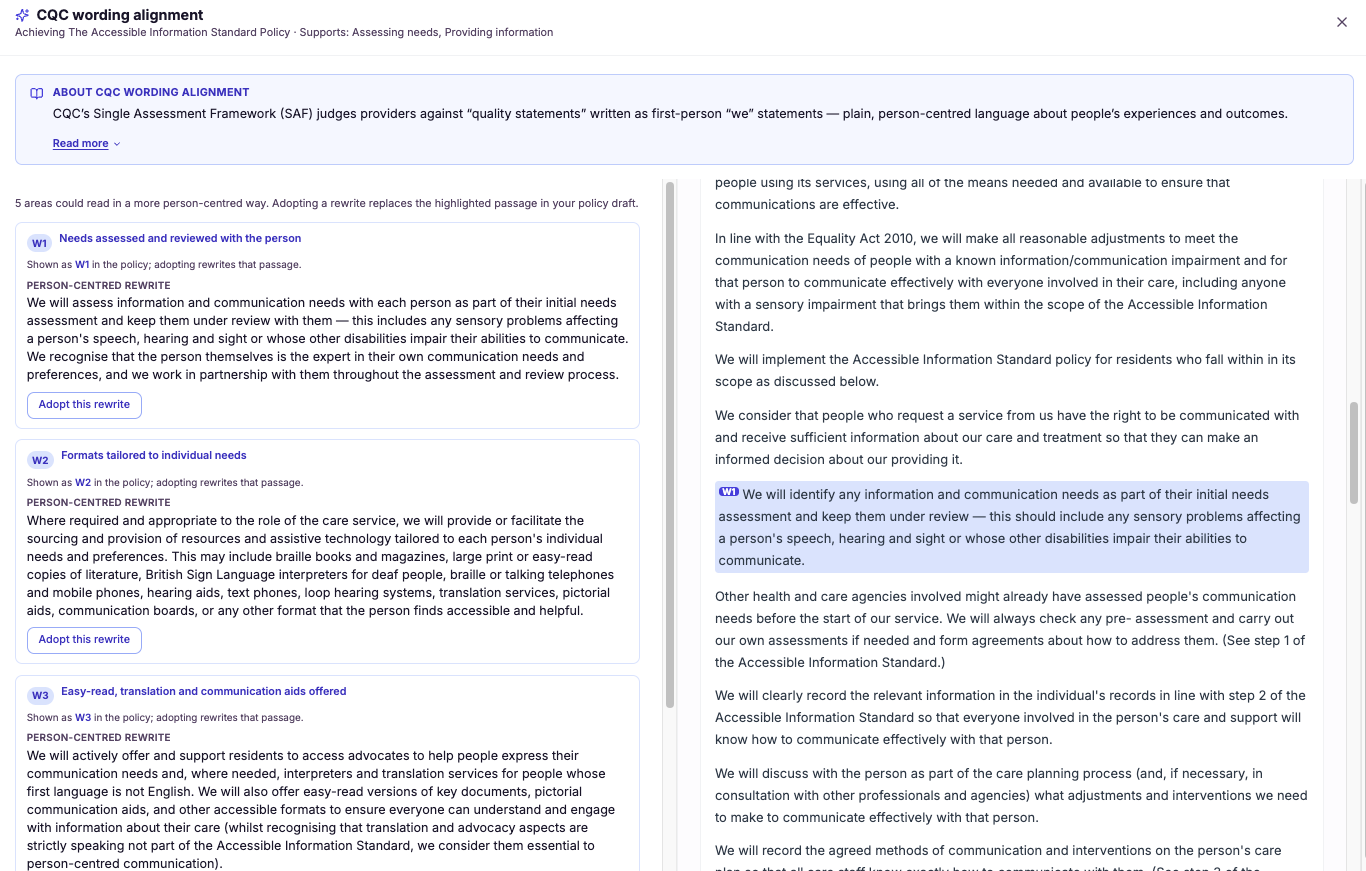
Each rewording is presented as a suggestion for you to accept, adjust or leave as it is.
Approved wording goes into the policy, keeping the document unmistakably yours.
- Suggests person-centred rewording rather than rewriting the policy from scratch
- Keeps your policy's own voice and house style intact
- Improves how residents and people are described and how procedures read
- Avoids imposing generic, templated language over your documents
- Every rewording is a suggestion you can accept, adjust or reject
Person-centred care should sound like it, in your own words.
Inspectors look for person-centred practice to show through in your documents, not just in what staff say. But when a policy is rewritten wholesale into a generic template, it loses the voice that made it belong to your service, and staff stop recognising it as their own.
CareStream keeps that ownership. By refining tone within your existing voice, it makes your policies more person-centred while still sounding like your service, which is exactly why the improvements stick.
Rewording works within your existing house style, so documents still sound like your service.
The focus is on describing people and procedures in warmer, more respectful, more person-centred language.
You get suggestions shaped to your document, never generic text dropped over the top of your own.
Every rewording is a suggestion you can accept, adapt or reject, keeping full control of the tone.
Frequently asked
Will this rewrite my whole policy or just improve the wording?
It improves the wording rather than rewriting the document. CareStream deliberately avoids replacing your policy with a generic version, because that strips out the voice that makes it belong to your service. Instead, it suggests targeted rewording that lifts how people and procedures are described. You keep your policy's structure, meaning and house style. The suggestions focus on tone, making the language warmer and more person-centred, while leaving the document unmistakably yours. It is refinement, not a rewrite, so your policies improve without losing their character.
How does it keep my policy's own voice?
Before suggesting anything, CareStream takes account of how your policy already speaks, including its tone, its terminology and the house style running through your documents. The rewording it proposes is shaped to match that voice rather than an external template. That is a deliberate design choice. Staff notice when a policy suddenly reads as if it came from somewhere else, and they are less likely to trust or follow it. By working within your existing voice, CareStream makes the improved wording feel like a natural evolution of your own document, so the changes are accepted rather than resisted.
Why does person-centred wording in policies matter for inspection?
Inspectors look for person-centred care to be reflected in your documents, not just described by your staff. When policies talk about people as cases or tasks, or set out procedures in cold, institutional language, the tone works against the person-centred practice you are trying to evidence, even when the underlying care is excellent. By improving how residents and the people you support are described and how procedures read, CareStream helps your policies reflect the values behind your care. The person-centred approach shows through on the page in your own voice, which is exactly the alignment between documents and practice that supports inspection readiness.
Do I have to accept every rewording suggestion?
No. Every rewording is presented as a suggestion, not a change made on your behalf. You review each one and decide whether to accept it as written, adjust it to suit your service, or leave the original wording exactly as it is. This keeps you in full control of your policy's tone. CareStream brings the person-centred phrasing and the sensitivity to your house style, and you make the final call on what actually goes into the document. The result is language you are genuinely comfortable standing behind, in your own voice.
Explore more features
More of what the CareStream compliance platform does for UK care providers.
Make your policies more person-centred, in your own voice.
Book a demo and see how CareStream suggests person-centred rewording that keeps your policy's house style while lifting its tone.