Legal basis + source citation on each recommendation
When someone recommends a change to your policies, the fair question is: says who? A registered manager under time pressure will not, and should not, act on advice they cannot trace back to something authoritative. Recommendations without a source are just opinions, and opinions are hard to defend to a board, a trustee or an inspector who asks why you made a change.
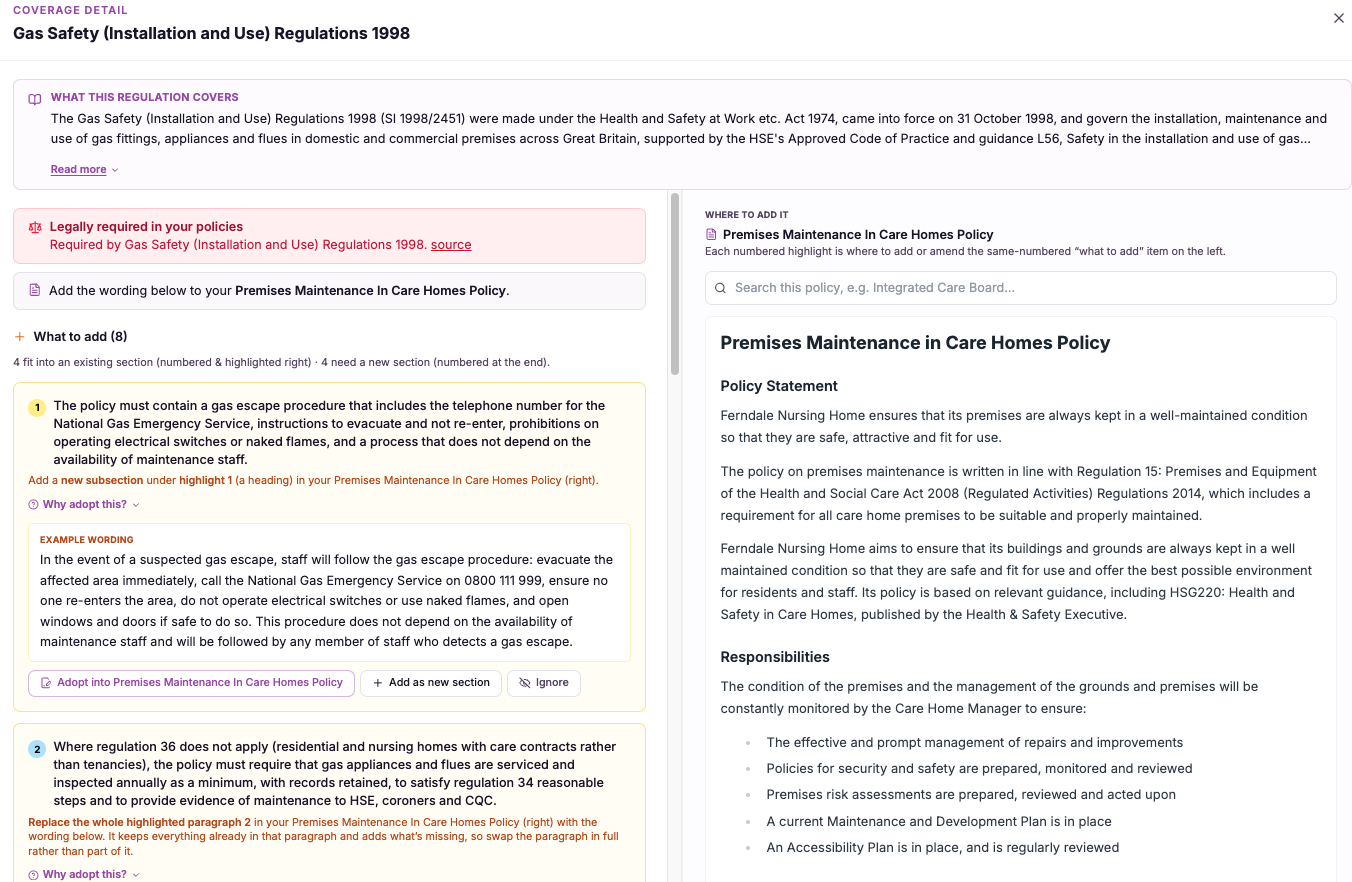
Recommendations you can trace, not just trust.
It is one thing to be told a policy needs a particular addition; it is another to know which regulation or standard requires it. Without that link, you are asked to take the advice on faith, and faith does not hold up well in a board meeting or an inspection when you are asked to justify a decision.
CareStream attaches the underlying legal or regulatory basis to each recommendation, naming the specific regulation, standard or statutory guidance behind it. This matters because it turns every suggested change into a defensible decision. You are not guessing, and you are not relying on an unattributed opinion; you can point to exactly why the change is warranted and stand behind it with confidence.
CareStream grounds every recommendation in the legal or regulatory basis behind it. Each suggested change cites the specific regulation, standard or item of statutory guidance it comes from, so you can trust why the change is being suggested and, just as importantly, evidence that reasoning to whoever asks. Nothing is proposed without a traceable reason attached.
Registered managers, nominated individuals and quality leads who must justify policy decisions to boards, trustees or inspectors across any care service.
Because every change cites the regulation or guidance behind it, you can evidence why each policy was updated rather than being caught unable to explain a decision.
The difference it makes day to day
- Every recommendation names the specific regulation, standard or guidance it rests on.
- You can explain to a board or trustee exactly why each policy change was made.
- Managers act on recommendations with confidence because the reasoning is traceable.
- You have ready evidence when an inspector asks why a policy was updated.
- Suggestions carry authority rather than reading as unattributed opinion.
- Compliance decisions become defensible, not just plausible.
How legal basis citation works.
When CareStream produces a recommendation, it does not treat the legal reasoning as an afterthought. The regulatory basis is part of how the recommendation is formed in the first place, because the gap was identified against that requirement.
So each recommendation carries the specific regulation, standard or statutory guidance it derives from, presented alongside the suggested change. You see the what and the why together, ready to act on or to evidence.
Gap tied to a rule
Each gap is identified against a specific regulation, standard or item of statutory guidance.
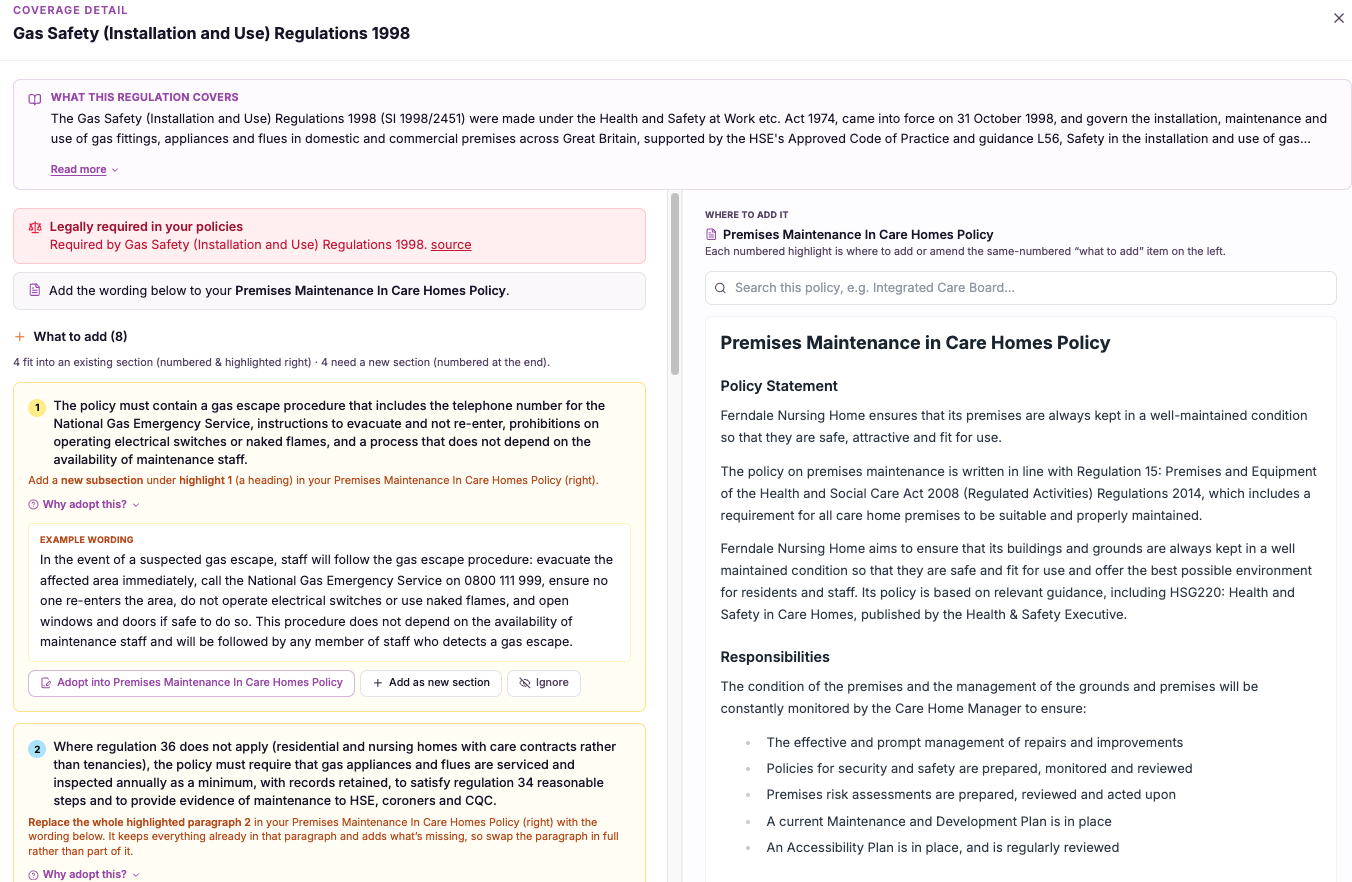
Recommendation formed
CareStream produces the suggested change needed to meet that requirement.
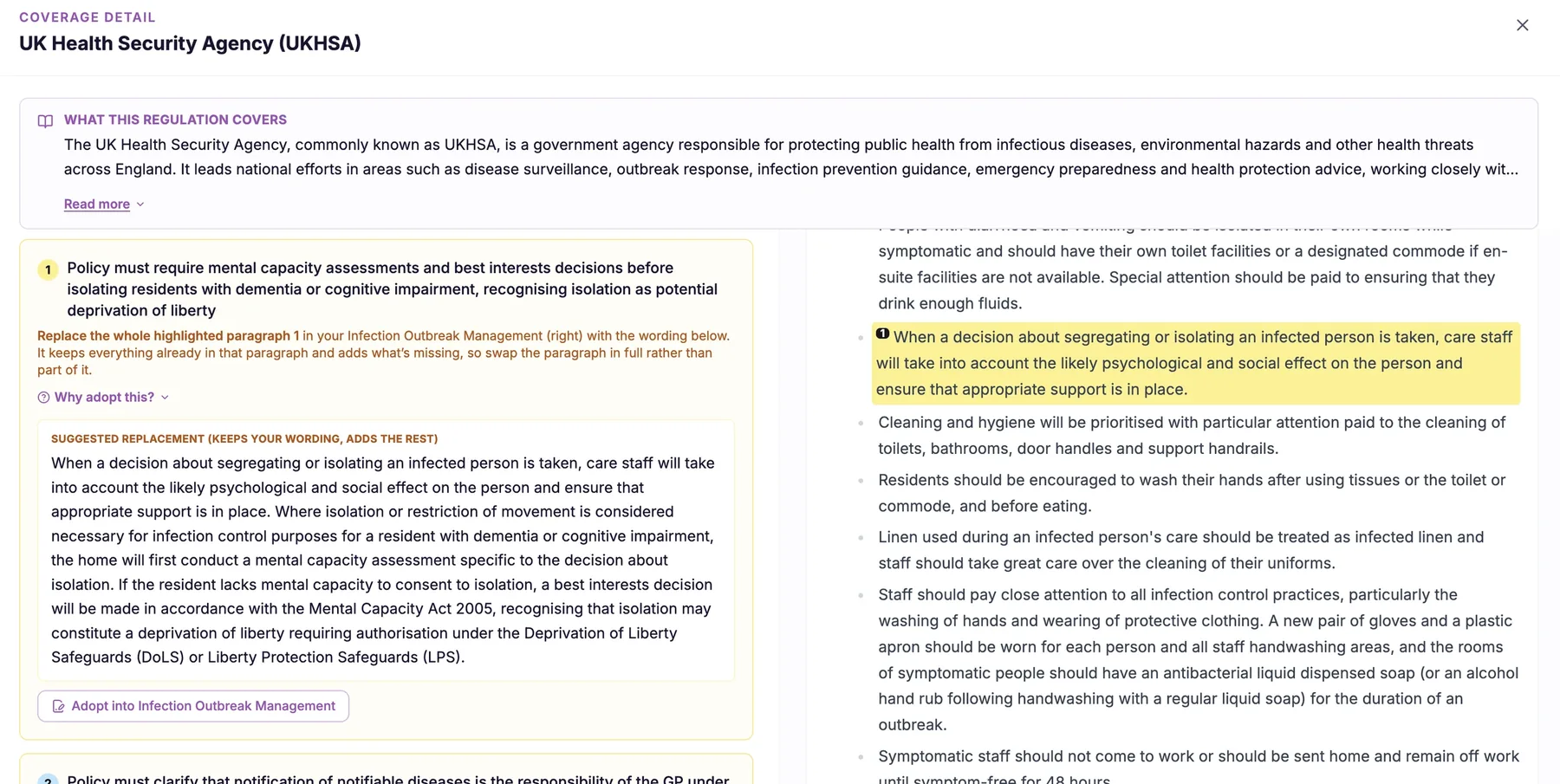
Basis attached
The specific legal or regulatory source behind the change is cited on the recommendation itself.
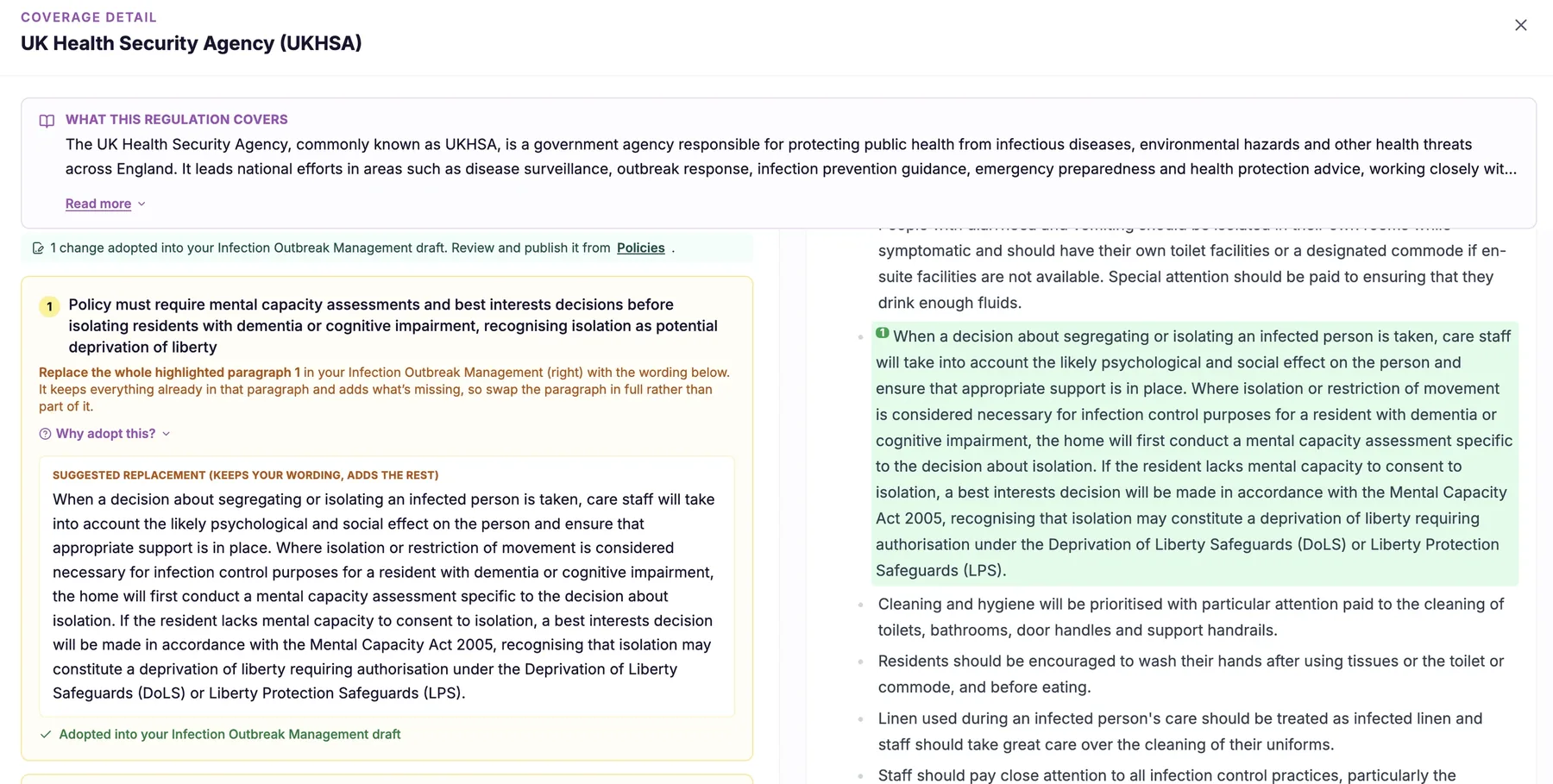
You see the suggested change and its underlying basis side by side, not in separate places.
You adopt the change knowing precisely which requirement it satisfies.
The cited basis is ready to show a board, trustee or inspector who asks why.
- Cites the specific regulation, standard or statutory guidance behind each recommendation
- Turns suggested changes into traceable, defensible decisions
- Gives managers ready evidence for boards, trustees and inspectors
- The reasoning is presented alongside the change, not hidden away
- Nothing is recommended without a stated basis attached

A recommendation you can't justify is a risk, not a fix.
Care leaders are accountable for the changes they make to their policies. If you cannot say why a change was made, an unattributed suggestion can become a liability the moment someone questions it, whether that is a trustee scrutinising spend or an inspector probing a decision.
By citing the legal or regulatory basis on every recommendation, CareStream makes each change defensible from the outset. You act on solid ground and can always show your reasoning, which is exactly what accountability in regulated care demands.
Each recommendation names the regulation, standard or guidance it comes from, so nothing rests on opinion alone.
You can justify every policy change to a board, trustee or inspector with the source in hand.
Managers adopt recommendations with confidence because they can see and check the reasoning behind them.
The cited basis doubles as evidence, so you are prepared for the question before it is asked.
Frequently asked
How do I know a recommendation is based on real regulation and not just an opinion?
Because every recommendation carries its source. Rather than asking you to take a suggested change on trust, CareStream cites the specific regulation, standard or item of statutory guidance the recommendation rests on, presented right alongside the change itself. That means you can check the reasoning before you act, not after. A suggestion with a named regulatory basis is a defensible decision; an unattributed one is just an opinion, and in regulated care the difference matters a great deal when someone asks you to justify what you changed and why.
Can I use these citations as evidence when talking to inspectors or trustees?
Yes, that is exactly what they are designed to support. When a board member questions a change, or an inspector asks why a policy was updated, you can point to the specific regulation, standard or guidance CareStream cited as the basis for the recommendation. The reasoning is documented rather than left in your memory. This turns each cited basis into ready-made evidence. Instead of scrambling to reconstruct why a decision was made, you have the justification attached to the change from the moment it was suggested, which is a far stronger position to be in during any form of scrutiny.
Does every recommendation get a source, or only some of them?
Every recommendation carries its basis. The regulatory source is not an optional extra bolted on to a few high-profile changes; it is part of how each recommendation is formed, because the gap was identified against that requirement in the first place. So whether the change is significant or minor, you can see the regulation, standard or statutory guidance behind it. That consistency is what lets you trust the whole set of recommendations, rather than wondering which ones are grounded and which are guesswork.
I'm not a compliance specialist. Will the cited basis actually help me?
It is particularly helpful if compliance is not your specialism. Many registered managers are asked to justify decisions to people who are more senior or more expert than they are, and doing that from memory is uncomfortable. Having the regulatory basis cited for you removes that pressure. You do not need to know every regulation by heart, because CareStream names the relevant one for each change and keeps it attached to the recommendation. That gives you the language and the authority to explain your policy decisions confidently, even when the questions come from a board, a trustee or an inspector.
Explore more features
More of what the CareStream compliance platform does for UK care providers.
Know the reason behind every recommendation.
Book a demo and see how CareStream cites the regulation or guidance behind each suggested change, so every decision is defensible.