Cross-policy consistency (contradictions between policies)
Most care providers do not have one policy. They have dozens, written at different times, by different people, sometimes copied from a template and adjusted along the way. It is very easy for two of those documents to end up saying different things about the same situation, and almost impossible to catch by reading them one at a time.
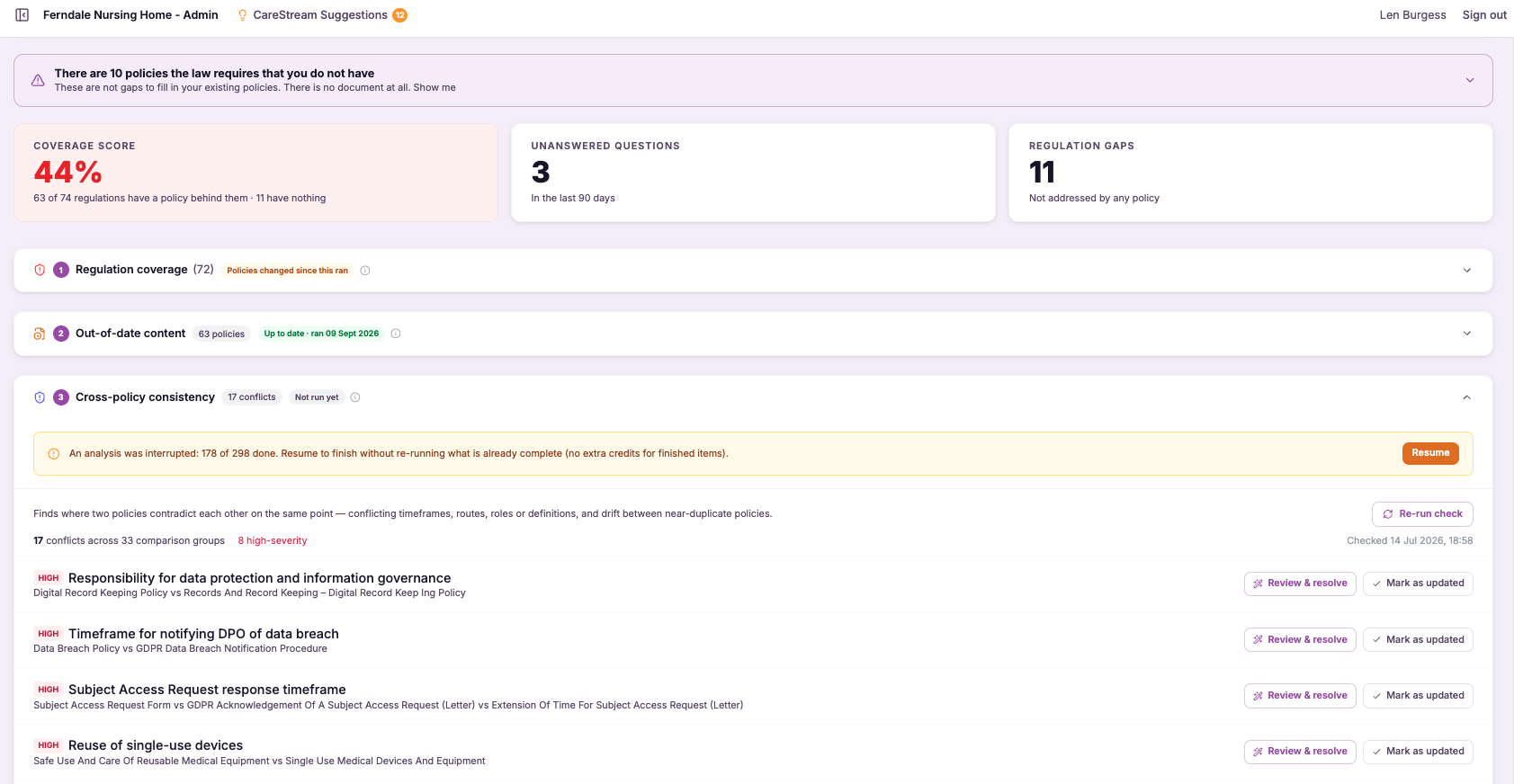
One consistent story across every policy.
Individual policies can each look perfectly reasonable on their own, yet still disagree with one another the moment you place them side by side. One might say a task can be delegated to a senior carer, while another reserves the same task for a nurse. One might set a 24 hour reporting window, while a related procedure says 48 hours. These clashes are the kind of thing an inspector spots quickly and a busy manager rarely has time to hunt for.
Cross-policy consistency treats your policies and procedures in health and social care as a single connected body of guidance rather than a pile of separate files. CareStream reads across the whole set, compares what each document says about the same topics and responsibilities, and surfaces the specific contradictions so you can resolve them and present one clear, consistent position on how your service operates.
Cross-policy consistency looks at your whole policy set together and finds the places where one care home policy contradicts another. If your medication policy says one thing about who signs off, and your delegation policy says another, CareStream flags it before an inspector does, so your documents support each other instead of quietly undermining your case.
Any care provider with a growing library of policies and procedures, from a single home to a multi-site group, where documents have built up over time.
You walk into inspection knowing your policies agree with each other, so an inspector cannot use one document to challenge another.
The difference it makes day to day
- You find contradictions between separate policies before an inspector ever opens the folder.
- Your documents reinforce each other instead of quietly telling staff two different things.
- You spend minutes reviewing flagged clashes rather than days reading every policy line by line.
- Staff get one clear instruction per situation, which reduces confusion and mistakes on shift.
- You can show inspectors a policy set that hangs together and tells a single consistent story.
- Every time you update a policy, you can re-check the whole set for new contradictions in one pass.
How cross-policy checking works.
CareStream does not just read each policy in isolation. It builds an understanding of what every document in your library says about who does what, when, and how, then compares those statements against each other to find where they disagree.
The result is a plain-English list of specific clashes, each pointing to the exact policies and passages involved, so you can decide which version is correct and bring the others into line without wading through the whole library yourself.
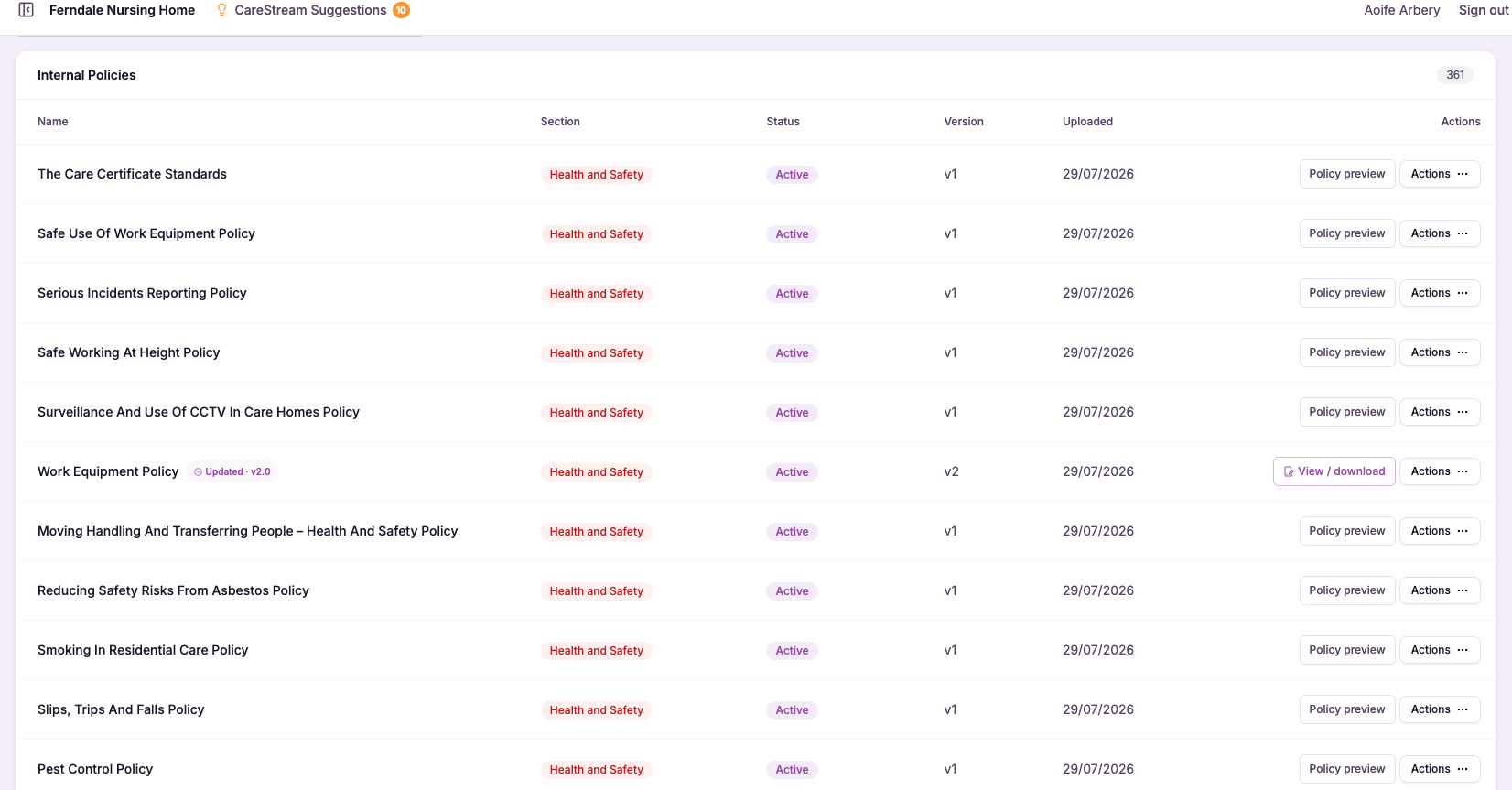
Ingest your policies
CareStream takes in your full set of care home and nursing home policies so it can work across all of them at once.
Map the responsibilities
It identifies what each policy says about the same tasks, roles, thresholds and procedures.
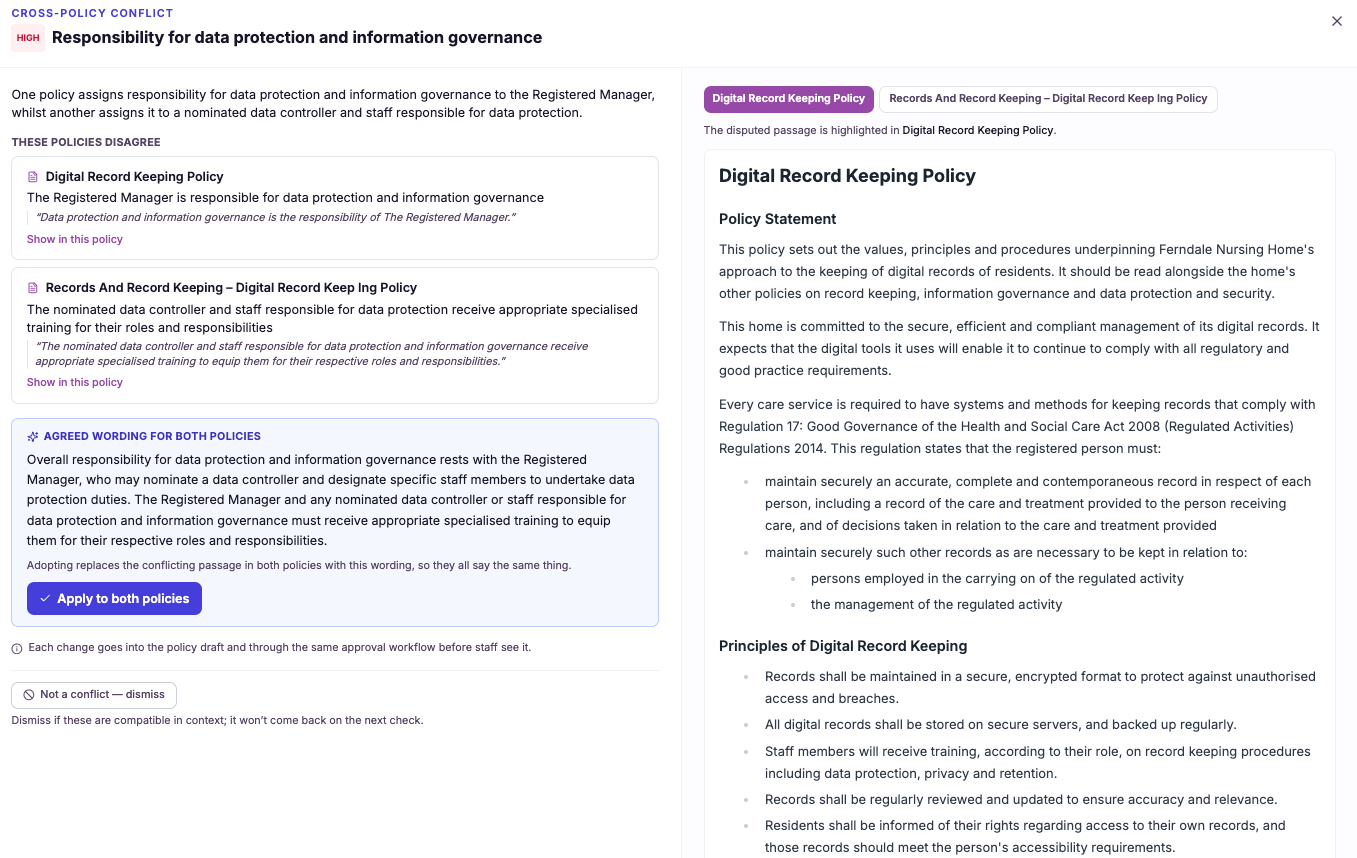
Compare across documents
It cross-references those statements to find places where one policy contradicts another for the same situation.
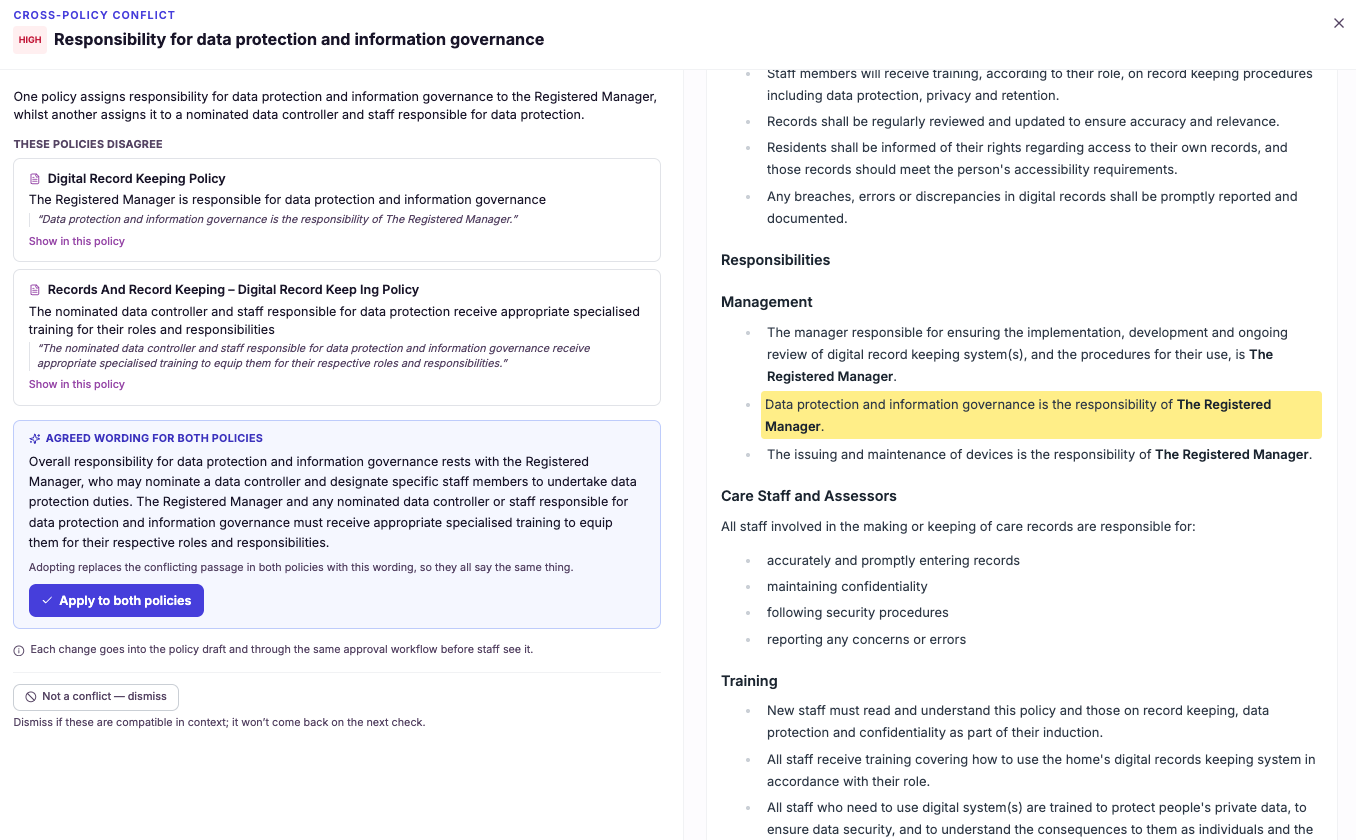
Each clash is surfaced in plain English, naming the policies involved and the passages that disagree.
You choose the correct position and bring the conflicting documents into line, guided by the flag.
Whenever you add or edit a policy, you can run the whole set again to catch any new inconsistencies.
- Checks your entire policy set, not one document at a time
- Finds contradictions between separate policies for the same situation
- Names the specific policies and passages that disagree
- Lets you re-run the check whenever a policy changes
- Turns a full library into one consistent, defensible position
Inspectors read across your policies, so you should too.
A single contradictory line does not just look untidy. It suggests your service does not have a firm grip on how things are actually done, and it invites an inspector to keep pulling the thread. The problem is that no manager can hold an entire policy library in their head to catch these clashes manually.
Cross-policy consistency works because it does the one thing a human reviewer cannot do reliably at scale: hold every policy in view at once and compare them systematically. That is how you turn a large, evolved set of documents into a coherent whole.
CareStream holds every policy in view at once, so nothing slips through because it lived in a different file.
Each contradiction points to the exact policies and wording, so fixing it is quick and unambiguous.
Run it again after any edit, so your library stays consistent as it grows and changes.
A consistent policy set removes an easy line of challenge and shows a service in control of its documents.
Frequently asked
How is this different from just proofreading each policy?
Proofreading checks a single document for spelling, grammar and clarity within its own pages. It cannot tell you that this policy disagrees with another one filed somewhere else, because you are only ever looking at one document at a time. That is exactly the gap that lets contradictions survive for years. Cross-policy consistency works the other way round. It compares your documents against each other, so it catches the clashes that only appear when two policies describe the same situation differently. It is not a substitute for careful writing, it is the layer that makes sure your carefully written policies do not quietly contradict one another.
What kinds of contradictions does it actually find?
The most common are disagreements about responsibility and thresholds. One policy might say a task can be delegated to a particular role while another reserves it for someone more senior, or two documents might set different reporting timescales, review frequencies or sign-off requirements for the same event. These are easy to create and very hard to spot by eye. CareStream surfaces each clash in plain English, naming the policies involved and the passages that disagree, so you can see immediately what the conflict is. You then decide which version is correct for your service and bring the others into line, which keeps the fix quick and firmly in your hands.
Do I need to reorganise my policies before using this?
No. The feature is designed to work with the policy set you already have, however it has grown over time. You do not need to restructure your library, rename files or force everything into a single template first. In practice, running the check often becomes the reason a library gets tidier, because the contradictions it surfaces point you straight to the documents that have drifted apart. You fix those as you go, and the set becomes more consistent with each pass rather than requiring a big reorganisation up front.
How often should I run the consistency check?
A good rhythm is to run it whenever you add a new policy or make a meaningful edit to an existing one, because that is exactly when a new contradiction is most likely to creep in. A change that looks self-contained can still clash with a related document elsewhere in the set. Many providers also run a full check ahead of an inspection or as part of a periodic review, so they can walk in confident that the whole library agrees with itself. Because the check runs across the entire set in one pass, keeping this habit adds very little effort and gives you ongoing reassurance rather than a once-a-year scramble.
Explore more features
More of what the CareStream compliance platform does for UK care providers.
Make sure your policies agree with each other.
See how CareStream reads across your whole policy set and flags the contradictions before an inspector finds them.