Audits linked to training
Audits are good at telling you where a problem is. An infection control audit that scores low points straight at a weakness in practice. What audits rarely do on their own is tell you what to do next, so a low score gets noted, discussed, and then too often sits in a folder while the underlying competence stays exactly where it was.
Turning a finding into a fix.
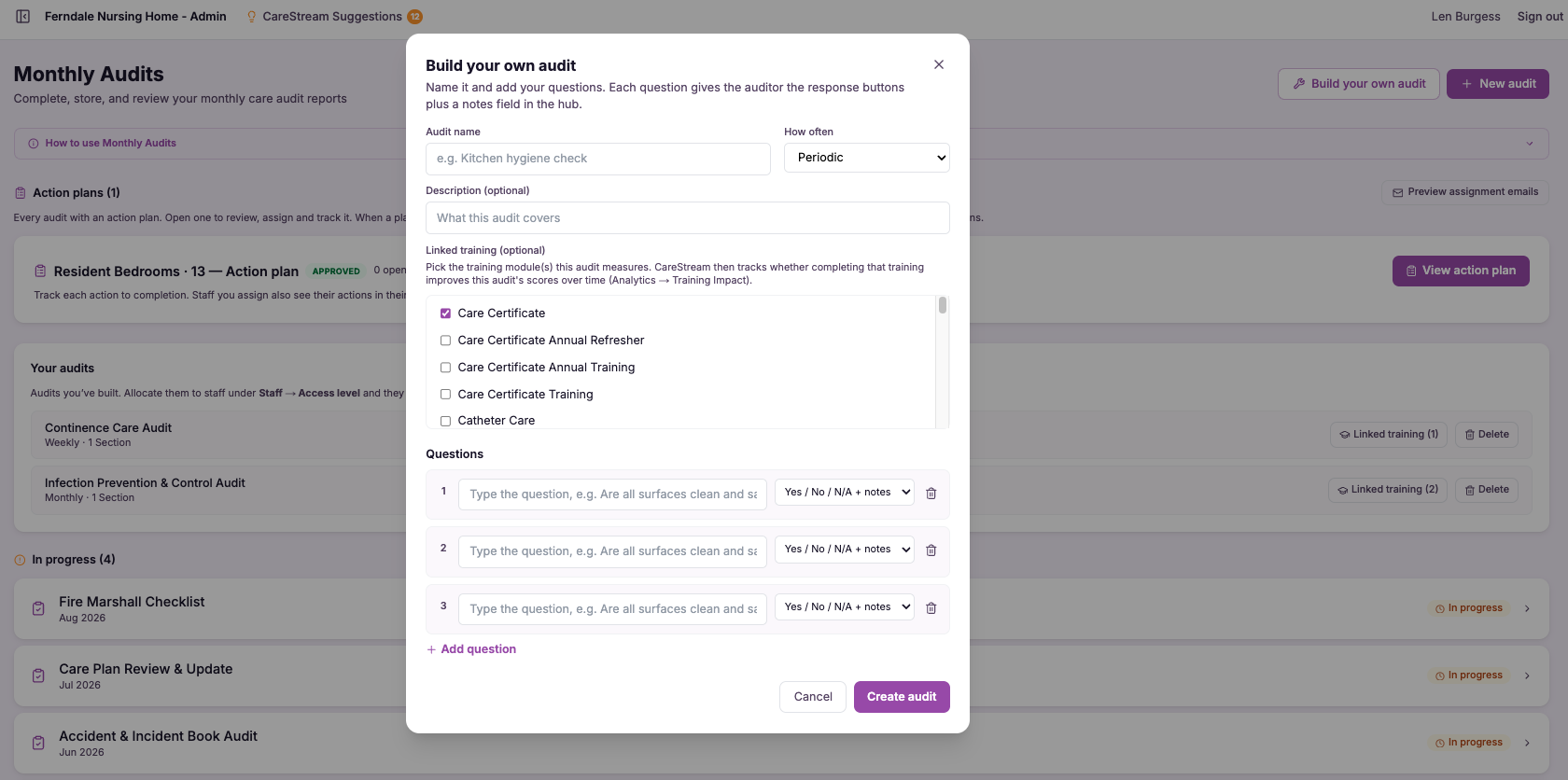
Linking audits to training means that an audit result is not the end of the process but the start of one. When an audit surfaces a weakness, for example an infection prevention and control audit scoring low, you can connect that finding to the training that addresses it, so the response to a problem is a concrete step to build competence rather than just a note in the minutes.
This matters because CQC's whole model is about continuous improvement, not one-off checks. Inspectors want to see that you notice a problem, do something about it, and can show the something worked. Connecting audits to training gives you exactly that chain of evidence, joining the moment you find an issue to the action that closes it.
CareStream links audits to training, so when an audit reveals a weakness you can connect it directly to the relevant training and act on it. Instead of a finding that ends in a report, you get a finding that leads to a fix, closing the loop between spotting an issue and improving the competence behind it.
Registered managers and quality leads in any care home, nursing home or care provider who want audit findings to drive real improvement in competence.
Because audit findings connect to training and re-audit, you can show CQC a full improvement loop, not just a list of scores in a folder.
The difference it makes day to day
- A low audit score leads to a clear training response rather than sitting unaddressed in a report.
- Weaknesses in practice are connected directly to the training that builds the missing competence.
- You close the loop between finding an issue and fixing the capability behind it.
- You can evidence to CQC that audit findings drive real improvement, not just documentation.
- Recurring low scores in an area point you to the training that needs strengthening.
- Your audit programme becomes a genuine improvement engine rather than a paperwork exercise.
How audits connect to training.
The approach follows the natural flow of quality improvement. You run an audit, you read the result, and where the result reveals a weakness, you link it to the training that addresses the gap in competence.
Because the audit and the training both live in CareStream, that link is a real connection you can act on and evidence, not a note you hope someone remembers. The finding and the fix are joined together, so the improvement story is visible from start to finish.
Run the audit
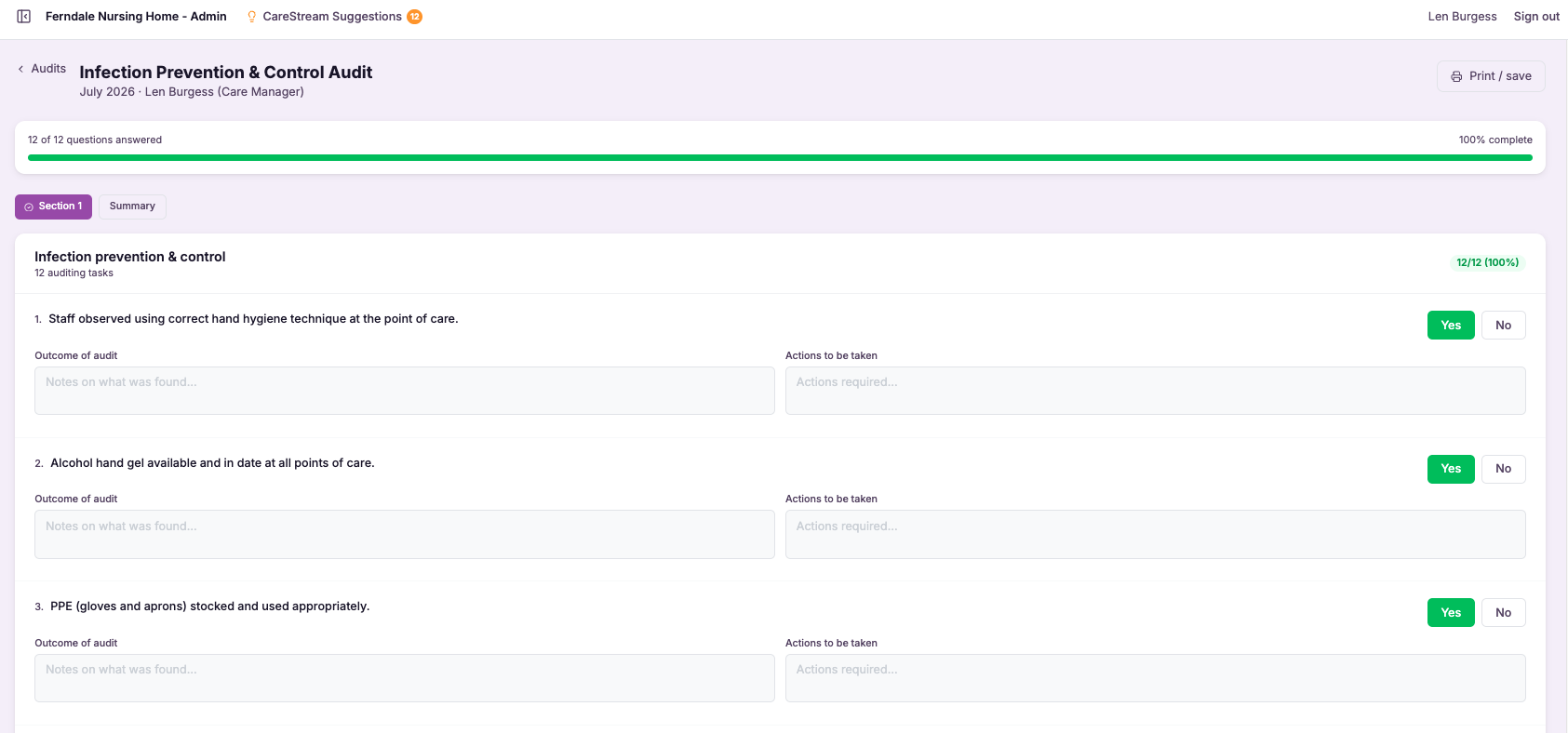
Carry out an audit, such as infection control, and record the scores that show where practice is strong or weak.
Spot the weakness
Read where the audit scores low, which is the signal that competence in that area needs attention.
Link to training
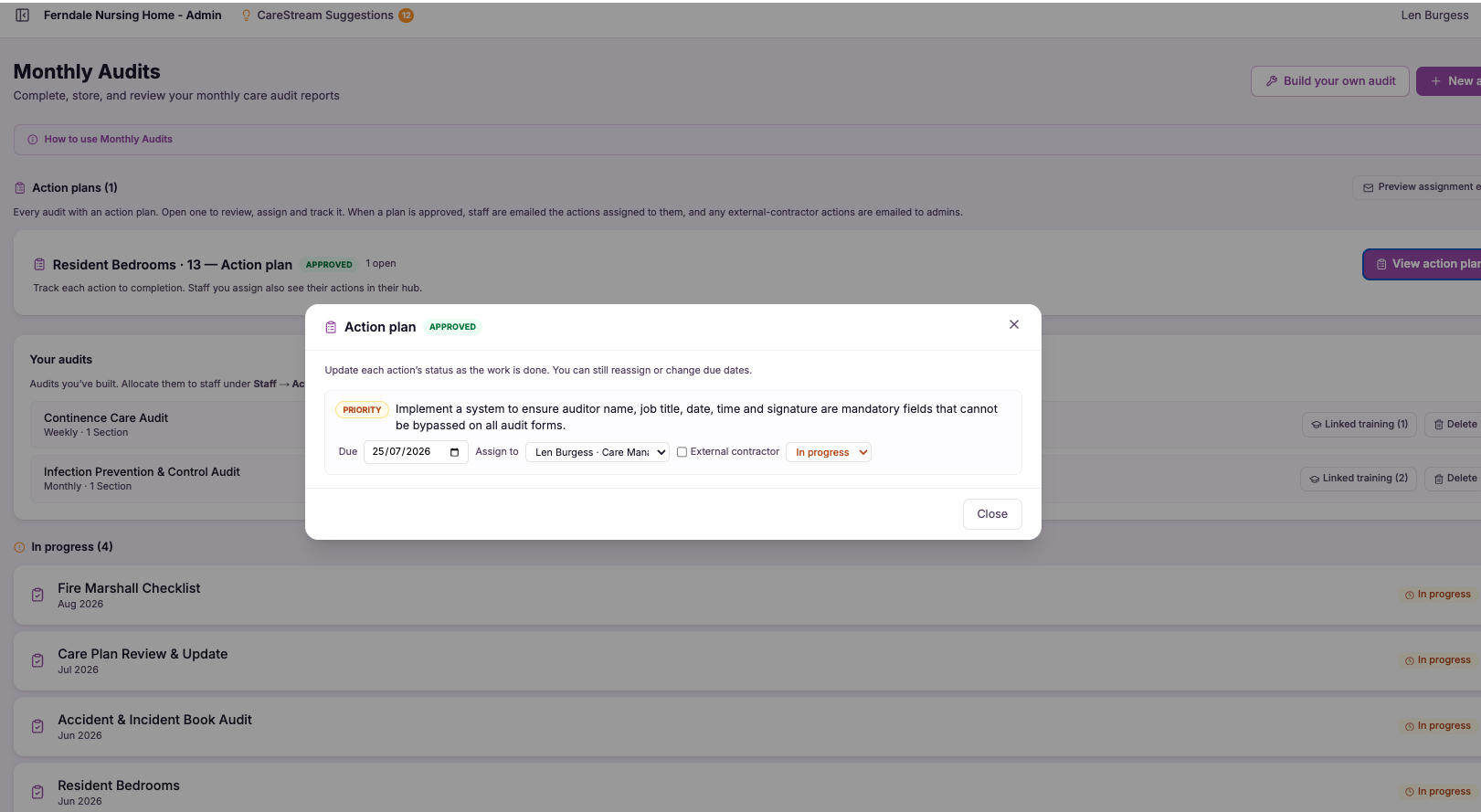
Connect the low-scoring finding to the relevant training that addresses the underlying gap.
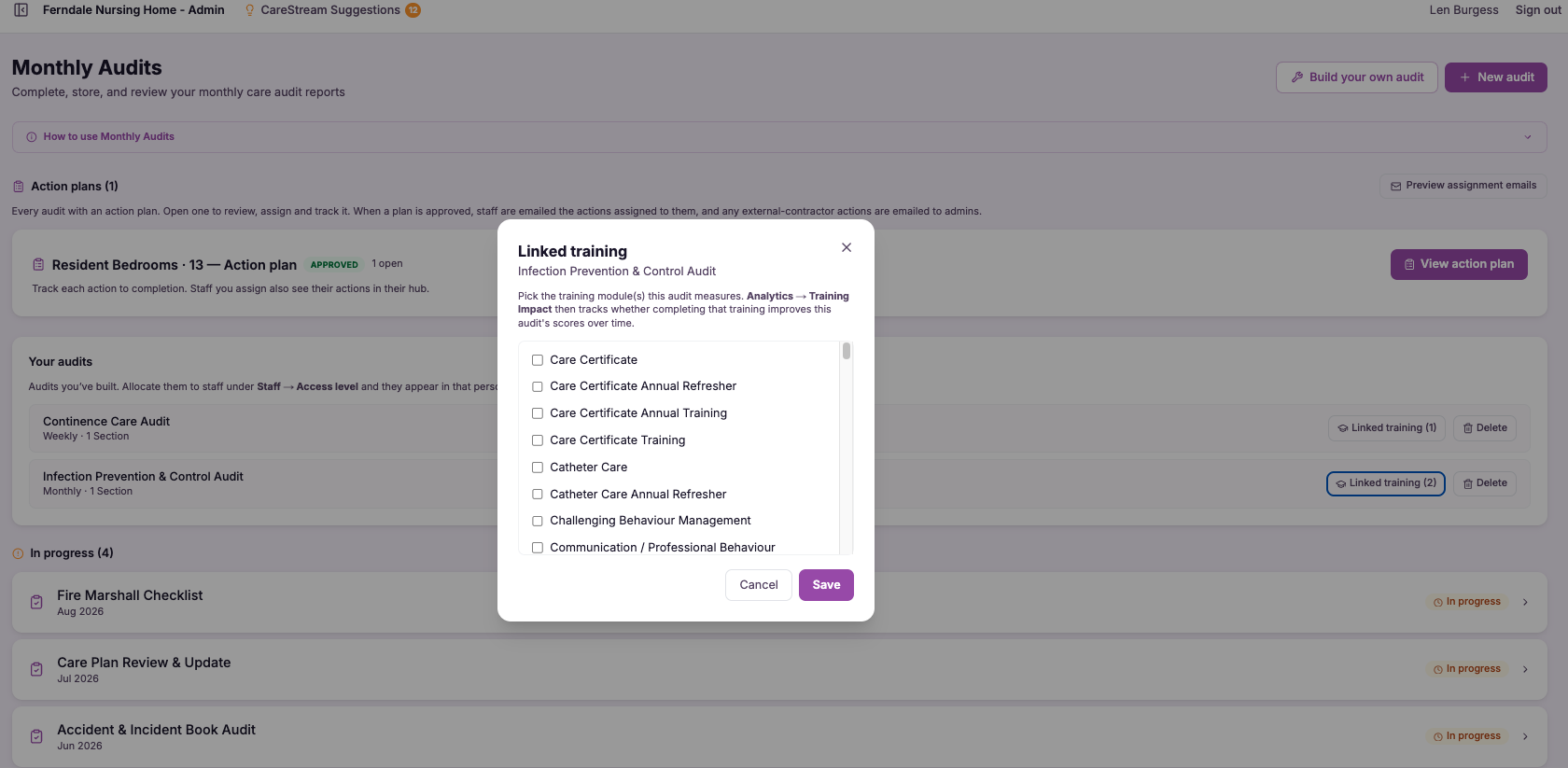
Direct the right people to that training, turning the finding into a concrete step rather than a note.
Run the audit again later to check whether the training has actually moved the score.
Show the whole chain from finding to training to improvement, exactly what an inspector wants to see.
- Audit findings can be connected directly to relevant training.
- A low score, for example on infection control, leads to a training response.
- The loop from spotting an issue to fixing competence is closed and visible.
- Improvement can be evidenced, not just findings recorded.
- Re-auditing shows whether the training actually raised the score.
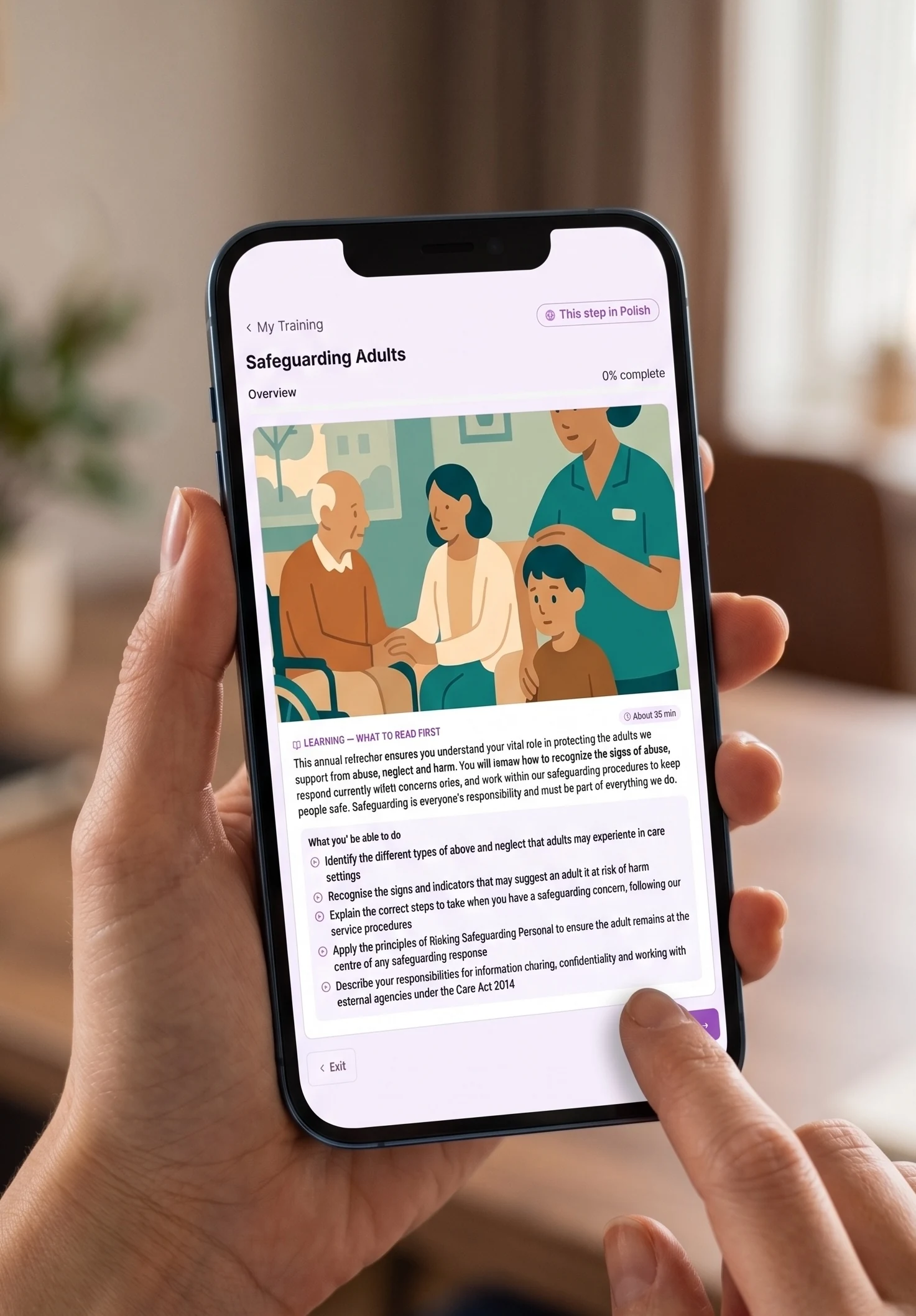
A finding is only useful if it leads somewhere.
The weakness in most audit programmes is not the auditing, it is the gap between the finding and the action. A low score gets recorded, everyone agrees it needs attention, and then the moment passes and the score reappears at the next audit because nothing changed the competence beneath it.
CareStream works because it closes that gap deliberately. By linking a finding to the training that addresses it, the platform turns each low score into a prompt to build competence, and re-auditing lets you prove the fix worked. That is continuous improvement made visible.
A low score connects to training instead of ending in a report.
The response addresses the underlying capability, not just the paperwork.
Re-auditing confirms the training actually moved the score.
You can evidence a full improvement cycle, exactly what CQC looks for.
Frequently asked
How does linking audits to training actually work?
When you run an audit and it reveals a weakness, for example an infection prevention and control audit scoring low, you can connect that finding to the training that addresses the underlying gap in competence. Because both the audit and the training live in CareStream, that connection is a real, actionable link rather than a note in the minutes that someone has to remember to follow up. From there you can direct the right people to the relevant training, and re-audit later to see whether the score has moved. This turns the audit from something that simply documents a problem into the first step of actually solving it.
Can you give an example of the loop in practice?
Take an infection control audit that comes back with a low score in a particular area of practice. On its own, that score tells you there is a weakness but does nothing to address it. By linking the finding to infection control training, you turn the low score into a prompt to build the competence that was missing. The loop closes when you re-run the audit and see whether the score has improved. That gives you a complete story: you found the issue, you responded with training, and you can show the result. It is exactly the kind of continuous improvement cycle CQC wants to see evidenced.
Why is this better than just recording audit results?
Recording audit results tells you where the problems are, but it does nothing to fix them, and a low score that sits in a folder tends to reappear at the next audit because the competence beneath it never changed. The value is in what happens after the finding, which is where most audit programmes lose momentum. By connecting findings to training, CareStream deliberately closes the gap between spotting an issue and fixing it. Instead of a growing list of scores, you build a record of problems noticed and acted upon, which is far more useful for both quality and inspection.
How does this support CQC inspection readiness?
CQC's model is built around continuous improvement, so inspectors are less interested in a perfect set of scores than in whether you notice problems, act on them, and can show the action worked. Linking audits to training gives you exactly that chain of evidence, from a low score to the training that addressed it to a re-audit that confirms the improvement. This lets you tell a confident, evidenced story about how your service learns and improves. Rather than presenting audits as isolated checks, you can demonstrate a genuine loop where findings drive competence, which speaks directly to well-led and to the quality statements around learning and improvement.
Explore more features
More of what the CareStream compliance platform does for UK care providers.
Turn every audit finding into a real fix.
See how CareStream connects audit weaknesses to the right training and closes the loop on improvement.