
Run a policy gap analysis on five policies before you spend anything.
You do not have to buy anything to find out what a policy gap analysis would show you. On the Free plan, CareStream checks up to five of your own uploaded policies against the regulations that apply to your service. Then you decide whether the rest is worth paying for.
14 day free trial · Set up in a day · UK data residency
You suspect the folder is out of date. You have not had time to check.
A scenario we see in many care settings.
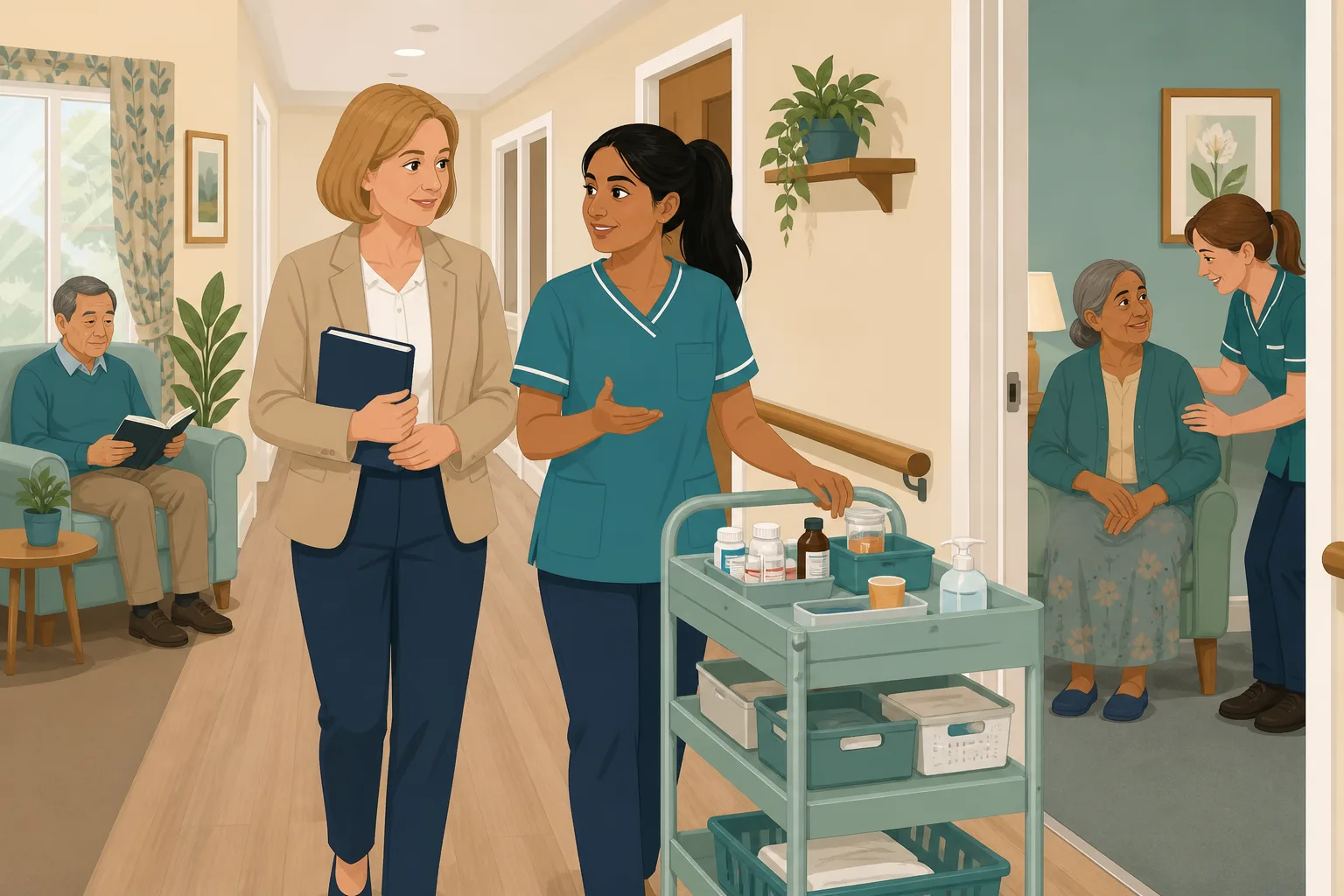
A registered manager took over a service eight months ago. The policy folder came with the job: some documents were written in house, some downloaded years ago, some edited by three different people. Everything is filed and nothing looks missing. But she has never read them side by side, and a proper policy audit would take a week she does not have. A paid review feels like a leap when she cannot say whether the problem is big or small. So she wants a small, honest first look before she commits money.

The new manager inherits a full policy folder and a long to do list.
She reads the policies the team asks about and they look sensible.
Everyone agrees the policies should be reviewed. A date goes in the diary.
The folder has never been read as a whole, so nobody knows what is missing.
A policy still names a body and a framework that have since been replaced.
One says report within 24 hours. Another, written later, says by the end of the shift.
A paid review feels risky when she has no idea how big the problem is.
“Show me how you know your policies are current.” A date in the diary is not an answer.
You do not need to guess how big the problem is. Five policies is enough to see what the checks find and how they work. Here is what you get for free, and where the free part stops.
An example scenario, not a named service.
A policy review you keep postponing is a risk you cannot size
The cost of not knowing is that you cannot decide what to do first.
Policies drift without anyone noticing
Care home policies are edited, copied and added to over the years. Small contradictions and old wording build up quietly, because nobody reads the whole set at once.
A manual policy audit takes days
Reading every policy against every regulation is a week of work. Most managers never get that week, so the review slips another year.
Paying before you know is a gamble
A tool that promises to find gaps is easy to doubt. Seeing it run on five of your own documents answers the question with evidence, not a sales pitch.
Five policies in, four checks out.
This is the free part of the policy gap detection feature, in the order a manager meets it. Read the guide to gap analysis for care homes for the thinking behind it.
Upload up to five policies and run the checks
- Create a free account and upload your policies as PDF, Word, ODT or text files. The Free plan covers up to five in total
- The coverage check reads each policy against the regulations that apply to your type of service, using a checklist of what a good policy should contain
- You can also run the out of date, consistency and wording checks on the same five policies
Illustration based on the Training screen. Example questions.
See what to add, with example wording to review
- Where a policy only partly covers a requirement, the coverage check lists what is missing and where it could go
- Each suggestion comes with example wording drafted by our own machine learning. It is guidance to review and adapt, not legal advice
- On the Free plan you can open three of these example wordings in total, so choose the ones that matter most
Illustration based on the Training screen. Example questions.
The out of date scan uses no machine learning at all
- It looks for replaced legislation, bodies and frameworks, old time bound wording, unfilled placeholders and thin policies
- It runs instantly and uses none of your allowance. It is a fixed set of checks, so the same policy gives the same answer
- A cross policy check finds where two policies disagree, quoting each one, so you see the contradiction for yourself
Illustration based on the Training screen. Example questions.
Fixing it, and getting staff to understand the change, is paid
- Adopting a fix, aligning wording to CQC policies, the approval chain and the readiness report are on Professional and above
- Nothing changes by itself. A fix stays a suggestion until an admin adopts it and the approval steps finish
- On the paid plans a short adhoc module on the changed policy shows whether staff understood it. The figures below are an illustration
Illustration based on the Knowledge gaps view. Example figures.
The questions managers ask, and how CareStream answers them
Read this as a conversation. The questions are the ones we hear most.
What do I actually get for free?
A free account lets you upload up to five policies in total and run all four checks on them: regulation coverage, out of date content, consistency between policies and wording. Re-runs are limited, and you can open three example wordings. It is a proper first look, not a full service.
Is this the same for everyone on every plan?
No. The free allowance is a separate entry route. It is not part of Starter. Gap detection, consistency checking, wording alignment, adopting fixes and the approval chain are on Professional and above. See the pricing page for current plans.
What does the coverage check compare my policies against?
A set of regulations and good practice requirements chosen for your type of service, each with a checklist of what a good policy should contain. A policy is marked covered, partly covered or missing against that checklist. It is a guide to look at, not a verdict.
How does it know a policy is out of date?
That check is a fixed scan with no machine learning. It looks for things like replaced legislation, bodies and frameworks, wording from the pandemic era, unfilled placeholders and missing review dates. It uses none of your allowance.
Will it rewrite my policies for me?
No. It suggests example wording, and on the paid plans an admin can adopt a suggestion, which is recorded as a tracked change. It then goes through approval before staff see it. Your original upload is never overwritten.
Does it tell me whether I am compliant?
No. It shows where your documents look thin, old or inconsistent. It does not give legal advice, guarantee compliance or predict a CQC rating. Your judgement and your own review still decide.
Can staff be checked on a policy once it is fixed?
Yes, on the paid plans. You allocate a short adhoc training module on the topic, staff answer in the Staff Hub, and a wrong answer goes to their Follow-up tab. You see the pattern in Knowledge gaps. The adhoc screen is not on the Free plan.
How do I try it, and what does it cost?
Create a free account at the sign up page and upload your first policies. The paid plans have a 14 day free trial. Current prices are on the pricing page.
A first look, not a full policy review
Five policies in total, for life
The free allowance is five policies, counted over the life of the account. Deleting one does not give the place back. Choose the five that worry you most.
Not on Starter, and fixes need Professional
The free allowance is its own route. Starter does not include it. Adopting fixes, the approval chain and the CQC report need Professional or above.
Suggestions, never automatic edits or advice
Findings and example wording are for you to review. They are not legal advice, they do not guarantee compliance and they do not predict a rating.
Training built from your own policies
Everything on this page is part of the product. Here is where to read more.
Training built from your own policies
Short training from your own policies, with wrong answers turned into lessons.
See the featurePolicy gap detection
Coverage, out of date wording, contradictions and wording checks across your policy set.
See gap detectionCQC and compliance
Evidence that builds itself, and a readiness report for your next inspection.
See CQC and complianceGuides on this subject
Policy Gap Analysis for Care Homes: A Step by Step Guide
Most care homes do not fail inspection because they lack policies. They fail because the policies they have do not match what actually happens on...
Read article
Six signs your policy set has quietly drifted out of date
Every care service has out-of-date care policies. Not because anyone is negligent, but because a policy library is a living thing, and living things...
Read article
Why Downloaded Care Policy Templates Create Contradictions (And What to Do About It)
Most care services run on a patchwork of downloaded templates, and nobody reconciled them after they were assembled. That is the uncomfortable truth...
Read articleFree policy checks, answered
About the free check
What is a policy gap analysis?
It compares your policies with what they should cover, and shows what is missing, old or in conflict. The care home guide explains the idea in detail.
Is there a free policy review for care homes?
On the Free plan you can upload up to five policies and run the four checks on them, with limited re-runs and three example wordings. It is a first look. The full set of fixes is on the paid plans.
Which care home policies should I upload first?
Choose the five you feel least sure about, or the ones an inspector is most likely to ask about, such as safeguarding, medication, infection control, incident reporting and complaints. You can see our guide to policies required for a care home.
Does the compliance gap analysis tell me I am compliant?
No. A compliance gap analysis shows where documents look weak. It cannot judge how you work in practice, and it does not guarantee compliance or a rating.
Is the free allowance on Starter?
No. It is a separate entry route. Starter does not include gap detection. Professional and above do.
What file types can I upload?
PDF, Word (DOCX), ODT and plain text files. Scanned images and spreadsheets are not supported, and a scanned PDF may be read poorly.
About inspections
What do CQC policies need to show?
Under Regulation 17, good governance means systems and processes to assess, monitor and improve the quality and safety of the service. The CQC guidance on Regulation 17 lists policies and procedures among governance arrangements.
How often should a policy review happen?
Many services review each policy yearly and after any change in practice, but you decide what suits your service. Our guide to how often care policies should be reviewed covers it. CareStream lets you set a review date and reminds you when one is due.
How to run a quick policy audit on your own
Whether or not you use software, a small first pass tells you more than a large plan you never start. Here is a way to do it in an afternoon.
Start with the five that matter most
A policy review does not have to cover everything at once. Pick the policies where a mistake would hurt people or where an inspector is most likely to look. Read them for three things: is anything missing, is anything old, and does anything contradict another policy.
Regulation 17 on good governance asks providers to run systems that assess, monitor and improve the quality and safety of the service. A simple, regular look at your own documents is one way to show you do that.
- Choose five policies and check each has a review date.
- Look for old names of bodies, frameworks or forms, and leftover placeholders.
- Compare timings, roles and escalation steps across policies on the same topic.
- Write down what you would change, then decide what to do first.
Then decide whether to go further
If the first five show only small points, you have learned something useful for nothing. If they show real problems, you know where to put your time and whether a paid plan is worth it. Either way, you decide with evidence.
For the inspector. Keep a dated note of what you checked, what you found and what you changed. It shows your governance is active, not just a date in the diary. See our CQC and compliance page.




