Syringe Drivers and Subcutaneous Medication training for your team
Licence this one module for the staff who need it. No CareStream subscription, no minimum order, no annual contract. One licence covers one member of staff for the complete Syringe Drivers and Subcutaneous Medication module, in the language they think in.
- Teach, then assessA full lesson with a real care scenario, followed by an assessment that checks they can apply it.
- Over 60 languagesStaff read the lesson and answer in their first language. Your records stay in English.
- Wrong answers get followed upA short micro-lesson goes back to the staff member on the exact point they missed, then they retry.
- Evidence you can hand overA dated completion record and a certificate per person, ready for your CQC file.
Syringe Drivers and Subcutaneous Medication, start to finish.
This training ensures you understand how syringe drivers and subcutaneous medication work to keep patients comfortable when they cannot take medicines by mouth. You will learn what these devices do, how they are monitored safely, and your role in observing and reporting. This is the same module CareStream subscribers get, written for care settings rather than adapted from a generic course. It runs about 35 minutes and ends with a 20 question assessment.
- What Syringe Drivers Are and Why We Use Them
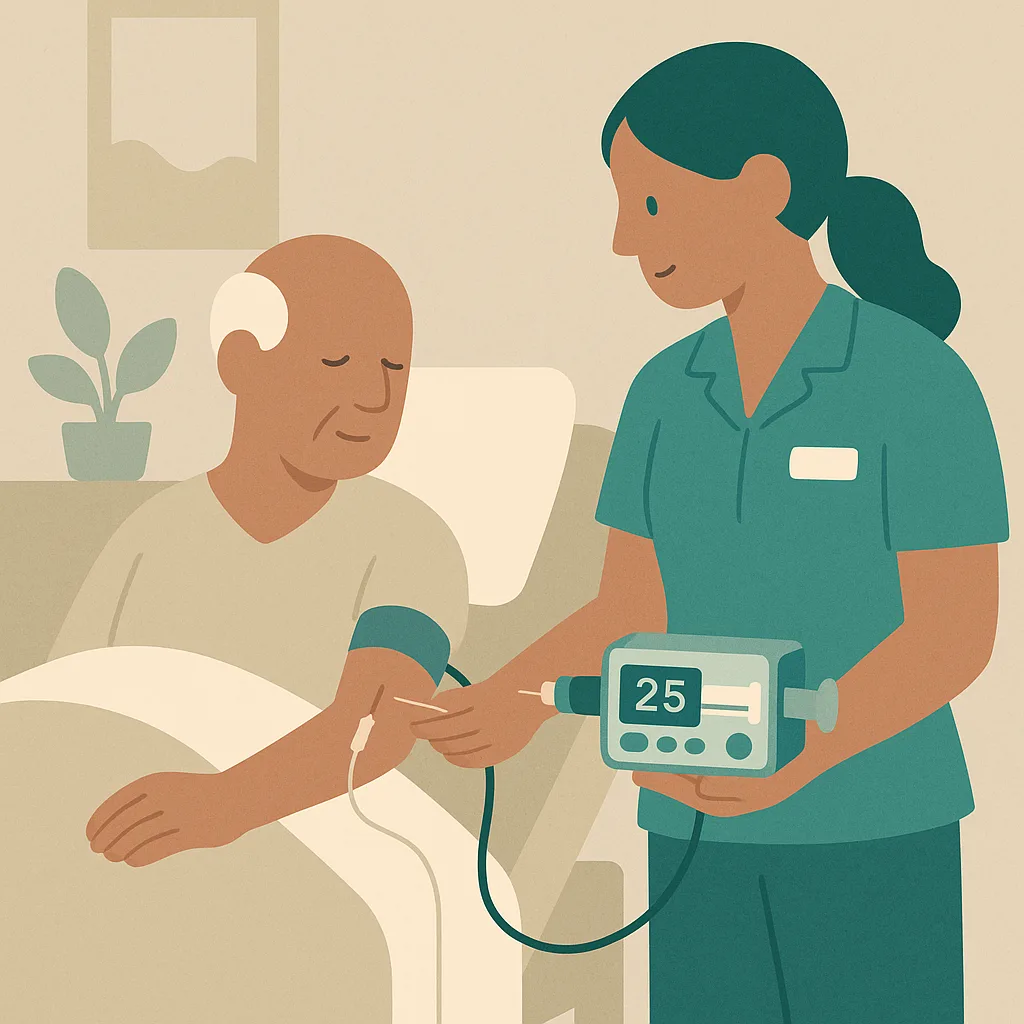
A syringe driver is a small battery powered pump that delivers medication continuously under the skin, usually over twenty four hours.
- The Subcutaneous Route and Common Medications
Subcutaneous means under the skin.
- How Syringe Drivers Are Set Up and Monitored
Only trained and competent registered nurses set up, adjust or manage syringe drivers.
- Caring for the Infusion Site and Recognising Problems
The subcutaneous infusion site is where the small cannula sits under the skin, usually on the upper arm, abdomen or thigh.
- Controlled Drugs and Safety Requirements
Many medicines given through syringe drivers are controlled drugs, especially opioids like morphine, oxycodone and diamorphine.
- Your Role and When to Escalate
Healthcare assistants, care workers and the wider team observe patients receiving subcutaneous medication and report any concerns, but never touch or adjust the syringe driver itself.
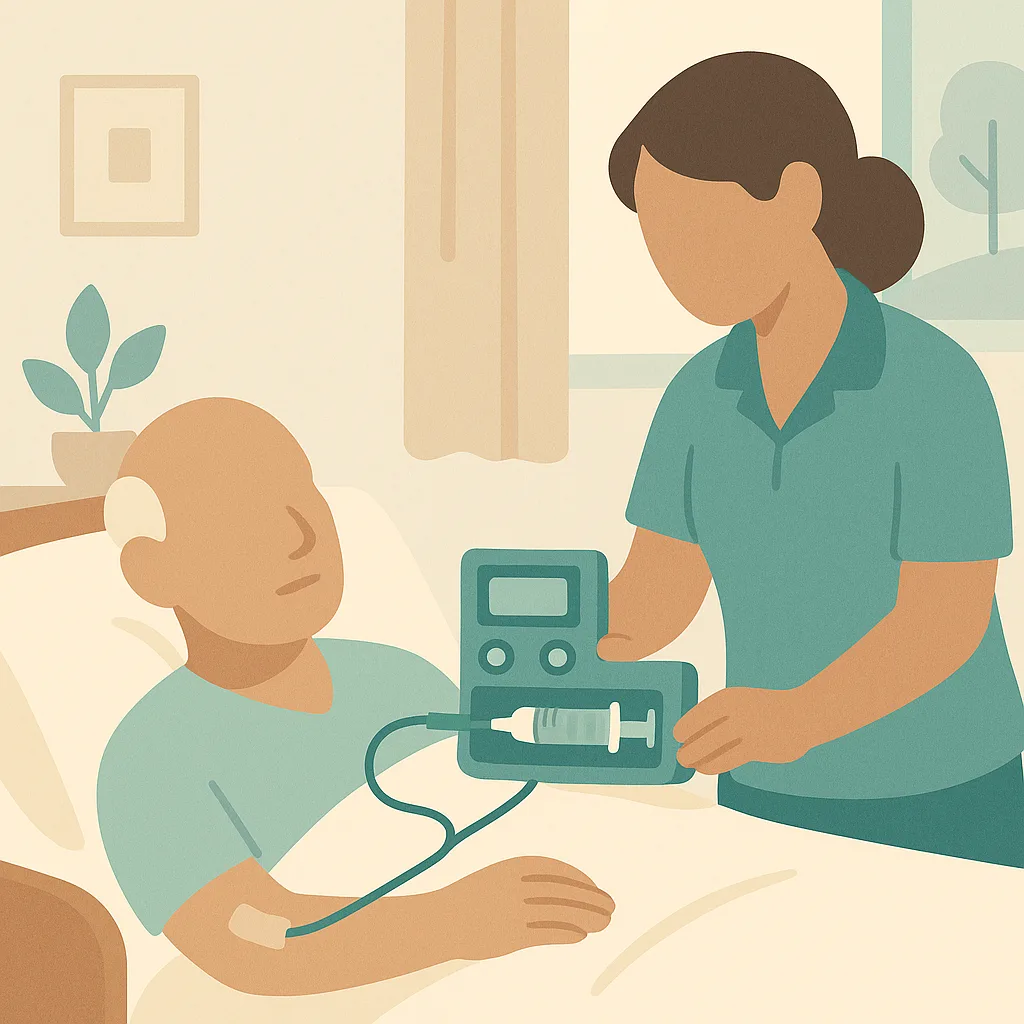
What your team will be able to do.
- Explain why syringe drivers and subcutaneous medication are used in palliative care and when they are needed
- Identify the key safety checks and monitoring requirements for continuous subcutaneous infusions
- Recognise signs that a syringe driver site or infusion needs attention and know when to escalate to a nurse
- Describe the roles and boundaries around syringe driver management and controlled drugs in this hospice
- Apply correct procedures when observing patients receiving subcutaneous medication and communicate sensitively with families
Syringe Drivers and Subcutaneous Medication in facts.
About 35 minutes, 6 lessons
20 questions, pass mark 80%
Every year
Yes, observed by the employer, checklist provided
What staff come away with
Syringe drivers deliver medication continuously under the skin when patients cannot take medicines by mouth, keeping them comfortable
Only trained and competent registered nurses set up, adjust and manage syringe drivers; your role is to observe and report
Report immediately to a nurse if you notice site redness, swelling, leaking, alarms, or the patient remaining in pain or distressed
Controlled drugs like morphine require strict checking, witnessing and recording procedures for safety
Reassure families gently that syringe drivers are for comfort and symptom control, not to hasten death
Never touch or adjust a syringe driver yourself; always escalate concerns to a registered nurse
Three steps, and nothing to set up.
Checkout takes a minute. Your licences and a receipt arrive by email straight away.
Enter their names and emails, or paste a list. They get an invite to the hub on any device.
You see who has finished, their score, and their certificate as each one comes in.
Everything a licence includes.
Dated, named, and downloadable as a PDF for your training file.
Over 60 languages, chosen per staff member. Your reporting stays in English.
Buy one module for one person if that is all you need. Nothing recurring.
Licences do not expire the moment you buy. Staff have a year to complete.
Before you buy.
How long does Syringe Drivers and Subcutaneous Medication training take?
About 35 minutes, across 6 short lessons, followed by a 20 question assessment with a pass mark of 80%. Staff can stop and pick up where they left off.
What does the Syringe Drivers and Subcutaneous Medication module cover?
6 lessons: What Syringe Drivers Are and Why We Use Them, The Subcutaneous Route and Common Medications, How Syringe Drivers Are Set Up and Monitored, Caring for the Infusion Site and Recognising Problems, Controlled Drugs and Safety Requirements and Your Role and When to Escalate. Each one pairs the teaching with a care scenario and a quick check.
How often do staff need to refresh Syringe Drivers and Subcutaneous Medication?
CareStream sets this module so it renews every year. Staff and managers are reminded before a certificate lapses, so the refresher is booked before the gap appears.
Does Syringe Drivers and Subcutaneous Medication need a practical assessment?
Yes. The online module is the knowledge part. Staff also need an observed assessment in the workplace, carried out by their employer, and CareStream provides the observation checklist to record it.
Do I need a CareStream subscription to buy this?
No. This page exists precisely so you do not. You buy the licences you need, your staff complete the module in the CareStream hub, and that is the end of it. There is no trial to start, no card kept on file, and no subscription that begins quietly afterwards.
If you later decide you want the full platform, anything your staff have already completed carries across into your account.
What does one licence actually cover?
One licence covers one named member of staff for this one module, including the lesson, the assessment, any follow-up questions triggered by a wrong answer, and their certificate. Licences are not shared between people, because the completion record has to belong to an individual to be worth anything at inspection.
How quickly can staff start?
Immediately. The licences are on your account as soon as the payment clears, and staff get their invite the moment you add them. There is no onboarding call and no setup period.
Can staff complete it in another language?
Yes. Each staff member has a first language on their profile, and the lesson, the questions and the feedback all arrive in it. They answer in that language too. What you see as a manager stays in English, so the record reads the same whoever completed it.
What if someone fails the assessment?
Nothing is lost. A wrong answer triggers a short follow-up lesson on that specific point, and they retry it. The record shows the improvement from the first attempt to the latest, which is stronger evidence than a single pass mark, because it shows the gap was found and closed.
Can I buy for more than one service?
Yes. Buy the total number of licences you need and allocate them across your services when you add staff. If you are licensing for a group and want an invoice rather than a card payment, get in touch and we will raise one.
Licence any of these the same way.
Same price, same terms, no subscription needed.