
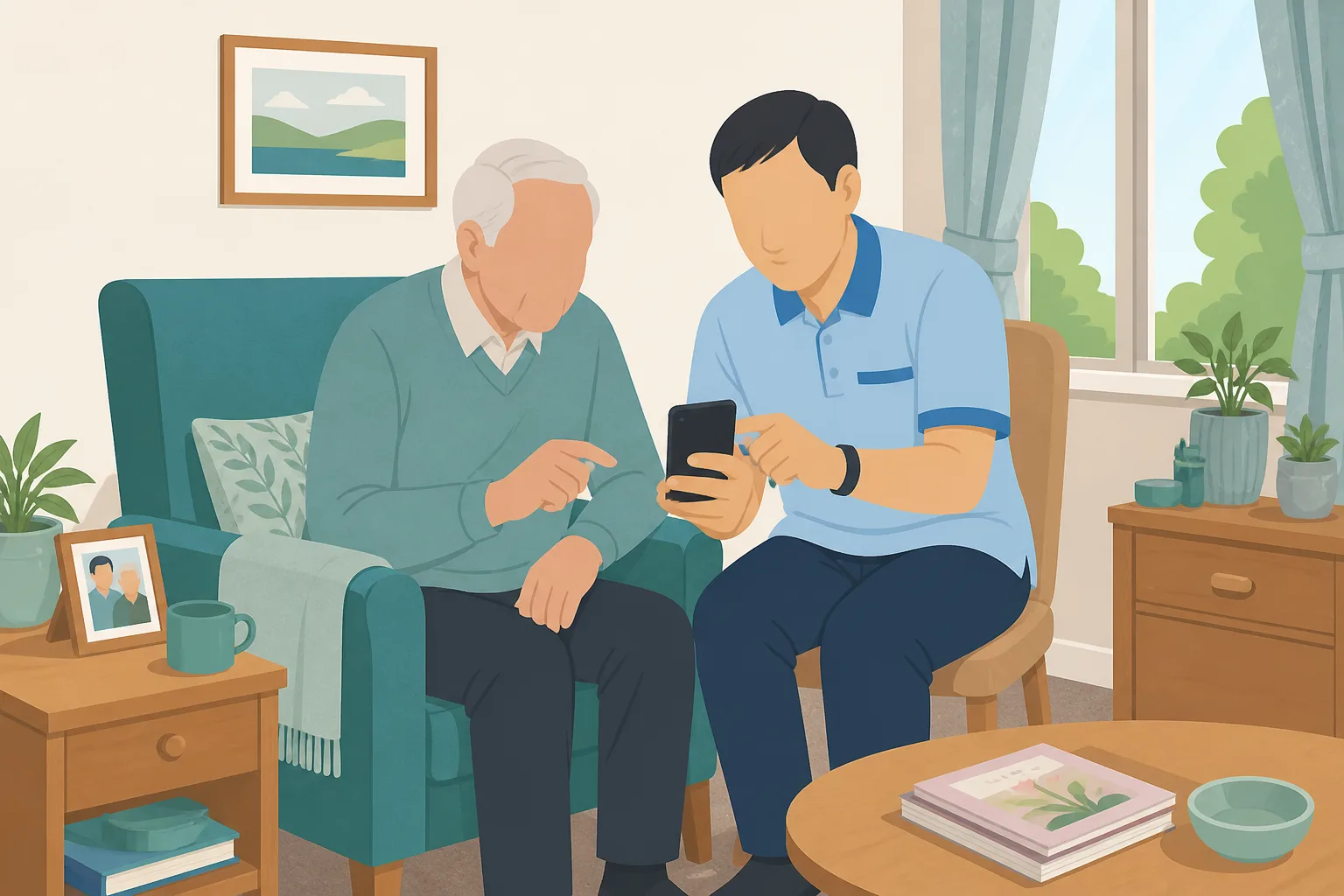
 Social Media, Mobile Phones and Photography PolicyNovember offerMovember: 15% off every policy · ends 22 Nov Add to basket
- 83elements checked
- 2 daysto deliver
- 6laws and standards
- 1 yearof updates
When you need this policy
- Staff carry personal phones on shiftSets out your mobile phone policy: where phones are kept, when they may be used and what staff do with work devices. It reflects the rules you tell us, not a generic ban.
- Someone wants to photograph a personCovers consent before photographs and video, who decides when a person lacks capacity under the Mental Capacity Act 2005, permitted uses and where images are stored. It links to privacy under Regulation 10 and secure records under Regulation 17.
- A post appears onlineSets out your social media guidelines for staff, including posts about people or colleagues, friend requests and official service accounts, and how a breach is reported and handled.
- Families and visitors ask to take photosExplains your rule on visitor photographs, how other people's privacy is protected and how images are kept and deleted in line with data protection law and the duty of confidentiality.
Build it now: 17 questions, about three minutes
Let's build your Social Media, Mobile Phones and Photography Policy
Answer 17 quick questions, about three minutes, and we'll write this policy for your service, in your name, with your people. You can skip anything and add it later.
Asked once, reused for every policy you buy
That's everything we need
0 of 17 answered. You can add the rest at any point before we write it.
- Registered company name
- Trading name (if different)
- Service address
- CQC provider ID
- CQC location ID
- Registered manager
- Nominated individual
- Personal phone rule
- Work devices provided
- Photograph consent process
- Permitted photograph uses
- Consent without capacity
- Service social media accounts
- Staff online conduct rule
- Family and visitor photographs
- Image storage and deletion
- Breach reporting route
Your answers are saved on this device and carried into your order.
Built from the law, checked against the law
The legislation, CQC standards and guidance we analyse to write it.
Your Social Media, Mobile Phones and Photography Policy is structured from these regulations, then verified against every required element of each one before a person signs it off. If the law changes, your policy is updated and you are told what changed and why.
Common law duty of confidentiality
- Defines circumstances when information may be disclosed without consent: legal obligation, court order, overriding public interest (including safeguarding), and informed consent obtained from the resident
- Requires that all disclosures of personal information are recorded in writing, documenting who disclosed what information, to whom, when, why the disclosure was lawful, and the reasoning behind the decision
- Establishes protocols for responding to requests for resident information from family members or visitors, including verifying consent, confirming legal authority (e.g. health and welfare Lasting Power of Attorney), or determining best interests before disclosure
- Requires secure storage of all records (care plans, medical records, personal details) to prevent unauthorised access, including physical security measures and system access controls
- Prohibits staff from discussing residents in settings where they may be overheard (corridors, public areas, outside work premises) and require private locations for handovers and clinical discussions
- Prohibits posting any information, images, or references about residents on social media or public platforms, including after a resident's death
Data Protection Act 2018
- Policy document identifying the specific lawful basis (legal condition) used for processing different categories of personal data, including health and social care condition for care records, employment condition for DBS checks and payroll, and substantial public interest condition for safeguarding referrals
- Appropriate policy document(s) required under Schedule 1 Part 2 for each substantial public interest condition relied upon (as required by Article 9(2)(g) and which the ICO may request to inspect)
- Privacy notice written in plain language that residents can read and in an accessible format, explaining how personal data is used
- Procedure for responding to subject access requests within one calendar month from receipt, free of charge, including process for redacting third-party information (residents, relatives, staff) that appears on shared pages in care records
- Staff training and written warning that accessing resident files without legitimate work purpose, photographing care plans, or similar unauthorised processing constitutes a personal criminal offence under section 170 of the Act
- Data breach notification procedure requiring reporting to the ICO within 72 hours of the organisation becoming aware (not when manager is informed) of breaches such as lost handover sheets, misdirected emails, stolen devices, or ransomware incidents

Mental Capacity Act 2005
- States that capacity is assessed decision-specific and time-specific, not once on admission or generically, and by the person making the decision
- Requires that before concluding a resident lacks capacity, all practicable steps are taken to support the decision (hearing aids, glasses, interpreter, easy-read information, appropriate time of day, quiet location, repeated attempts, trusted person present)
- Confirms that residents retain the right to make unwise decisions and that disagreement with a decision does not constitute evidence of incapacity
- Defines restraint by what is actually happening (keypads, bedrails, sensor mats, lap belts, covert medication) and requires that each is lawful only if staff reasonably believe it necessary and proportionate to prevent harm
- Requires best interests decisions to be based on the individual resident's wishes, feelings, beliefs and values, with consultation of people who know them, not what is medically optimal or what the home prefers
- Requires instruction of an Independent Mental Capacity Advocate (IMCA) when there is nobody to consult and the decision is serious

Regulation 10: Dignity and respect
- Requires doors to be closed and knocked on before entering resident rooms, and curtains to be drawn during personal care
- Prohibits discussion of residents' personal or care matters in public areas such as corridors, lifts, dining rooms or within earshot of other residents
- Addresses provision of continence care in a manner that does not announce itself audibly down corridors or to other residents
- Sets out procedures to respect residents' choices regarding timing of getting up, clothing, meals, and frequency of bathing or showering
- Addresses support for residents to maintain community involvement, including going out, receiving visitors, maintaining relationships, keeping pets where applicable, and practising their faith
- Requires consideration of all nine Equality Act protected characteristics (age, disability, gender reassignment, marriage and civil partnership, pregnancy and maternity, race, religion or belief, sex and sexual orientation) in care delivery

Regulation 17: Good governance
- Mandates that all care records are written contemporaneously (at the time events occur), not retrospectively, and must prohibit altering or completing records after the fact to prevent unlawful falsification of documentation
- Establishes a schedule of regular audits across all areas of care delivery (including medicines, care plans, infection control, falls, safeguarding) specifying that audits must be conducted by personnel who did not deliver the care being audited
- Requires that data from incidents, falls, complaints, and safeguarding events be trended and analysed for patterns (e.g. time of day, staffing levels, location) rather than simply counted as numbers
- Mandates that the same event must be cross-referenced and appear in all relevant logs (complaints log, safeguarding log, incident log, whistleblowing log) to ensure no events fall through gaps in reporting
- Establishes that action plans arising from audits, incidents, or complaints must have fixed completion dates that are not repeatedly rolled forward, and actions must be evidenced as closed with documentary proof
- Requires that feedback from residents, families, and staff be actively sought, that response rates be monitored for representativeness, and that recurring themes must trigger documented action within a defined timeframe

UK General Data Protection Regulation (UK GDPR)
- Identifies lawful basis for processing under Article 6 (legitimate interests or public task) and Article 9(2)(h) condition (health and social care provision) for resident personal and health data
- Includes or references an appropriate policy document as required by Schedule 1 of the Data Protection Act 2018 for processing special category data
- Specifies that information sharing for direct care, safeguarding, or vital interests is permitted and lawful, and that GDPR does not prevent such sharing
- Defines unauthorised access to records (including looking up records without legitimate reason) as a criminal offence under section 170 of the Data Protection Act 2018
- States that falsifying, altering or retrospectively amending care records is a criminal offence under section 173 of the Data Protection Act 2018
- Establishes 72-hour breach notification timeline from awareness of breach and designates who can initiate breach reporting outside normal office hours when registered manager is unavailable

Written for your service
What we ask you, so none of it is assumed.
Most policy packs are one document sold to everyone with a find and replace on the home name. Your Social Media, Mobile Phones and Photography Policy is written from the legislation above and from your answers to the questions below. Where you have told us something, it says so. Where you have not, it sets out what must happen rather than claiming you already do it.
Your registered name, address, CQC numbers and who holds the key roles. About three minutes. Nothing else is asked before you buy.
Asked once in your own account and used across every policy you own, so a second policy never asks you the same thing twice.
Why it matters. A policy that claims you assess your premises annually, when you never have, is not a harmless overstatement. It is a signed statement handed to your inspector. We would rather write what you must do than guess what you already do.
How it is made
From your details to a policy you can stand behind.
The short questions above: who you are, your CQC registration, and the people this policy names.
One section per required element of the legislation, in your name, with your people.
Automated checks against every required element, then a person reads it before it ships.
When legislation changes, your policy is updated and you are told what changed and why.
Common questions
What you are actually buying.
What exactly do I receive?
A complete Social Media, Mobile Phones and Photography Policy written for your organisation, in your dashboard and as a print-ready PDF on your own letterhead. It names your service, your registration details and your leads, because you gave us them.
Is this a template?
No. Each policy is written for the organisation buying it, structured from the legislation itself, verified against 83 required regulatory elements, and read by a person before it carries your name.
How quickly will I get it?
Within 2 working days of you completing the short questions above. Most arrive sooner.
What happens when the law changes?
We monitor UK care legislation continuously. When something affecting this policy changes, your copy is updated and you are told what changed and why. The first year of updates is included, then £12 a year per policy.
Can I edit the policy myself?
No, and deliberately so: we stand behind every word we approve. If something needs changing, tell us and we amend and re-verify it, so it always remains a document we can both defend to an inspector.
What if I need more than one policy?
Most services do. The Statutory Starter Pack covers the twenty policies every CQC-registered service is expected to hold, and the Complete Policy Library covers all 148.
Does a care service need a social media policy?
Nothing in the regulations we fetched uses that name. Regulation 10 requires privacy and Regulation 17 secure records. A written social media policy shows how your staff protect both when they use phones and online accounts.
Can care staff use personal phones at work?
That is your decision. The policy records your rule, such as lockers, break only use or emergency pockets, so every shift applies the same mobile phone policy.
Is consent needed to photograph a resident?
Your policy should set out how consent is gained and recorded before any photograph. Where a person cannot decide, it records how a decision is made under the Mental Capacity Act 2005.
What is the difference between this and a template?
A social media policy template, mobile phone policy template or workplace social media policy found online is generic. This policy is written for your service from your answers, so it states your actual phone rules, consent steps and reporting route.
Does it cover staff posting on their own accounts?
Yes. As a social media policy for staff, it sets out your expectations for personal accounts, including posts about people, colleagues and the service, and what happens if a post breaches the rules.
Where do photographs have to be stored?
Your photography policy records where you store images, who can see them and when they are deleted. Section 170 of the Data Protection Act 2018 makes some knowing or reckless obtaining or disclosure of personal data an offence.
Why CareStream
Policies written the way an inspector expects to read them.
Before you buy
What the document actually looks like.
Every section it contains, and a page of the real thing. We show the structure and the personalisation rather than the wording, because the wording is what you are paying us to write for your service.
Contents of your Social Media, Mobile Phones and Photography Policy
- Purpose and scopewho it covers
- Legal and regulatory frameworkcited in full
- Definitions used in this policy
- Roles and responsibilitiesyour people, named
- Procedure, step by step
- Recording, reporting and escalation
- Training and competency
- Monitoring, audit and review
- Related policies and documents
- Version control and approvalsigned and dated
Section 4 · Roles and responsibilities
Who is accountable, by name
Overall accountability for this policy rests with your registered manager, supported by your nominated individual. Day to day responsibility sits with your named lead, who is the first point of contact for staff at your service address.
The remaining wording is written for the organisation buying it, so it is not shown here.
“The inspector asked for evidence and I had it on screen before she finished the sentence.”
Registered Manager · 48-bed nursing home, West SussexRelated policies
More policies your service may need.
More statutory and operational policies CareStream writes for your service, personalised, human-reviewed and kept updated, exactly like this one.
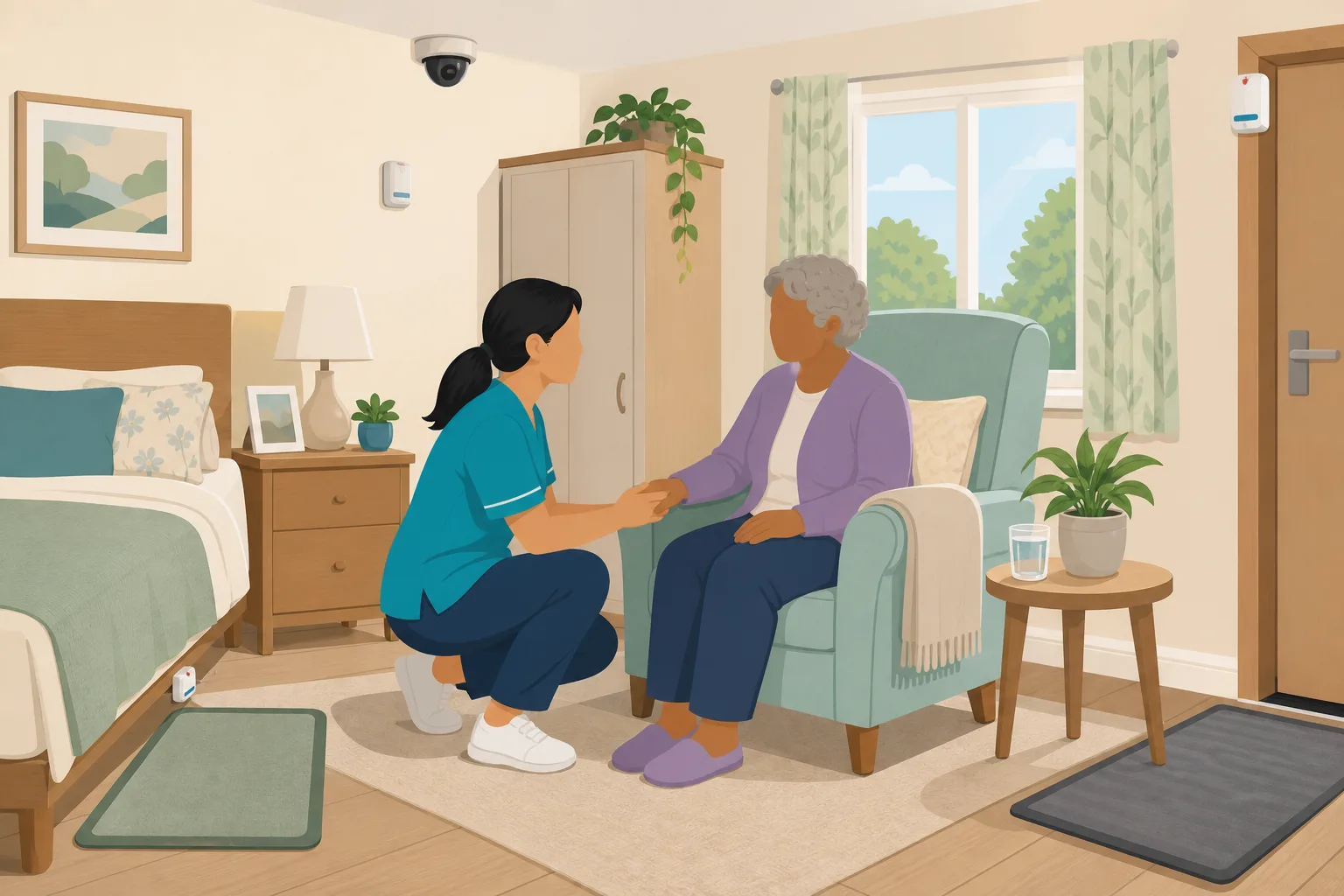
CCTV, Surveillance and Monitoring Technology Policy
A care home CCTV policy template written for you, covering cameras, sensor mats and door alarms: privacy, consent, best interests and data use.

Confidentiality Policy
Keeping personal information confidential, and when sharing is right.

Caldicott and Information Sharing Policy
The Caldicott principles applied to your service, and who decides when data is shared.
Electronic Call Monitoring and Visit Records Policy
An electronic call monitoring policy for how visits are logged and monitored, what happens when logging fails, and how visit records are audited.

Safe Handling of Property, Tenant Belongings and Keys Policy
A key holding policy for your service: entering people's homes, key control, handling belongings, searches and respecting privacy in a tenancy.
Care After Death and Verification of Death Policy
A care after death policy covering verification of expected death, last offices, notifying family and the coroner, and property, written around how your hospice works.
Compared
The four ways care services get a policy.
We have compared what each approach does rather than naming competitors, because products change and the comparison should still be true next year.
| CareStream | A policy pack | A consultant | A free template | |
|---|---|---|---|---|
| Questions asked at the point of purchase, so it is personalised rather than blank | ||||
| Written for your service, naming your manager and your leads | ||||
| Structured from the regulations, every required element checked before it is sent | ||||
| A branded companion document setting out the law it was written against | ||||
| Read and approved by a person before it carries your name | ||||
| Prints on your own letterhead with a sign-off and version block | ||||
| Named role holders update everywhere when the person changes | ||||
| Kept current when the law changes, and you are told what changed | ||||
| Turnaround stated before you buy | ||||
| Your staff can ask it questions in their own language | ||||
| What it costs | £39 to £79 per policy, one-off | £250 to £995 for the pack | A day rate, typically £400 upwards | Nothing |
Prices are the published rates of the common alternatives as at September 2026, for comparison only.
Training
Owning the policy is half of it
An inspector asks whether your staff understood it, not whether you hold it. Ninety eight modules written and kept current by us, to the same regulations, from £25.99 per staff member with no subscription.




