
 Safe Handling of Property, Tenant Belongings and Keys PolicyNovember offerMovember: 15% off every policy · ends 22 Nov Add to basket
- 81elements checked
- 2 daysto deliver
- 6laws and standards
- 1 yearof updates
When you need this policy
- A new tenant moves inRecords whether you hold a key, how agreement is recorded, and how belongings are listed at move in, with privacy under regulation 10 kept central.
- A key goes missingSets out who is told, how locks are dealt with and how the loss is recorded, with the service held accountable under its own arrangements.
- Property is reported missingCovers how reports are recorded and when a safeguarding referral is made, because regulation 13 treats theft or misuse of a person's property as abuse.
- Someone asks to search a roomStates who may decide, what consent and capacity mean in practice, and how the decision and its reason are recorded.
Build it now: 19 questions, about three minutes
Let's build your Safe Handling of Property, Tenant Belongings and Keys Policy
Answer 19 quick questions, about three minutes, and we'll write this policy for your service, in your name, with your people. You can skip anything and add it later.
Asked once, reused for every policy you buy
That's everything we need
0 of 19 answered. You can add the rest at any point before we write it.
- Registered company name
- Trading name (if different)
- Service address
- CQC provider ID
- CQC location ID
- Registered manager
- Nominated individual
- Entry rules
- Keys held by service
- Key storage and log
- Key consent record
- Lost key response
- Belongings inventory
- Belongings storage
- Searching rules
- Privacy and visitors
- Missing property reports
- Emergency entry
- Move out property return
Your answers are saved on this device and carried into your order.
Built from the law, checked against the law
The legislation, CQC standards and guidance we analyse to write it.
Your Safe Handling of Property, Tenant Belongings and Keys Policy is structured from these regulations, then verified against every required element of each one before a person signs it off. If the law changes, your policy is updated and you are told what changed and why.
Adult safeguarding under the Care Act 2014 and Care and Support Statutory Guidance
- Clear definitions of all types of abuse covered by the policy (physical, emotional, financial, sexual, discriminatory, and neglect)
- Specific signs and indicators that staff should recognise for each type of abuse and neglect
- Immediate step-by-step reporting procedure for staff to follow when they identify or suspect abuse or neglect
- Designated person or role responsible for receiving and managing safeguarding concerns within the care home
- Procedure for preserving evidence when abuse or neglect is suspected or identified
- Protocol for working with and notifying local authority safeguarding teams and other external agencies

Data Protection Act 2018
- Policy document identifying the specific lawful basis (legal condition) used for processing different categories of personal data, including health and social care condition for care records, employment condition for DBS checks and payroll, and substantial public interest condition for safeguarding referrals
- Appropriate policy document(s) required under Schedule 1 Part 2 for each substantial public interest condition relied upon (as required by Article 9(2)(g) and which the ICO may request to inspect)
- Privacy notice written in plain language that residents can read and in an accessible format, explaining how personal data is used
- Procedure for responding to subject access requests within one calendar month from receipt, free of charge, including process for redacting third-party information (residents, relatives, staff) that appears on shared pages in care records
- Staff training and written warning that accessing resident files without legitimate work purpose, photographing care plans, or similar unauthorised processing constitutes a personal criminal offence under section 170 of the Act
- Data breach notification procedure requiring reporting to the ICO within 72 hours of the organisation becoming aware (not when manager is informed) of breaches such as lost handover sheets, misdirected emails, stolen devices, or ransomware incidents

Human Rights Act 1998
- States that residents whose placements are arranged or paid for by the local authority can bring direct claims against the care home under the Human Rights Act pursuant to section 73 of the Care Act
- Requires that any visiting restriction imposed due to an outbreak or other reason must be justified individually for each affected resident, not applied blanketly, with documented assessment of lawfulness, legitimate aim and proportionality for each person
- Prohibits the application of DNACPR decisions based solely on age or care home residency, requiring instead that each DNACPR be a documented clinical decision made specifically about the individual resident
- Requires that before any camera or surveillance equipment is installed in a resident's room, a proportionality analysis and a data protection impact assessment must be completed and documented, addressing the Article 8 rights of the resident, visitors and staff
- Requires that any decision to serve notice or terminate a placement for a resident whose dementia produces challenging behaviour must be documented as an interference with the resident's home under Article 8, assessed for proportionality, and considered as potential discrimination arising from disability under section 15 Equality Act
- Requires that any control or restriction on a resident's money be documented with reference to Article 1 Protocol 1 rights and recorded justification

Mental Capacity Act 2005
- States that capacity is assessed decision-specific and time-specific, not once on admission or generically, and by the person making the decision
- Requires that before concluding a resident lacks capacity, all practicable steps are taken to support the decision (hearing aids, glasses, interpreter, easy-read information, appropriate time of day, quiet location, repeated attempts, trusted person present)
- Confirms that residents retain the right to make unwise decisions and that disagreement with a decision does not constitute evidence of incapacity
- Defines restraint by what is actually happening (keypads, bedrails, sensor mats, lap belts, covert medication) and requires that each is lawful only if staff reasonably believe it necessary and proportionate to prevent harm
- Requires best interests decisions to be based on the individual resident's wishes, feelings, beliefs and values, with consultation of people who know them, not what is medically optimal or what the home prefers
- Requires instruction of an Independent Mental Capacity Advocate (IMCA) when there is nobody to consult and the decision is serious

Regulation 10: Dignity and respect
- Requires doors to be closed and knocked on before entering resident rooms, and curtains to be drawn during personal care
- Prohibits discussion of residents' personal or care matters in public areas such as corridors, lifts, dining rooms or within earshot of other residents
- Addresses provision of continence care in a manner that does not announce itself audibly down corridors or to other residents
- Sets out procedures to respect residents' choices regarding timing of getting up, clothing, meals, and frequency of bathing or showering
- Addresses support for residents to maintain community involvement, including going out, receiving visitors, maintaining relationships, keeping pets where applicable, and practising their faith
- Requires consideration of all nine Equality Act protected characteristics (age, disability, gender reassignment, marriage and civil partnership, pregnancy and maternity, race, religion or belief, sex and sexual orientation) in care delivery

Regulation 13: Safeguarding service users from abuse and improper treatment
- Definition and recognition criteria for all forms of abuse covered: physical, emotional, sexual, financial, discriminatory abuse, neglect, and improper treatment
- System for immediate internal investigation by the provider upon becoming aware of any safeguarding concern, operating independently of external section 42 enquiries
- Comprehensive register of all restrictions and restraints applied to each resident (including physical devices, chemical restraint, environmental controls, door codes, and manual guidance) with documented justification for necessity, proportionality, and evidence that less restrictive options were considered
- Clear reporting procedures including timescales for escalation to management, external safeguarding authorities, CQC notification requirements, and circumstances triggering police involvement
- Mandatory DBS referral procedure under section 35 Safeguarding Vulnerable Groups Act 2006 when staff are dismissed or resign in circumstances where dismissal would have occurred due to safeguarding concerns
- Safeguarding controls for residents' finances including handling of personal allowances, cash, possessions, and prevention of financial abuse by family members or others with access to residents' money

Written for your service
What we ask you, so none of it is assumed.
Most policy packs are one document sold to everyone with a find and replace on the home name. Your Safe Handling of Property, Tenant Belongings and Keys Policy is written from the legislation above and from your answers to the questions below. Where you have told us something, it says so. Where you have not, it sets out what must happen rather than claiming you already do it.
Your registered name, address, CQC numbers and who holds the key roles. About three minutes. Nothing else is asked before you buy.
Asked once in your own account and used across every policy you own, so a second policy never asks you the same thing twice.
Why it matters. A policy that claims you assess your premises annually, when you never have, is not a harmless overstatement. It is a signed statement handed to your inspector. We would rather write what you must do than guess what you already do.
How it is made
From your details to a policy you can stand behind.
The short questions above: who you are, your CQC registration, and the people this policy names.
One section per required element of the legislation, in your name, with your people.
Automated checks against every required element, then a person reads it before it ships.
When legislation changes, your policy is updated and you are told what changed and why.
Common questions
What you are actually buying.
What exactly do I receive?
A complete Safe Handling of Property, Tenant Belongings and Keys Policy written for your organisation, in your dashboard and as a print-ready PDF on your own letterhead. It names your service, your registration details and your leads, because you gave us them.
Is this a template?
No. Each policy is written for the organisation buying it, structured from the legislation itself, verified against 81 required regulatory elements, and read by a person before it carries your name.
How quickly will I get it?
Within 2 working days of you completing the short questions above. Most arrive sooner.
What happens when the law changes?
We monitor UK care legislation continuously. When something affecting this policy changes, your copy is updated and you are told what changed and why. The first year of updates is included, then £12 a year per policy.
Can I edit the policy myself?
No, and deliberately so: we stand behind every word we approve. If something needs changing, tell us and we amend and re-verify it, so it always remains a document we can both defend to an inspector.
What if I need more than one policy?
Most services do. The Statutory Starter Pack covers the twenty policies every CQC-registered service is expected to hold, and the Complete Policy Library covers all 148.
Why does a supported living service need a key holding policy?
Staff in tenancies enter people's own homes, so you need clear rules on who holds keys, why and with what agreement. A key holding policy shows this in writing.
Can staff search a tenant's room?
Only as your own policy allows. It should state who can authorise a search, what consent or lawful authority is needed and how the reason is recorded. Many services rule out searches without agreement.
Is theft of a person's belongings a safeguarding matter?
Regulation 13 defines abuse to include theft, misuse or misappropriation of money or property belonging to a service user. Your safeguarding adults policy should show how reports are escalated.
Does the policy cover extra care housing?
Yes. It is written for supported living services, extra care housing, Shared Lives and learning disability and autism services, using your own keys, entry and storage arrangements.
Does this replace our supported living policies and procedures?
No. It is one policy within your wider supported living policies and procedures, alongside safeguarding, tenancy and privacy. It focuses on keys, entry and belongings.
What will inspectors look for on privacy and keys?
Regulation 10 requires dignity and respect, including privacy. Inspectors may ask how staff enter homes and how tenants agreed to it. Your records show this, which matters for supported living CQC inspections.
Why CareStream
Policies written the way an inspector expects to read them.
Before you buy
What the document actually looks like.
Every section it contains, and a page of the real thing. We show the structure and the personalisation rather than the wording, because the wording is what you are paying us to write for your service.
Contents of your Safe Handling of Property, Tenant Belongings and Keys Policy
- Purpose and scopewho it covers
- Legal and regulatory frameworkcited in full
- Definitions used in this policy
- Roles and responsibilitiesyour people, named
- Procedure, step by step
- Recording, reporting and escalation
- Training and competency
- Monitoring, audit and review
- Related policies and documents
- Version control and approvalsigned and dated
Section 4 · Roles and responsibilities
Who is accountable, by name
Overall accountability for this policy rests with your registered manager, supported by your nominated individual. Day to day responsibility sits with your named lead, who is the first point of contact for staff at your service address.
The remaining wording is written for the organisation buying it, so it is not shown here.
“The inspector asked for evidence and I had it on screen before she finished the sentence.”
Registered Manager · 48-bed nursing home, West SussexRelated policies
More policies your service may need.
More statutory and operational policies CareStream writes for your service, personalised, human-reviewed and kept updated, exactly like this one.
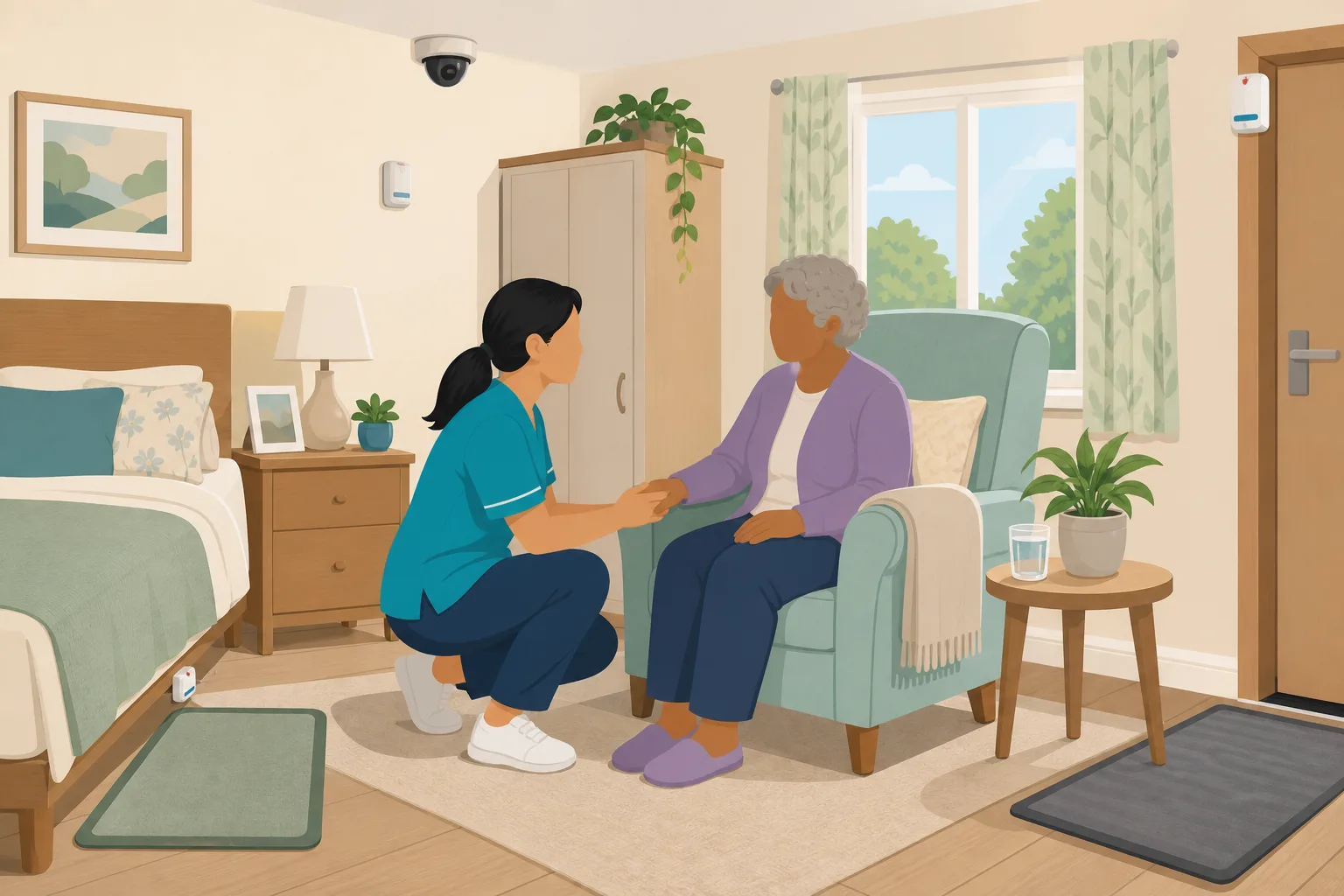
CCTV, Surveillance and Monitoring Technology Policy
A care home CCTV policy template written for you, covering cameras, sensor mats and door alarms: privacy, consent, best interests and data use.

Relationships, Sexuality and Sexual Safety Policy
How your service supports adult relationships and sexual expression, assesses consent and capacity, sets staff boundaries and acts on abuse concerns, written around your own practice.

Sexuality, Relationships and Intimacy Policy
How your service respects privacy, relationships and intimacy, handles consent and capacity, and acts on safeguarding concerns, written around your own practice.

Hate Crime, Mate Crime and Cuckooing Policy
Spotting and responding to hate crime, mate crime and cuckooing in people's own homes: signs, reporting, police and safeguarding links, written around your service.

Handling People's Money, Valuables and Property Policy
How your staff hold, spend, record and safeguard people's cash, cards, valuables and shopping, including appointeeship and deputies, and how financial abuse is prevented.

Tenancy, Housing and Care Separation Policy
A tenancy and care separation policy for your service: how housing and care stay distinct, who does what, and how people keep choice over where and with whom they live.
Compared
The four ways care services get a policy.
We have compared what each approach does rather than naming competitors, because products change and the comparison should still be true next year.
| CareStream | A policy pack | A consultant | A free template | |
|---|---|---|---|---|
| Questions asked at the point of purchase, so it is personalised rather than blank | ||||
| Written for your service, naming your manager and your leads | ||||
| Structured from the regulations, every required element checked before it is sent | ||||
| A branded companion document setting out the law it was written against | ||||
| Read and approved by a person before it carries your name | ||||
| Prints on your own letterhead with a sign-off and version block | ||||
| Named role holders update everywhere when the person changes | ||||
| Kept current when the law changes, and you are told what changed | ||||
| Turnaround stated before you buy | ||||
| Your staff can ask it questions in their own language | ||||
| What it costs | £39 to £79 per policy, one-off | £250 to £995 for the pack | A day rate, typically £400 upwards | Nothing |
Prices are the published rates of the common alternatives as at September 2026, for comparison only.
Training
Owning the policy is half of it
An inspector asks whether your staff understood it, not whether you hold it. Ninety eight modules written and kept current by us, to the same regulations, from £25.99 per staff member with no subscription.




