
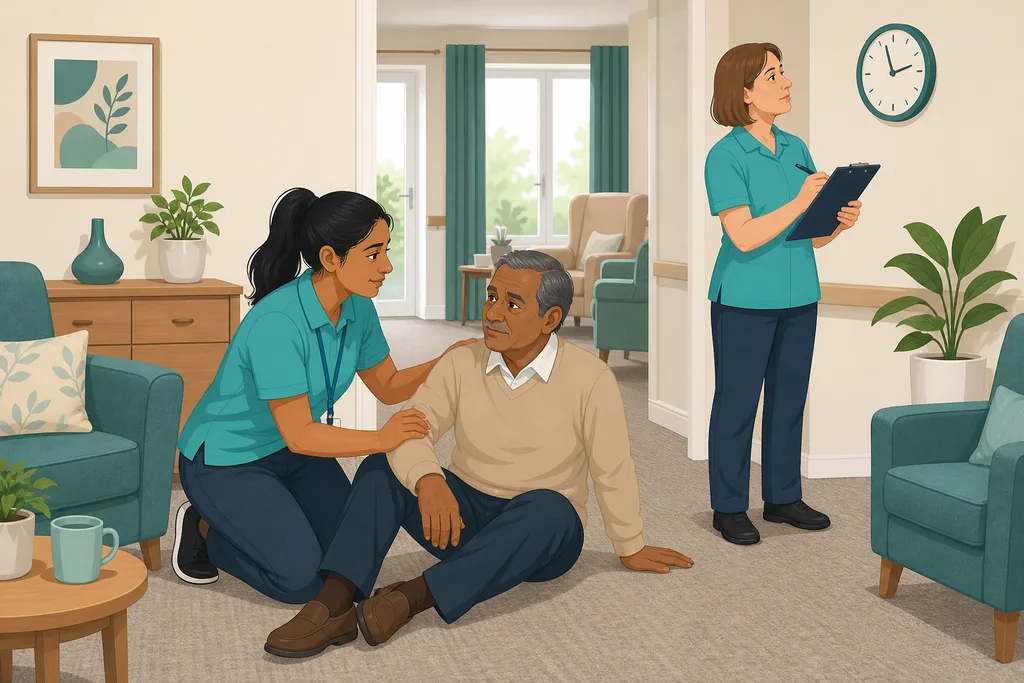
Seizures and Epilepsy Emergencies training for your team
Licence this training for just the staff who need it. No CareStream subscription, no minimum order, no annual contract. One licence covers one member of staff for the complete Seizures and Epilepsy Emergencies training, in the language they think in.
- Teach, then assessA full lesson with a real care scenario, followed by an assessment that checks they can apply it.
- Over 60 languagesStaff read the lesson and answer in their first language. Your records stay in English.
- Wrong answers get followed upA short micro-lesson goes back to the staff member on the exact point they missed, then they retry.
- Evidence you can hand overA dated completion record and a certificate per person, ready for your CQC file.
Seizures and Epilepsy Emergencies, start to finish.
This module covers how to recognise different types of seizures, respond safely during a seizure emergency, and know when to call for medical help. You will learn the specific actions to take to protect the person you support, how to time and observe seizures accurately, and how to provide appropriate care afterwards. This is the same training CareStream subscribers get, written for care settings rather than adapted from a generic course. It runs about 35 minutes and ends with a 20 question assessment.
- Understanding Seizures and Epilepsy
A seizure happens when there is sudden abnormal electrical activity in the brain.
- Responding to Tonic Clonic Seizures
Tonic clonic seizures are the most recognisable type, involving stiffening then rhythmic jerking movements, and loss of consciousness.
- Knowing When to Call 999
Most seizures stop by themselves within a few minutes and do not require an ambulance.
- Emergency Rescue Medication
Some people who experience prolonged or cluster seizures have emergency rescue medication prescribed, usually buccal midazolam or rectal diazepam.
- Recovery Phase Care
After a seizure ends, the person enters a recovery phase which can last from minutes to hours.
- Accurate Recording and Reporting
Accurate records of seizures are essential for medical management and care planning.
What your team will be able to do.
- Recognise the different types of seizures that people you support may experience
- Describe the correct steps to take during a tonic clonic seizure to keep the person safe
- Identify when a seizure becomes a medical emergency requiring 999 call
- Explain how to provide appropriate care and observation during the recovery phase after a seizure
- Apply correct timing, recording and reporting procedures following any seizure
Seizures and Epilepsy Emergencies in facts.
About 35 minutes, 6 lessons
20 questions, pass mark 80%
Every year
Yes, observed by the employer, checklist provided
What staff come away with
Seizures are caused by abnormal electrical activity in the brain and can look very different depending on the type
During a tonic clonic seizure, protect the person from injury, cushion their head, move objects away, and never put anything in their mouth
Call 999 if a seizure lasts longer than 5 minutes, if a second seizure starts before recovery, if the person is injured, or if you have any concerns
Emergency rescue medication must only be given by staff trained and assessed as competent, following the care plan exactly
After a seizure, stay with the person, monitor them closely during recovery, and do not give food or drink until they are fully alert
Record seizures accurately with exact times, detailed observations, and report immediately to the nurse or senior on duty
Three steps, and nothing to set up.
Checkout takes a minute. Your licences and a receipt arrive by email straight away.
Enter their names and emails, or paste a list. They get an invite to the hub on any device.
You see who has finished, their score, and their certificate as each one comes in.
Everything a licence includes.
Dated, named, and downloadable as a PDF for your training file.
Over 60 languages, chosen per staff member. Your reporting stays in English.
Buy training for one person if that is all you need. Nothing recurring.
Licences do not expire the moment you buy. Staff have a year to complete.
Before you buy.
How long does Seizures and Epilepsy Emergencies training take?
About 35 minutes, across 6 short lessons, followed by a 20 question assessment with a pass mark of 80%. Staff can stop and pick up where they left off.
What does the Seizures and Epilepsy Emergencies training cover?
6 lessons: Understanding Seizures and Epilepsy, Responding to Tonic Clonic Seizures, Knowing When to Call 999, Emergency Rescue Medication, Recovery Phase Care and Accurate Recording and Reporting. Each one pairs the teaching with a care scenario and a quick check.
How often do staff need to refresh Seizures and Epilepsy Emergencies?
CareStream sets this training so it renews every year. Staff and managers are reminded before a certificate lapses, so the refresher is booked before the gap appears.
Does Seizures and Epilepsy Emergencies need a practical assessment?
Yes. The online training is the knowledge part. Staff also need an observed assessment in the workplace, carried out by their employer, and CareStream provides the observation checklist to record it.
Do I need a CareStream subscription to buy this?
No. This page exists precisely so you do not. You buy the licences you need, your staff complete the training in the CareStream hub, and that is the end of it. There is no trial to start, no card kept on file, and no subscription that begins quietly afterwards.
If you later decide you want the full platform, anything your staff have already completed carries across into your account.
What does one licence actually cover?
One licence covers one named member of staff for this training, including the lesson, the assessment, any follow-up questions triggered by a wrong answer, and their certificate. Licences are not shared between people, because the completion record has to belong to an individual to be worth anything at inspection.
How quickly can staff start?
Immediately. The licences are on your account as soon as the payment clears, and staff get their invite the moment you add them. There is no onboarding call and no setup period.
Can staff complete it in another language?
Yes. Each staff member has a first language on their profile, and the lesson, the questions and the feedback all arrive in it. They answer in that language too. What you see as a manager stays in English, so the record reads the same whoever completed it.
What if someone fails the assessment?
Nothing is lost. A wrong answer triggers a short follow-up lesson on that specific point, and they retry it. The record shows the improvement from the first attempt to the latest, which is stronger evidence than a single pass mark, because it shows the gap was found and closed.
Can I buy for more than one service?
Yes. Buy the total number of licences you need and allocate them across your services when you add staff. If you are licensing for a group and want an invoice rather than a card payment, get in touch and we will raise one.
Licence any of these the same way.
Same price, same terms, no subscription needed.




