
 Medicines In Possession and Custody Medicines Policy (prison healthcare)November offerMovember: 15% off every policy · ends 22 Nov Add to basket
- 70elements checked
- 2 daysto deliver
- 6laws and standards
- 1 yearof updates
When you need this policy
- Someone arrives with their own medicinesSets out who assesses whether the person can keep medicines, how the decision is recorded and how it links to the safe management of medicines duty in Regulation 12.
- Held medicines are shared or tradedCovers your checks for hoarding and diversion, what happens when medicines go missing, and how concerns about safety are escalated and recorded. It also sets out supervised administration of medicines where a person cannot hold their own.
- A person's circumstances changeExplains when possession decisions are reviewed, such as a new prescription or a change in risk, and how patient self administration of medication is stopped or supervised.
- Storage and stock need checkingRecords your safe storage of medicines policy: lockable storage, stock handling, controlled drugs under the Misuse of Drugs Act 1971, and who audits the records.
Build it now: 19 questions, about three minutes
Let's build your Medicines In Possession and Custody Medicines Policy (prison healthcare)
Answer 19 quick questions, about three minutes, and we'll write this policy for your service, in your name, with your people. You can skip anything and add it later.
Asked once, reused for every policy you buy
That's everything we need
0 of 19 answered. You can add the rest at any point before we write it.
- Registered company name
- Trading name (if different)
- Service address
- CQC provider ID
- CQC location ID
- Registered manager
- Nominated individual
- In possession risk assessment
- Possession categories used
- Review triggers
- Medicines never held in possession
- Secure storage arrangements
- Supervised administration process
- Diversion and trading checks
- Lost or misused medicines
- Liaison with custody staff
- Transfers and releases
- Records and audit
- Staff competence and training
Your answers are saved on this device and carried into your order.
Built from the law, checked against the law
The legislation, CQC standards and guidance we analyse to write it.
Your Medicines In Possession and Custody Medicines Policy (prison healthcare) is structured from these regulations, then verified against every required element of each one before a person signs it off. If the law changes, your policy is updated and you are told what changed and why.
Medicines Act 1968
- Prohibits staff from transferring medicines between residents, including using one resident's labelled medicine for another resident, even in emergencies or to prevent supply shortages
- Requires medicines to be administered exactly as prescribed on the label or MAR chart, with explicit prohibition of crushing, opening capsules, altering timing, or adjusting doses without prescriber authorisation
- Establishes a formal covert administration protocol requiring capacity assessment, best interests decision, pharmacist review of medicine suitability, prescriber authorisation, family consultation, written plan and review date before any covert administration begins
- Requires a signed homely remedies protocol from a GP or pharmacist for any over-the-counter medicines (such as paracetamol) kept in the home, specifying dose limits, duration limits, and requiring each administration to be recorded
- Requires MAR charts to be signed at the point of administration (when medicine goes in the resident's mouth), with explicit prohibition of signing in advance or completing records retrospectively at end of round
- Prohibits staff from dispensing, relabelling, or transferring medicines into the home's own compliance aids or dosette boxes

Misuse of Drugs Act 1971
- Distinguishes whether the facility operates as a nursing home (where controlled drugs belong to the home and full regulatory regime applies) or residential home (where controlled drugs belong to individual residents) and states the corresponding legal obligations for storage, registers, and disposal
- Prohibits the supply or transfer of controlled drugs between residents under any circumstances, including emergency situations, identifying this as a criminal offence under section 4 of the Misuse of Drugs Act
- Establishes procedures for anticipatory prescribing, pharmacy relationships, and stock management to prevent situations where prescribed controlled drugs are unavailable when needed
- Specifies that controlled drug registers are maintained as bound books with entries in ink made on the same day or next day, with corrections made only by signed and dated marginal notes (never overwritten, tippexed, or with pages removed)
- Defines that two-signature checks (where implemented as good practice) require the second signatory to have actually witnessed the administration, not merely co-sign, and clarify this creates an evidential record
- Treats any discrepancy in controlled drug running balance as a potential error, theft, or diversion requiring investigation and documented determination of cause, not dismissal as a counting mistake

Regulation 12: Safe care and treatment
- Requires individual risk assessments for each resident (not generic policies) that identify specific risks to that person's health and safety
- Defines 'reasonably practicable' mitigation measures, clarifying that cost, time and trouble must be grossly disproportionate to the risk before a safety measure can be refused
- Requires assessment of staff competence on specific equipment with specific residents (e.g. this hoist, this sling, this resident), not just training attendance certificates
- Requires Medication Administration Record (MAR) charts to be signed at the point of administration (when tablet goes in resident's mouth) and include reconciliation procedures before first dose after hospital admission or return
- Requires a PRN (as required medication) protocol for every PRN medicine for every individual resident
- Establishes infection prevention and control procedures including staff exclusion rules (e.g. staff with diarrhoea must not return within 24 hours) and clarifies that dipstick tests are not diagnoses

Regulation 13: Safeguarding service users from abuse and improper treatment
- Definition and recognition criteria for all forms of abuse covered: physical, emotional, sexual, financial, discriminatory abuse, neglect, and improper treatment
- System for immediate internal investigation by the provider upon becoming aware of any safeguarding concern, operating independently of external section 42 enquiries
- Comprehensive register of all restrictions and restraints applied to each resident (including physical devices, chemical restraint, environmental controls, door codes, and manual guidance) with documented justification for necessity, proportionality, and evidence that less restrictive options were considered
- Clear reporting procedures including timescales for escalation to management, external safeguarding authorities, CQC notification requirements, and circumstances triggering police involvement
- Mandatory DBS referral procedure under section 35 Safeguarding Vulnerable Groups Act 2006 when staff are dismissed or resign in circumstances where dismissal would have occurred due to safeguarding concerns
- Safeguarding controls for residents' finances including handling of personal allowances, cash, possessions, and prevention of financial abuse by family members or others with access to residents' money

Regulation 17: Good governance
- Mandates that all care records are written contemporaneously (at the time events occur), not retrospectively, and must prohibit altering or completing records after the fact to prevent unlawful falsification of documentation
- Establishes a schedule of regular audits across all areas of care delivery (including medicines, care plans, infection control, falls, safeguarding) specifying that audits must be conducted by personnel who did not deliver the care being audited
- Requires that data from incidents, falls, complaints, and safeguarding events be trended and analysed for patterns (e.g. time of day, staffing levels, location) rather than simply counted as numbers
- Mandates that the same event must be cross-referenced and appear in all relevant logs (complaints log, safeguarding log, incident log, whistleblowing log) to ensure no events fall through gaps in reporting
- Establishes that action plans arising from audits, incidents, or complaints must have fixed completion dates that are not repeatedly rolled forward, and actions must be evidenced as closed with documentary proof
- Requires that feedback from residents, families, and staff be actively sought, that response rates be monitored for representativeness, and that recurring themes must trigger documented action within a defined timeframe

RPS professional guidance on the safe and secure handling of medicines
- Identifies a named individual at board or senior leadership level who is accountable for medicines risk across the organisation, distinct from operational staff who administer medicines
- Defines the process for professional engagement with the supplying community pharmacy, including sharing of medication error data and reconciliation issues
- Establishes an audit trail system that tracks each individual medicine from receipt at the care home door through storage, administration and disposal, including running balances that distinguish recording errors from actual losses
- Specifies the requirements for witnessed destruction of Schedule 2 controlled drugs, identifying that an authorised witness (not simply a second staff member) is required and documenting who holds this authorisation
- Includes a resident self-administration assessment and support procedure that respects residents' rights under Regulation 9 to manage their own medicines where they have capacity and wish to do so, including risk assessment and secure personal storage arrangements
- Defines the medicines reconciliation process that must occur before first dose administration when residents are admitted or return from hospital, specifying what constitutes a reliable source for verification when discharge information conflicts with supplied medicines

Written for your service
What we ask you, so none of it is assumed.
Most policy packs are one document sold to everyone with a find and replace on the home name. Your Medicines In Possession and Custody Medicines Policy (prison healthcare) is written from the legislation above and from your answers to the questions below. Where you have told us something, it says so. Where you have not, it sets out what must happen rather than claiming you already do it.
Your registered name, address, CQC numbers and who holds the key roles. About three minutes. Nothing else is asked before you buy.
Asked once in your own account and used across every policy you own, so a second policy never asks you the same thing twice.
Why it matters. A policy that claims you assess your premises annually, when you never have, is not a harmless overstatement. It is a signed statement handed to your inspector. We would rather write what you must do than guess what you already do.
How it is made
From your details to a policy you can stand behind.
The short questions above: who you are, your CQC registration, and the people this policy names.
One section per required element of the legislation, in your name, with your people.
Automated checks against every required element, then a person reads it before it ships.
When legislation changes, your policy is updated and you are told what changed and why.
Common questions
What you are actually buying.
What exactly do I receive?
A complete Medicines In Possession and Custody Medicines Policy (prison healthcare) written for your organisation, in your dashboard and as a print-ready PDF on your own letterhead. It names your service, your registration details and your leads, because you gave us them.
Is this a template?
No. Each policy is written for the organisation buying it, structured from the legislation itself, verified against 70 required regulatory elements, and read by a person before it carries your name.
How quickly will I get it?
Within 2 working days of you completing the short questions above. Most arrive sooner.
What happens when the law changes?
We monitor UK care legislation continuously. When something affecting this policy changes, your copy is updated and you are told what changed and why. The first year of updates is included, then £12 a year per policy.
Can I edit the policy myself?
No, and deliberately so: we stand behind every word we approve. If something needs changing, tell us and we amend and re-verify it, so it always remains a document we can both defend to an inspector.
What if I need more than one policy?
Most services do. The Statutory Starter Pack covers the twenty policies every CQC-registered service is expected to hold, and the Complete Policy Library covers all 148.
Is a self administration of medicines policy a legal requirement?
No single law requires a policy with that name. Regulation 12 requires the proper and safe management of medicines, and Regulation 17 requires good governance. A written policy shows how your service meets these duties.
Does the policy cover prison and custody settings?
It is written around your answers, so it can set out in possession arrangements for secure and custody healthcare. NHS England describes equivalence of care for people in the justice system, and the policy reflects your own arrangements.
What is a medicines in possession policy?
It sets out how your service decides which people may keep their own medicines, which doses are supervised, and how storage, records and reviews work. It records your arrangements, not clinical decisions.
Does it include supervised doses and storage?
Yes. The in possession medication policy covers supervised administration, secure storage, diversion checks and records, using the process you describe. Clinical decisions about a person stay with their prescriber.
Does the policy cover controlled drugs?
It records how controlled drugs are kept outside possession and handled in line with the Misuse of Drugs Act 1971, using your own storage and recording arrangements.
Is the policy clinical or legal advice?
No. It sets out your organisation's own arrangements for medicines in possession. Clinical decisions stay with qualified professionals, and legal questions with a legal adviser.
Why CareStream
Policies written the way an inspector expects to read them.
Before you buy
What the document actually looks like.
Every section it contains, and a page of the real thing. We show the structure and the personalisation rather than the wording, because the wording is what you are paying us to write for your service.
Contents of your Medicines In Possession and Custody Medicines Policy (prison healthcare)
- Purpose and scopewho it covers
- Legal and regulatory frameworkcited in full
- Definitions used in this policy
- Roles and responsibilitiesyour people, named
- Procedure, step by step
- Recording, reporting and escalation
- Training and competency
- Monitoring, audit and review
- Related policies and documents
- Version control and approvalsigned and dated
Section 4 · Roles and responsibilities
Who is accountable, by name
Overall accountability for this policy rests with your registered manager, supported by your nominated individual. Day to day responsibility sits with your named lead, who is the first point of contact for staff at your service address.
The remaining wording is written for the organisation buying it, so it is not shown here.
“The inspector asked for evidence and I had it on screen before she finished the sentence.”
Registered Manager · 48-bed nursing home, West SussexRelated policies
More policies your service may need.
More statutory and operational policies CareStream writes for your service, personalised, human-reviewed and kept updated, exactly like this one.
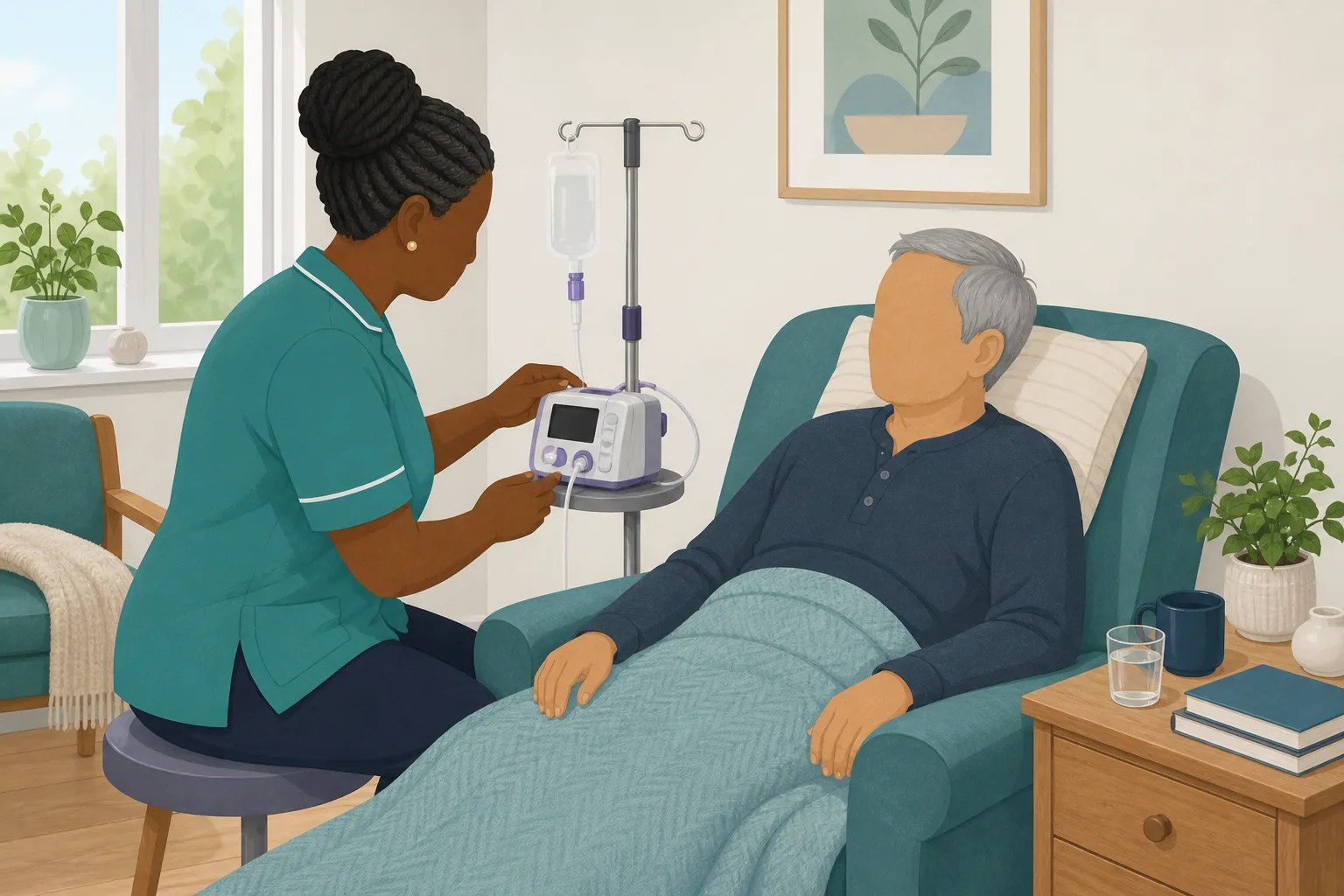
Syringe Driver and Anticipatory Medicines Policy
Syringe driver set up, monitoring and anticipatory medicines, from prescribing and stock to competence and 24 hour access, written for your hospice.

Medicines Management Policy
Ordering, storage, administration, recording and disposal of medicines, including errors and self-administration.

Reducing Restrictive Practice and Restraint Reduction Policy
A service wide plan for reducing restrictive practice: monitoring, post incident debrief, review of every restriction and governance oversight.

Shared Lives Carer Approval, Matching and Household Review Policy
A Shared Lives policy for your scheme: how carers are recruited and approved, how people are matched, how households are reviewed, and how an arrangement ends.

Self-harm, Suicide and Ligature Risk Policy
A ligature risk policy written for your hospice: self-harm and suicide risk assessment, environmental ligature checks, observation, response and review, set out in your own words.

Controlled Drugs Policy
Receipt, storage, administration, recording and destruction of controlled drugs.
Compared
The four ways care services get a policy.
We have compared what each approach does rather than naming competitors, because products change and the comparison should still be true next year.
| CareStream | A policy pack | A consultant | A free template | |
|---|---|---|---|---|
| Questions asked at the point of purchase, so it is personalised rather than blank | ||||
| Written for your service, naming your manager and your leads | ||||
| Structured from the regulations, every required element checked before it is sent | ||||
| A branded companion document setting out the law it was written against | ||||
| Read and approved by a person before it carries your name | ||||
| Prints on your own letterhead with a sign-off and version block | ||||
| Named role holders update everywhere when the person changes | ||||
| Kept current when the law changes, and you are told what changed | ||||
| Turnaround stated before you buy | ||||
| Your staff can ask it questions in their own language | ||||
| What it costs | £39 to £79 per policy, one-off | £250 to £995 for the pack | A day rate, typically £400 upwards | Nothing |
Prices are the published rates of the common alternatives as at September 2026, for comparison only.
Training
Owning the policy is half of it
An inspector asks whether your staff understood it, not whether you hold it. Ninety eight modules written and kept current by us, to the same regulations, from £25.99 per staff member with no subscription.




