
 Missing Person, Absconding and Absence from Support PolicyNovember offerMovember: 15% off every policy · ends 22 Nov Add to basket
- 85elements checked
- 2 daysto deliver
- 7laws and standards
- 1 yearof updates
When you need this policy
- Someone is not where expectedSets out your search steps, who leads, and when to call the police and family, using your own thresholds. A missing person policy and missing resident procedure staff can follow under pressure.
- A person is at risk of leaving unsupportedCovers risk assessment and mitigation under Regulation 12, and how your service reduces risk without restricting liberty beyond what is lawful and proportionate.
- Locked doors or restrictions are questionedLinks your absconding policy to capacity, best interests and Deprivation of Liberty Safeguards, as Regulation 13 says a person must not be deprived of liberty without lawful authority.
- An inspector asks what you learnedRecords how each episode is reported, reviewed and fed back into the care plan, with your own missing person procedure care home staff use, and an absconding procedure for notifications and safeguarding referrals.
Build it now: 18 questions, about three minutes
Let's build your Missing Person, Absconding and Absence from Support Policy
Answer 18 quick questions, about three minutes, and we'll write this policy for your service, in your name, with your people. You can skip anything and add it later.
Asked once, reused for every policy you buy
That's everything we need
0 of 18 answered. You can add the rest at any point before we write it.
- Registered company name
- Trading name (if different)
- Service address
- CQC provider ID
- CQC location ID
- Registered manager
- Nominated individual
- Leaving risk assessment
- Identification information held
- Building security measures
- First search steps
- Escalation thresholds
- Search leads and cover
- Independent outing routine
- Capacity and DoLS link
- Return welfare check
- Post incident review
- Recording and reporting
Your answers are saved on this device and carried into your order.
Built from the law, checked against the law
The legislation, CQC standards and guidance we analyse to write it.
Your Missing Person, Absconding and Absence from Support Policy is structured from these regulations, then verified against every required element of each one before a person signs it off. If the law changes, your policy is updated and you are told what changed and why.
Adult safeguarding under the Care Act 2014 and Care and Support Statutory Guidance
- Clear definitions of all types of abuse covered by the policy (physical, emotional, financial, sexual, discriminatory, and neglect)
- Specific signs and indicators that staff should recognise for each type of abuse and neglect
- Immediate step-by-step reporting procedure for staff to follow when they identify or suspect abuse or neglect
- Designated person or role responsible for receiving and managing safeguarding concerns within the care home
- Procedure for preserving evidence when abuse or neglect is suspected or identified
- Protocol for working with and notifying local authority safeguarding teams and other external agencies

CQC statutory notifications
- Defines the specific categories of notifiable events including deaths during care provision, serious injuries (e.g. fractures from falls), allegations of abuse or rough handling by staff, resident-on-resident incidents, suspected financial abuse by visitors or others, police attendance for any reason, DoLS applications and authorisation outcomes, and service disruptions affecting resident safety (e.g. heating failure)
- Specifies that notifications are submitted without delay regardless of other circumstances such as family notification, management availability, or ongoing investigations
- States that allegations trigger notification duty even when the provider believes the allegation to be unfounded, because the trigger is the allegation itself not its merit
- Requires notifications be submitted via CQC provider portal using official forms, not alternative methods such as email to inspectors
- Identifies a named person responsible for submitting notifications and a designated deputy to cover periods of absence
- Requires a written log of borderline decisions documenting the reasoning for why incidents were assessed as not meeting notification thresholds, recorded at the time of decision

Deprivation of Liberty Safeguards (DoLS)
- Defines the process for identifying when a deprivation of liberty may be occurring, including assessment of whether the resident is under continuous supervision and control and not free to leave
- Requires carrying out capacity assessments to determine whether a resident lacks capacity to consent to their care arrangements
- Establishes procedures for applying for DoLS authorisation from the relevant supervisory body when a deprivation of liberty is identified
- Requires maintaining a restrictions audit document listing all actual restrictions applied to each resident (door codes, bedrails, sensor mats, lap belts, covert medication, supervised visits, prevention from leaving)
- Requires recording the resident's wishes and feelings contemporaneously and repeatedly to assess whether they positively accept or acquiesce to the arrangements
- Establishes procedures for implementing care in line with any conditions attached to a DoLS authorisation

Least restrictive practice principles
- Requires individualised written assessment for each restriction applied to each resident (e.g. bedrail, keypad lock, lap belt, sensor mat, low bed, restrictive chair, medication, locked doors, money held by staff, prevented exit), naming the specific harm, likelihood of that harm, and why the restriction is proportionate for that individual resident
- Requires documented evidence that less restrictive alternatives have been actively tried and evaluated before any restrictive measure is implemented, with specific detail of what alternatives were considered and tested
- Prohibits blanket restrictions (e.g. all doors locked, all residents prevented from going out unaccompanied, all money held centrally) and requires that any environmental or procedural restriction is justified individually for each resident
- Requires capacity assessment for each decision where restriction is proposed, and where resident has capacity to make the decision (even if unwise), their decision must be respected and documented
- Requires that where a resident lacks capacity, any restrictive intervention is subject to a documented best interests decision under Mental Capacity Act section 4, including the resident's wishes and feelings and consultation with people who know them
- Requires that restraint (including physical intervention, equipment, medication, environmental controls) is only used where staff reasonably believe it necessary to prevent harm to the resident, and is proportionate to the likelihood and seriousness of that harm, documented for that resident on that specific occasion

Mental Capacity Act 2005
- States that capacity is assessed decision-specific and time-specific, not once on admission or generically, and by the person making the decision
- Requires that before concluding a resident lacks capacity, all practicable steps are taken to support the decision (hearing aids, glasses, interpreter, easy-read information, appropriate time of day, quiet location, repeated attempts, trusted person present)
- Confirms that residents retain the right to make unwise decisions and that disagreement with a decision does not constitute evidence of incapacity
- Defines restraint by what is actually happening (keypads, bedrails, sensor mats, lap belts, covert medication) and requires that each is lawful only if staff reasonably believe it necessary and proportionate to prevent harm
- Requires best interests decisions to be based on the individual resident's wishes, feelings, beliefs and values, with consultation of people who know them, not what is medically optimal or what the home prefers
- Requires instruction of an Independent Mental Capacity Advocate (IMCA) when there is nobody to consult and the decision is serious

Regulation 12: Safe care and treatment
- Requires individual risk assessments for each resident (not generic policies) that identify specific risks to that person's health and safety
- Defines 'reasonably practicable' mitigation measures, clarifying that cost, time and trouble must be grossly disproportionate to the risk before a safety measure can be refused
- Requires assessment of staff competence on specific equipment with specific residents (e.g. this hoist, this sling, this resident), not just training attendance certificates
- Requires Medication Administration Record (MAR) charts to be signed at the point of administration (when tablet goes in resident's mouth) and include reconciliation procedures before first dose after hospital admission or return
- Requires a PRN (as required medication) protocol for every PRN medicine for every individual resident
- Establishes infection prevention and control procedures including staff exclusion rules (e.g. staff with diarrhoea must not return within 24 hours) and clarifies that dipstick tests are not diagnoses

Regulation 13: Safeguarding service users from abuse and improper treatment
- Definition and recognition criteria for all forms of abuse covered: physical, emotional, sexual, financial, discriminatory abuse, neglect, and improper treatment
- System for immediate internal investigation by the provider upon becoming aware of any safeguarding concern, operating independently of external section 42 enquiries
- Comprehensive register of all restrictions and restraints applied to each resident (including physical devices, chemical restraint, environmental controls, door codes, and manual guidance) with documented justification for necessity, proportionality, and evidence that less restrictive options were considered
- Clear reporting procedures including timescales for escalation to management, external safeguarding authorities, CQC notification requirements, and circumstances triggering police involvement
- Mandatory DBS referral procedure under section 35 Safeguarding Vulnerable Groups Act 2006 when staff are dismissed or resign in circumstances where dismissal would have occurred due to safeguarding concerns
- Safeguarding controls for residents' finances including handling of personal allowances, cash, possessions, and prevention of financial abuse by family members or others with access to residents' money

Written for your service
What we ask you, so none of it is assumed.
Most policy packs are one document sold to everyone with a find and replace on the home name. Your Missing Person, Absconding and Absence from Support Policy is written from the legislation above and from your answers to the questions below. Where you have told us something, it says so. Where you have not, it sets out what must happen rather than claiming you already do it.
Your registered name, address, CQC numbers and who holds the key roles. About three minutes. Nothing else is asked before you buy.
Asked once in your own account and used across every policy you own, so a second policy never asks you the same thing twice.
Why it matters. A policy that claims you assess your premises annually, when you never have, is not a harmless overstatement. It is a signed statement handed to your inspector. We would rather write what you must do than guess what you already do.
How it is made
From your details to a policy you can stand behind.
The short questions above: who you are, your CQC registration, and the people this policy names.
One section per required element of the legislation, in your name, with your people.
Automated checks against every required element, then a person reads it before it ships.
When legislation changes, your policy is updated and you are told what changed and why.
Common questions
What you are actually buying.
What exactly do I receive?
A complete Missing Person, Absconding and Absence from Support Policy written for your organisation, in your dashboard and as a print-ready PDF on your own letterhead. It names your service, your registration details and your leads, because you gave us them.
Is this a template?
No. Each policy is written for the organisation buying it, structured from the legislation itself, verified against 85 required regulatory elements, and read by a person before it carries your name.
How quickly will I get it?
Within 2 working days of you completing the short questions above. Most arrive sooner.
What happens when the law changes?
We monitor UK care legislation continuously. When something affecting this policy changes, your copy is updated and you are told what changed and why. The first year of updates is included, then £12 a year per policy.
Can I edit the policy myself?
No, and deliberately so: we stand behind every word we approve. If something needs changing, tell us and we amend and re-verify it, so it always remains a document we can both defend to an inspector.
What if I need more than one policy?
Most services do. The Statutory Starter Pack covers the twenty policies every CQC-registered service is expected to hold, and the Complete Policy Library covers all 148.
What should a missing person policy cover?
It should cover risk assessment, prevention, the immediate search, who is contacted and when, what happens on return, recording and review. CareStream writes each section from your own answers about your service.
Is a missing person policy care home version different from supported living?
Yes. A care home often has a secured building and grounds. Supported living usually means people go out freely, so the policy centres on agreed absence times, check ins and risk reviews. Your answers set which applies.
Does an absconding policy mean locking people in?
No. Regulation 13 says people must not be deprived of liberty without lawful authority. The policy sets out proportionate steps and links to capacity assessment and DoLS, so restrictions are never invented.
When do we call the police?
That is your own decision point. The policy records the thresholds you set, such as time elapsed or level of risk, and who makes the call. We write what you tell us.
How is this different from a missing person policy template?
A template is the same for everyone. A missing resident policy from CareStream, like this missing person policy is written from your answers on doors, search roles, escalation and review, then read by a person.
Does it cover people who go out independently?
Yes. It can set out sign out, agreed return times and check ins, so independence is supported and an absence that is out of pattern is recognised and followed up.
Why CareStream
Policies written the way an inspector expects to read them.
Before you buy
What the document actually looks like.
Every section it contains, and a page of the real thing. We show the structure and the personalisation rather than the wording, because the wording is what you are paying us to write for your service.
Contents of your Missing Person, Absconding and Absence from Support Policy
- Purpose and scopewho it covers
- Legal and regulatory frameworkcited in full
- Definitions used in this policy
- Roles and responsibilitiesyour people, named
- Procedure, step by step
- Recording, reporting and escalation
- Training and competency
- Monitoring, audit and review
- Related policies and documents
- Version control and approvalsigned and dated
Section 4 · Roles and responsibilities
Who is accountable, by name
Overall accountability for this policy rests with your registered manager, supported by your nominated individual. Day to day responsibility sits with your named lead, who is the first point of contact for staff at your service address.
The remaining wording is written for the organisation buying it, so it is not shown here.
“The inspector asked for evidence and I had it on screen before she finished the sentence.”
Registered Manager · 48-bed nursing home, West SussexRelated policies
More policies your service may need.
More statutory and operational policies CareStream writes for your service, personalised, human-reviewed and kept updated, exactly like this one.

Dementia Care Policy
Person centred dementia care: knowing each person, communication, distress, leaving unsupported, activity, capacity and end of life, written around your service.

Reducing Restrictive Practice and Restraint Reduction Policy
A service wide plan for reducing restrictive practice: monitoring, post incident debrief, review of every restriction and governance oversight.
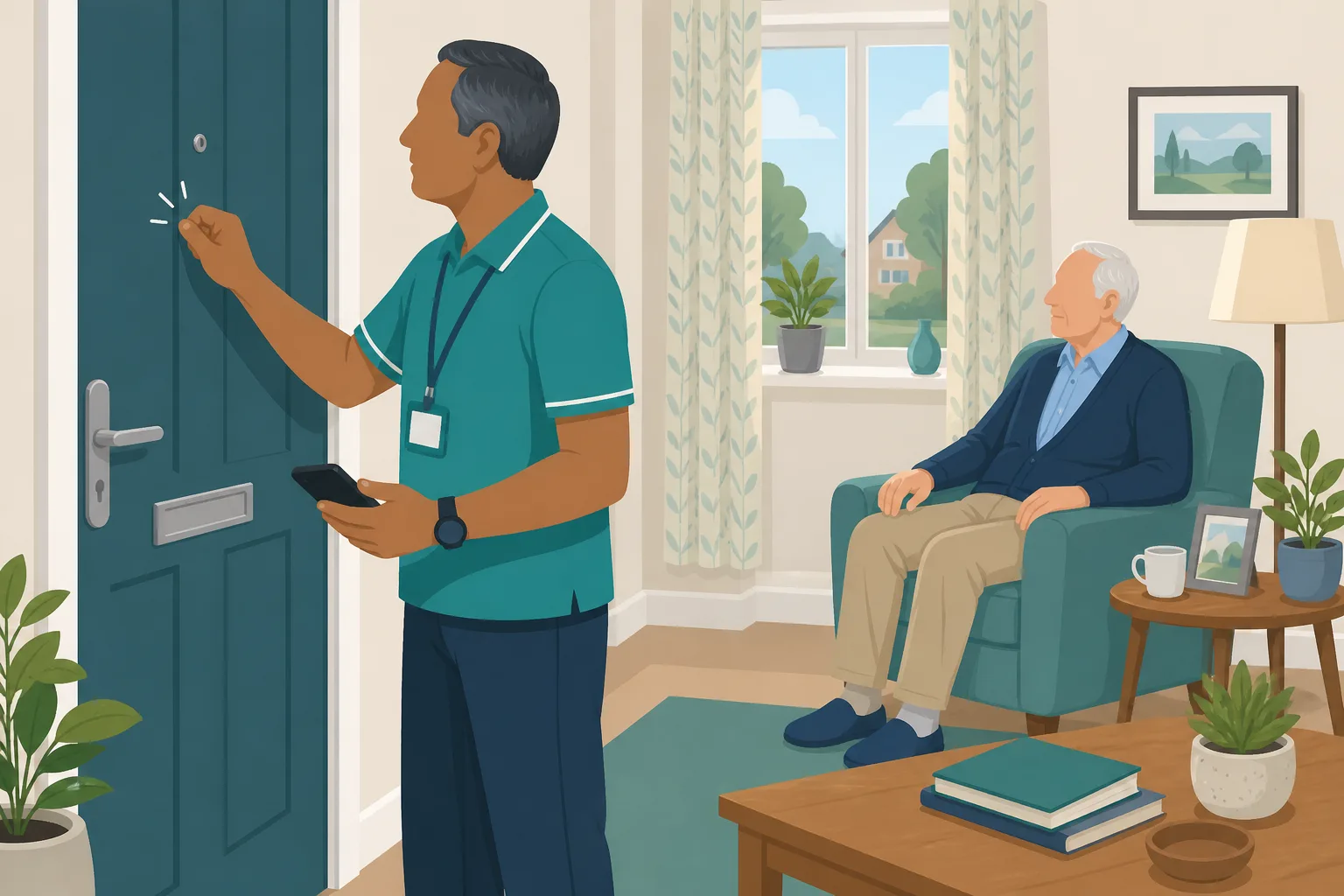
No Access and Concern for Welfare Policy
What staff do when no one answers the door: retries, key holders, contacts, police and ambulance, recording and notifications, written around how your service works.

Self-harm, Suicide and Ligature Risk Policy
A ligature risk policy written for your hospice: self-harm and suicide risk assessment, environmental ligature checks, observation, response and review, set out in your own words.

STOMP and Psychotropic Medicines Reduction Policy
Non-drug options, PRN psychotropic use, structured reviews and safe reduction plans, written around how your service supports people.

Hate Crime, Mate Crime and Cuckooing Policy
Spotting and responding to hate crime, mate crime and cuckooing in people's own homes: signs, reporting, police and safeguarding links, written around your service.
Compared
The four ways care services get a policy.
We have compared what each approach does rather than naming competitors, because products change and the comparison should still be true next year.
| CareStream | A policy pack | A consultant | A free template | |
|---|---|---|---|---|
| Questions asked at the point of purchase, so it is personalised rather than blank | ||||
| Written for your service, naming your manager and your leads | ||||
| Structured from the regulations, every required element checked before it is sent | ||||
| A branded companion document setting out the law it was written against | ||||
| Read and approved by a person before it carries your name | ||||
| Prints on your own letterhead with a sign-off and version block | ||||
| Named role holders update everywhere when the person changes | ||||
| Kept current when the law changes, and you are told what changed | ||||
| Turnaround stated before you buy | ||||
| Your staff can ask it questions in their own language | ||||
| What it costs | £39 to £79 per policy, one-off | £250 to £995 for the pack | A day rate, typically £400 upwards | Nothing |
Prices are the published rates of the common alternatives as at September 2026, for comparison only.
Training
Owning the policy is half of it
An inspector asks whether your staff understood it, not whether you hold it. Ninety eight modules written and kept current by us, to the same regulations, from £25.99 per staff member with no subscription.




