
 Health Action Plans, Annual Health Checks and Hospital Passports PolicyNovember offerMovember: 15% off every policy · ends 22 Nov Add to basket
- 72elements checked
- 2 daysto deliver
- 6laws and standards
- 1 yearof updates
When you need this policy
- A person is due an annual health checkSets out how the annual health check learning disability staff support is prompted, booked, prepared for and followed up, based on NHS England guidance that people aged 14 and over can have one.
- Staff ask what goes in a health action planYour health action plan policy says who writes it with the person, the format, and when it is reviewed. It is your own process, not a health action plan template to fill in.
- Someone is admitted to hospital at short noticeCovers the hospital passport, also called a health passport learning disability services use: what it holds, where it is kept, who takes it, and who stays with the person. It is not a hospital passport template, it is your arrangements in writing.
- An inspector asks how health needs are metShows how you assess risk and work with other services, the duty in Regulation 12(2)(i), and make reasonable adjustments under Regulation 9(3)(h).
Build it now: 19 questions, about three minutes
Let's build your Health Action Plans, Annual Health Checks and Hospital Passports Policy
Answer 19 quick questions, about three minutes, and we'll write this policy for your service, in your name, with your people. You can skip anything and add it later.
Asked once, reused for every policy you buy
That's everything we need
0 of 19 answered. You can add the rest at any point before we write it.
- Registered company name
- Trading name (if different)
- Service address
- CQC provider ID
- CQC location ID
- Registered manager
- Nominated individual
- Register check method
- Health check booking
- Health check preparation
- Accompaniment arrangements
- Health action plan format
- Plan review schedule
- Hospital passport format
- Hospital admission support
- Usual reasonable adjustments
- Screening and checks support
- Consent and best interests
- Declined or missed checks
Your answers are saved on this device and carried into your order.
Built from the law, checked against the law
The legislation, CQC standards and guidance we analyse to write it.
Your Health Action Plans, Annual Health Checks and Hospital Passports Policy is structured from these regulations, then verified against every required element of each one before a person signs it off. If the law changes, your policy is updated and you are told what changed and why.
Accessible Information Standard (DCB1605)
- Requires asking every resident or person using the service about their information and communication support needs at the first interaction or earliest opportunity (pre-admission assessment, first home visit, or initial care planning), with the person defining their own needs rather than staff inferring them from a diagnosis
- Requires recording needs as specific support requirements and methods (e.g. 'reads 18pt print', 'uses British Sign Language', 'needs easy read with photographs') rather than recording only the underlying impairment or disability label
- Requires use of the coded data items associated with the standard's four subsets where electronic systems use SNOMED CT, Read v2 or CTV3
- Requires that recorded needs are flagged with a highly visible alert (banner on electronic record, symbol on care plan cover, notation on handover sheet) that prompts staff to act whenever the record is accessed
- Requires sharing recorded needs with other NHS and adult social care providers (hospitals, ambulance services, GPs, other care services) where there is consent or permission to do so
- Requires meeting recorded needs in practice across all information and communications the service produces, including care plans, reviews, risk assessments, consent forms, medication information, menus, activity schedules, house rules, tenancy/contract documents, complaints procedures, and safeguarding information

Common law duty of confidentiality
- Defines circumstances when information may be disclosed without consent: legal obligation, court order, overriding public interest (including safeguarding), and informed consent obtained from the resident
- Requires that all disclosures of personal information are recorded in writing, documenting who disclosed what information, to whom, when, why the disclosure was lawful, and the reasoning behind the decision
- Establishes protocols for responding to requests for resident information from family members or visitors, including verifying consent, confirming legal authority (e.g. health and welfare Lasting Power of Attorney), or determining best interests before disclosure
- Requires secure storage of all records (care plans, medical records, personal details) to prevent unauthorised access, including physical security measures and system access controls
- Prohibits staff from discussing residents in settings where they may be overheard (corridors, public areas, outside work premises) and require private locations for handovers and clinical discussions
- Prohibits posting any information, images, or references about residents on social media or public platforms, including after a resident's death

Equality Act 2010
- Identifies all nine protected characteristics covered by the Equality Act 2010: age, disability, gender reassignment, race, religion or belief, sex, sexual orientation, marriage and civil partnership, and pregnancy and maternity
- States that reasonable adjustments for residents with disabilities are anticipatory and must be made before a resident who needs them arrives, not in response to individual requests
- Specifies the procedure for responding when a resident expresses discriminatory preferences about staff characteristics (race, religion, ethnicity) including that rosters will not be changed to accommodate prejudice, and that the response involves risk assessment, care plan documentation, supervision and manager intervention
- Distinguishes between discriminatory preferences and lawful requests based on dignity (such as requests for same-sex carers for intimate care under Schedule 9 occupational requirement exception) and requires that the reasoning for accommodating or declining such requests is documented in writing
- Establishes the procedure for responding to harassment of staff by residents or third parties (including groping and racial abuse), including immediate management action, support for affected staff, and recognition of employer liability including anticipated direct liability for third-party harassment from October 2026
- Requires monitoring and analysis of discipline data, rota allocation data and promotion data by protected characteristics including ethnicity and sex to identify potentially discriminatory patterns or outcomes

Mental Capacity Act 2005
- States that capacity is assessed decision-specific and time-specific, not once on admission or generically, and by the person making the decision
- Requires that before concluding a resident lacks capacity, all practicable steps are taken to support the decision (hearing aids, glasses, interpreter, easy-read information, appropriate time of day, quiet location, repeated attempts, trusted person present)
- Confirms that residents retain the right to make unwise decisions and that disagreement with a decision does not constitute evidence of incapacity
- Defines restraint by what is actually happening (keypads, bedrails, sensor mats, lap belts, covert medication) and requires that each is lawful only if staff reasonably believe it necessary and proportionate to prevent harm
- Requires best interests decisions to be based on the individual resident's wishes, feelings, beliefs and values, with consultation of people who know them, not what is medically optimal or what the home prefers
- Requires instruction of an Independent Mental Capacity Advocate (IMCA) when there is nobody to consult and the decision is serious

Regulation 12: Safe care and treatment
- Requires individual risk assessments for each resident (not generic policies) that identify specific risks to that person's health and safety
- Defines 'reasonably practicable' mitigation measures, clarifying that cost, time and trouble must be grossly disproportionate to the risk before a safety measure can be refused
- Requires assessment of staff competence on specific equipment with specific residents (e.g. this hoist, this sling, this resident), not just training attendance certificates
- Requires Medication Administration Record (MAR) charts to be signed at the point of administration (when tablet goes in resident's mouth) and include reconciliation procedures before first dose after hospital admission or return
- Requires a PRN (as required medication) protocol for every PRN medicine for every individual resident
- Establishes infection prevention and control procedures including staff exclusion rules (e.g. staff with diarrhoea must not return within 24 hours) and clarifies that dipstick tests are not diagnoses

Regulation 9: Person-centred care
- Requires a collaborative assessment process carried out with the service user (not merely from hospital discharge summaries or records), distinguishing the initial admission assessment from the ongoing person-centred assessment that involves the person and their family over time
- Specifies how to ascertain and document the views, wishes, beliefs and values of service users who lack capacity to participate directly, including interpreting distress, behaviour and communication as expressions of preference rather than symptoms to be managed
- Requires that care plan information is presented in a format accessible to frontline staff (including agency carers) enabling them to learn key individual preferences, communication needs and care requirements within the time constraints of their shift before entering a resident's room
- Establishes a system to identify, record, flag, share and meet each resident's communication and information needs (including sensory impairments, language needs, cognitive impairment) ensuring these are visible to all staff, external carers, ambulance crews and hospital staff, not only within the care plan
- Requires event-triggered review and revision of care plans when a resident's needs change (such as falls, hospital admission, weight loss, new medication, bereavement, decline in mobility, change in continence or behaviour), not only calendar-based monthly reviews
- Addresses nutritional and hydration needs with explicit regard to wellbeing as defined in the Care Act 2014, including the resident's control over day-to-day life, personal dignity and relationships, treating mealtimes as social rather than purely clinical events

Written for your service
What we ask you, so none of it is assumed.
Most policy packs are one document sold to everyone with a find and replace on the home name. Your Health Action Plans, Annual Health Checks and Hospital Passports Policy is written from the legislation above and from your answers to the questions below. Where you have told us something, it says so. Where you have not, it sets out what must happen rather than claiming you already do it.
Your registered name, address, CQC numbers and who holds the key roles. About three minutes. Nothing else is asked before you buy.
Asked once in your own account and used across every policy you own, so a second policy never asks you the same thing twice.
Why it matters. A policy that claims you assess your premises annually, when you never have, is not a harmless overstatement. It is a signed statement handed to your inspector. We would rather write what you must do than guess what you already do.
How it is made
From your details to a policy you can stand behind.
The short questions above: who you are, your CQC registration, and the people this policy names.
One section per required element of the legislation, in your name, with your people.
Automated checks against every required element, then a person reads it before it ships.
When legislation changes, your policy is updated and you are told what changed and why.
Common questions
What you are actually buying.
What exactly do I receive?
A complete Health Action Plans, Annual Health Checks and Hospital Passports Policy written for your organisation, in your dashboard and as a print-ready PDF on your own letterhead. It names your service, your registration details and your leads, because you gave us them.
Is this a template?
No. Each policy is written for the organisation buying it, structured from the legislation itself, verified against 72 required regulatory elements, and read by a person before it carries your name.
How quickly will I get it?
Within 2 working days of you completing the short questions above. Most arrive sooner.
What happens when the law changes?
We monitor UK care legislation continuously. When something affecting this policy changes, your copy is updated and you are told what changed and why. The first year of updates is included, then £12 a year per policy.
Can I edit the policy myself?
No, and deliberately so: we stand behind every word we approve. If something needs changing, tell us and we amend and re-verify it, so it always remains a document we can both defend to an inspector.
What if I need more than one policy?
Most services do. The Statutory Starter Pack covers the twenty policies every CQC-registered service is expected to hold, and the Complete Policy Library covers all 148.
What is a health action plan policy for?
It sets out how your service helps each person to have a health action plan, who writes it with them, how it is kept up to date and how staff act on it. It is written for your service.
Who can have an annual health check?
NHS England says anyone over 14 with a learning disability can have an annual health check, and the GP needs to know about the learning disability. The policy sets out how your staff support this.
Is this a hospital passport template?
No. It is a policy written for your service that explains how a hospital passport is created, kept, shared and used. You still write each person's own passport in your own format.
Does the policy cover consent and capacity?
Yes. It sets out how consent is sought for health checks and for sharing a passport, and how the Mental Capacity Act 2005 is applied where capacity is in question, using your own process.
Does it suit care homes and Shared Lives as well as supported living?
Yes. You choose your service type when you answer the questions, and the policy reflects who supports the person, who accompanies them and how records are held.
How is a learning disability annual health check recorded?
The policy records how checks are tracked for each person, including dates, outcomes, actions taken and what happens if a check is declined or missed. You tell us the system you use.
Why CareStream
Policies written the way an inspector expects to read them.
Before you buy
What the document actually looks like.
Every section it contains, and a page of the real thing. We show the structure and the personalisation rather than the wording, because the wording is what you are paying us to write for your service.
Contents of your Health Action Plans, Annual Health Checks and Hospital Passports Policy
- Purpose and scopewho it covers
- Legal and regulatory frameworkcited in full
- Definitions used in this policy
- Roles and responsibilitiesyour people, named
- Procedure, step by step
- Recording, reporting and escalation
- Training and competency
- Monitoring, audit and review
- Related policies and documents
- Version control and approvalsigned and dated
Section 4 · Roles and responsibilities
Who is accountable, by name
Overall accountability for this policy rests with your registered manager, supported by your nominated individual. Day to day responsibility sits with your named lead, who is the first point of contact for staff at your service address.
The remaining wording is written for the organisation buying it, so it is not shown here.
“The inspector asked for evidence and I had it on screen before she finished the sentence.”
Registered Manager · 48-bed nursing home, West SussexRelated policies
More policies your service may need.
More statutory and operational policies CareStream writes for your service, personalised, human-reviewed and kept updated, exactly like this one.

Activities, Social Inclusion and Meaningful Occupation Policy
A care home activities policy covering meaningful occupation, community links, outings, and cultural and spiritual needs, written around how your home runs its programme.

Positive Risk-Taking and Enablement Policy
How your service supports informed choice and independence, weighs risk against rights, records decisions and reviews them, written around your own practice.

STOMP and Psychotropic Medicines Reduction Policy
Non-drug options, PRN psychotropic use, structured reviews and safe reduction plans, written around how your service supports people.

Admissions, Transfer and Discharge Policy
Pre-admission assessment, capacity to agree, emergency admissions, hospital transfer and return, and planned discharge, written around how your service really works.

Dementia Care Policy
Person centred dementia care: knowing each person, communication, distress, leaving unsupported, activity, capacity and end of life, written around your service.
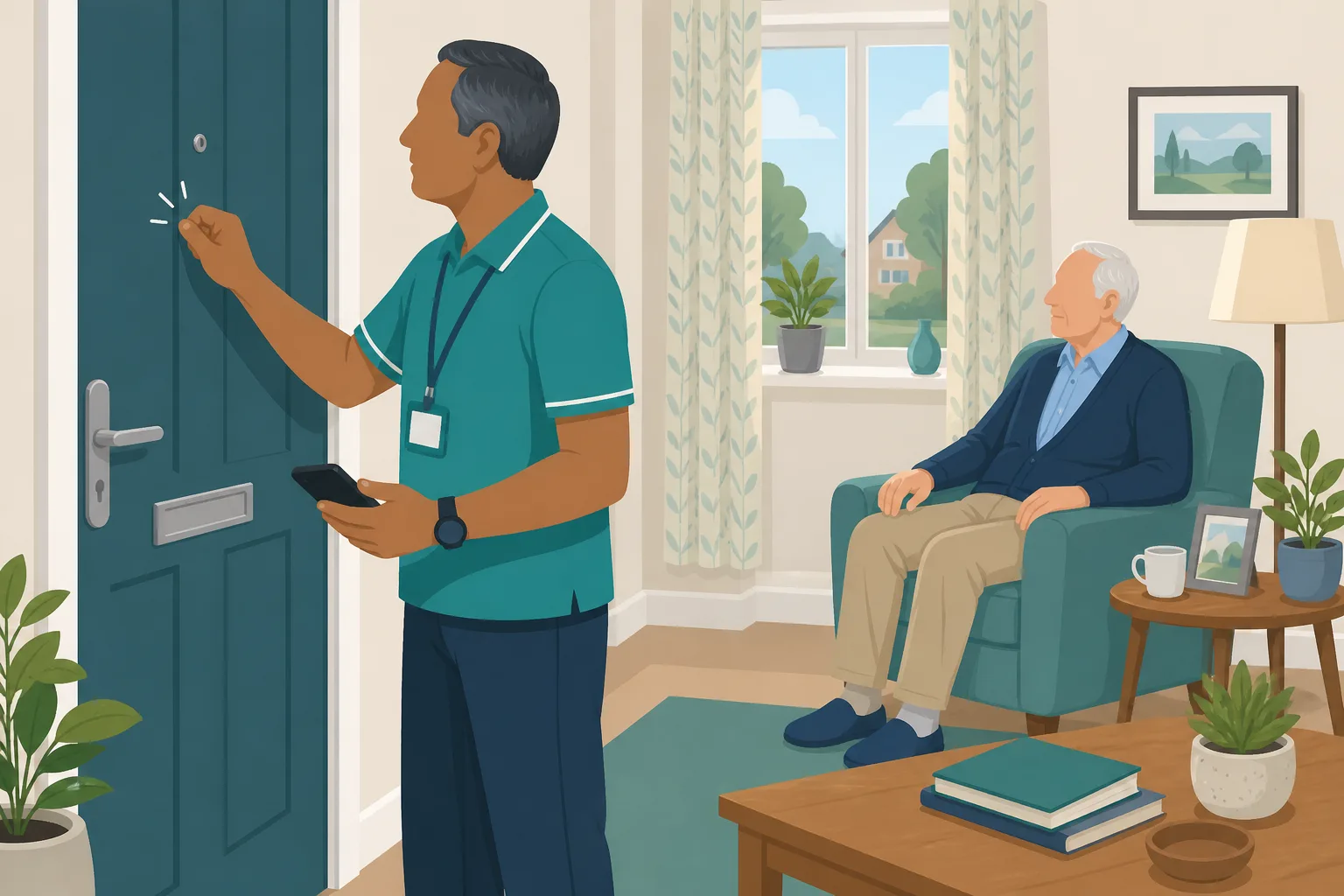
No Access and Concern for Welfare Policy
What staff do when no one answers the door: retries, key holders, contacts, police and ambulance, recording and notifications, written around how your service works.
Compared
The four ways care services get a policy.
We have compared what each approach does rather than naming competitors, because products change and the comparison should still be true next year.
| CareStream | A policy pack | A consultant | A free template | |
|---|---|---|---|---|
| Questions asked at the point of purchase, so it is personalised rather than blank | ||||
| Written for your service, naming your manager and your leads | ||||
| Structured from the regulations, every required element checked before it is sent | ||||
| A branded companion document setting out the law it was written against | ||||
| Read and approved by a person before it carries your name | ||||
| Prints on your own letterhead with a sign-off and version block | ||||
| Named role holders update everywhere when the person changes | ||||
| Kept current when the law changes, and you are told what changed | ||||
| Turnaround stated before you buy | ||||
| Your staff can ask it questions in their own language | ||||
| What it costs | £39 to £79 per policy, one-off | £250 to £995 for the pack | A day rate, typically £400 upwards | Nothing |
Prices are the published rates of the common alternatives as at September 2026, for comparison only.
Training
Owning the policy is half of it
An inspector asks whether your staff understood it, not whether you hold it. Ninety eight modules written and kept current by us, to the same regulations, from £25.99 per staff member with no subscription.




