Consent for Procedures training that gets your team CQC-ready
- CQC-aligned, mapped to the Care Certificate framework
- Completed in the hub in over 60 languages
- A certificate for every staff member, for your CQC evidence
- A wrong answer triggers a follow-up lesson, so gaps are closed
No subscription needed. Bulk discounts from 10+ licences.
From £25.99 per staff member, one-off. No subscription needed.
Trusted by UK care providers
Specialists in the technology behind it all
The same technology behind the world's best products powers CareStream, so your team's consent for procedures training stays accurate, always up to date with the latest guidance, and is delivered in over 60 languages.

The Three Elements of Valid Consent
Consent is only valid when three things exist together. First, the patient must have capacity to make this particular decision.
Second, they must be acting voluntarily, free from pressure or coercion. Third, they must have been given enough information in a form they can understand.
If any one of these is missing, consent is not valid and we cannot proceed. This applies whether consent is verbal, written or implied.
A signature on a form means nothing if the patient did not understand what they were agreeing to or felt pressured to sign.
A patient signs a consent form but later tells you she did not understand the explanation because English is not her first language and she felt too embarrassed to ask for an interpreter. Is the consent valid?
In the hub, a wrong answer sends the staff member a short follow-up lesson and a fresh question on the same point. They close the gap before they can finish the module, and every attempt is recorded for your CQC evidence.
That is how the training works. Give your whole team the full Consent for Procedures module.
Avg. Duration
About 35 minutes
Certificate
For every staff member
Available Languages (60+)
Course Published by

A clear, practical grounding in consent for procedures.
This training ensures every member of our hospital team understands that valid consent is a process, not just a signature. You will learn how consent must be informed, voluntary and given by someone with capacity, how our two stage consent process works from outpatient clinic to theatre, and how the lessons of the Paterson Inquiry shape our safeguards against over treatment in private care.
By the end, your staff will be able to:
- Identify the three essential elements that make consent valid under current law
- Explain how our hospital's two stage consent process protects patients and gives them time to reflect
- Recognise when a patient may lack capacity and describe the Mental Capacity Act steps to follow
- Apply the Montgomery standard by understanding what material risk means for individual patients
- Describe your role in safeguarding consent at each point in the patient journey from admission to theatre
A closer look at the consent for procedures module.
The module is built in short, practical sections. Each one teaches a part of the topic, then applies it to a real care scenario and checks understanding before moving on.
The Three Elements of Valid Consent
Consent is only valid when three things exist together. First, the patient must have capacity to make this particular decision. Second, they must be acting voluntarily, free from pressure or coercion. Third, they must have been given enough information in a form they can understand. If any one of these is missing, consent is not valid and we cannot proceed. This applies whether consent is verbal, written or implied. A signature on a form means nothing if the patient did not understand what they were agreeing to or felt pressured to sign.
Our Two Stage Consent Process and the Reflection Period
Our hospital uses a two stage approach that is a direct lesson from the Paterson Inquiry. Stage one happens at the outpatient appointment where the consultant discusses the diagnosis, the proposed procedure, its benefits, material risks and reasonable alternatives including doing nothing, and gives the patient written information to take away. The patient then has a defined period to reflect, ask questions, seek a second opinion and change their mind. Stage two happens on the day of admission when consent is confirmed again before anything proceeds. This reflection period protects patients from being rushed into decisions and is a safeguard against over treatment.

Material Risk and the Montgomery Standard
The Supreme Court decision in Montgomery v Lanarkshire in 2015 transformed consent law. Patients must now be told about risks that are material to them as individuals, not just risks that a body of doctors would mention. A risk is material if a reasonable person in the patient's position would attach significance to it, or if the doctor knows this particular patient would want to know about it. This means tailoring the discussion to what matters to this patient, not reciting a generic list. Patients must also be told about reasonable alternatives including the option of doing nothing.

Who Should Take Consent and Your Role in the Process
Consent should be taken by the consultant who will perform the procedure or by a colleague who genuinely understands it and can answer questions. The wider team including pre assessment nurses, ward nurses, resident medical officers, operating department practitioners and theatre staff all play a part in safeguarding consent. You must check that the consent form is complete, that the patient still understands and agrees, that the surgical site is correctly marked, and that consent is confirmed again as part of the surgical safety checklist. Anaesthetic consent is handled separately. If you have any doubt about whether consent is valid, you must raise it.

Capacity and the Mental Capacity Act
We must always start with the presumption that an adult patient has capacity to make their own decisions. Capacity is decision specific, so a person may have capacity for some decisions but not others. If you have reason to doubt capacity, a formal assessment must be done for this specific decision using the Mental Capacity Act test. Can the person understand the information, retain it, weigh it up and communicate their decision? If a person lacks capacity, we must act in their best interests following the Mental Capacity Act Code of Practice, and involve those with authority to decide such as a lasting power of attorney for health or the Court of Protection for serious decisions.

Private Care, Financial Pressures and Paterson Lessons
In private healthcare, there is a unique tension because the consultant who recommends a procedure is also paid to perform it. This creates a risk of over treatment, as the Paterson Inquiry exposed. Our safeguards include the two stage consent process with a reflection period, multidisciplinary discussion for cancer and major decisions, and treating objective unhurried consent as protection for patients. Patients must be given clear information about costs or insurance authorisation, but financial pressures must never distort clinical decisions. Patients are free to change their mind at any point, and we must respect that choice even if it means cancelling a planned procedure.

The things your team must remember.
- Valid consent requires three elements together: capacity, voluntary decision and enough information understood.
- Our two stage process gives patients a reflection period between the outpatient discussion and the day of surgery to protect them from rushed decisions.
- Material risk under Montgomery means telling patients about risks that matter to them as individuals, not just common risks.
- Everyone in the team safeguards consent by checking understanding, not just checking signatures, and raising concerns if consent seems doubtful.
- Always presume an adult has capacity unless there is reason to doubt it, then assess capacity for the specific decision using the Mental Capacity Act.
- In private care, patients must have objective unhurried consent free from financial pressure, and they can withdraw consent at any time.
Not a slideshow once a year. Training that sticks.
CareStream delivers consent for procedures training in the hub your team already uses, grounded in best practice and your own policies, so it fits your care setting and not a generic template.
Short teaching sections and a real care scenario, then an assessment that checks understanding.
Staff complete it in over 60 languages, while your records stay in English.
A wrong answer triggers a short follow-up lesson and a fresh question, so the gap is closed.
Automatic reminders at 90, 30 and 7 days, with a live compliance dashboard.
From your dashboard to your team, in the CareStream hub.
Training is delivered in the hub each staff member logs into. You allocate the modules, they complete them in their own language, and you get the completion records and certificates for your CQC evidence, with any gaps closed by automatic follow up training.
Assign Consent for Procedures to each staff member in seconds. No course builder and no setup for each person.
Staff work through the module on any device, in over 60 languages, teaching then checking understanding. A wrong answer sends a short follow up lesson.
See live completion status and a certificate for every person, ready as evidence for CQC.
Any step, in their language, in one tap.
Care teams are diverse and training should not leave anyone behind. On any lesson or question, a staff member taps the language button and the whole step flips into the language they think in. They understand it properly, and your records stay in English.
- One tap flips any lesson or question into their language, instantly.
- Over 60 languages, with no setup and no separate versions to manage.
- Completions and certificates stay in English for your CQC evidence.
Try the language buttons in the preview above.
Built for real learning, not box ticking
Every CareStream course goes further than a lesson and a quiz. These features come as standard on every course, giving your staff a richer way to learn and giving you the evidence to prove it.

Every course is built on recognised UK guidance and cites its sources, from NICE and Skills for Care to the NHS and the legislation itself.
A plain English glossary of the technical terms in each course. A simple way to support every learner, including staff with English as a second language.
A quick knowledge check before the lesson is compared with the final assessment, so every certificate comes with evidence of how much the course actually taught.
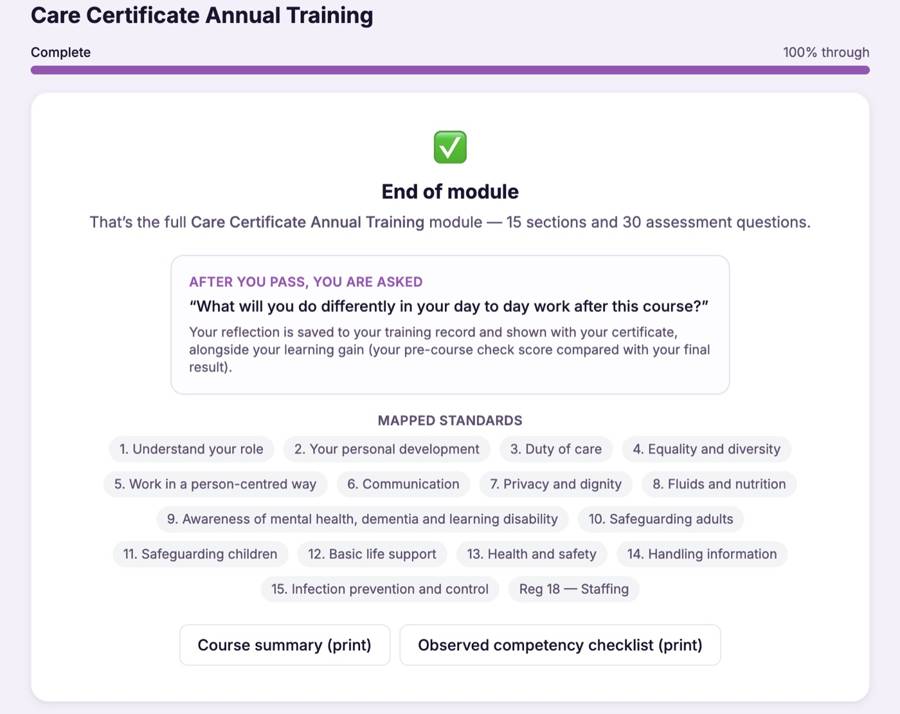
After passing, staff record what they will do differently in their day to day work. Their reflection is saved to their training record and shown with their certificate.
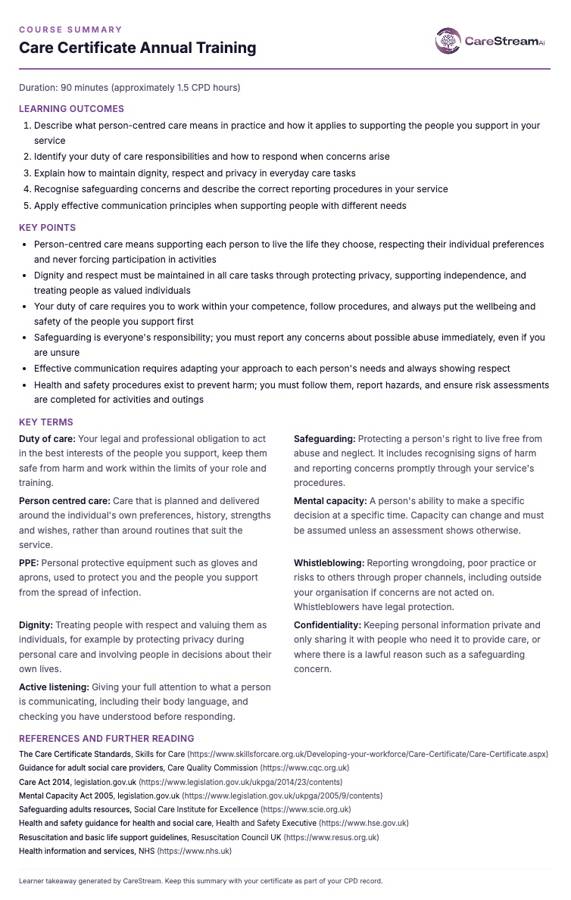
A printable one page takeaway of the outcomes, key points and key terms. Perfect for staff files, supervision conversations and the staff room wall.
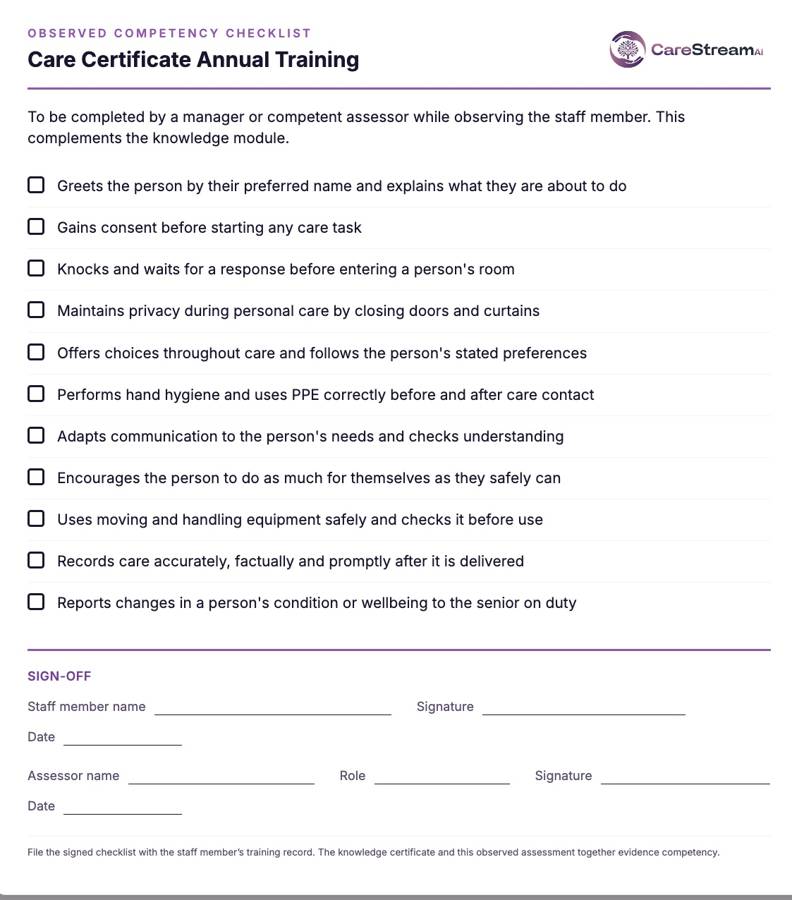
A printable checklist for managers to confirm skills in practice, with a sign off section. It completes the picture beyond the knowledge assessment.
Wrong answers become lessons, not failures
Most e learning marks an answer wrong and moves on. CareStream does not. Every wrong answer triggers an automatic follow up loop that teaches the point again and rechecks it, so no knowledge gap is left behind.
A wrong answer immediately opens a short lesson explaining the point, so the gap is closed there and then.
A fresh question on the same point checks the lesson has landed. The loop repeats until it has.
Staff move on to the next module and their certificate once they genuinely know the answer, not just after one lucky guess.
Why choose CareStream?
Training built for the care sector, delivered the way busy teams actually learn.
- 90+ care-specific training courses
- Bitesize, engaging lessons your staff actually finish
- Mapped to the Care Certificate & CQC standards
- Available in 60+ languages
- Instant certificate on completion
- Flexible learning, anytime, on any device
- Content kept up to date with UK care regulations
- Time to complete: ~35 min
Frequently asked questions.
Is Consent for Procedures training mandatory in care settings?
How often should staff complete Consent for Procedures training?
Can CareStream deliver Consent for Procedures training in other languages?
Does the training include an assessment?
More training your team may need
More mandatory and role-specific training CareStream delivers to your team, in the hub, in any language. Add any of these to your basket.
 Annual Certificate
Duty of Candour
This training explains your legal and professional duty to be open and honest with residents and their families when mistakes happen in care. You will learn when the formal Duty of Candour applies, what actions you must take, and how to support residents through difficult conversations. Being transparent builds trust and helps us learn from incidents.
Bulk discounts from 10+ licences
 Annual Certificate
Whistleblowing
This training explains how to raise concerns about poor practice, risks to residents, or wrongdoing at the Home. You will learn when and how to speak up, what protection you have, and why reporting concerns is part of your duty of care. Speaking up keeps residents safe and maintains high standards of care.
Bulk discounts from 10+ licences
 Annual Certificate
Complaints Handling
This training covers how we handle complaints at our home, following our Duty of Candour Policy. You will learn when and how to be open with residents and families when things go wrong, how to respond to concerns properly, and how to record and learn from complaints. Handling complaints well protects residents and builds trust.
Bulk discounts from 10+ licences
 Annual Certificate
Venous Thromboembolism (VTE) Prevention
This training ensures you understand how to prevent blood clots in hospital patients through proper risk assessment, mechanical and pharmacological prevention methods, and patient involvement. Hospital acquired thrombosis is a leading cause of preventable death, and in independent hospitals where we perform high volumes of elective and orthopaedic surgery, getting VTE prevention right is essential to patient safety and regulatory compliance.
Bulk discounts from 10+ licences
 Annual Certificate
Sterile Services and Instrument Decontamination
This training ensures you understand how surgical instruments are safely cleaned, disinfected and sterilised so they cannot transmit infection between patients. You will learn the decontamination cycle, the dirty to clean workflow, equipment operation, tracking requirements and the critical safety checks that protect every surgical patient in our hospital.
Bulk discounts from 10+ licences
 Annual Certificate
Clinical Governance
This module explains the framework through which our hospital continuously improves the quality of care and maintains high standards. You will learn how the systems you use every day, from incident reporting to clinical audit, fit together to keep patients safe. Clinical governance is everyone's responsibility, from the board to the bedside, and this training shows you how your role contributes to safe, effective care.
Bulk discounts from 10+ licences
Give your team consent for procedures training that actually sticks.
Add it to your basket, allocate it in seconds, and let the evidence build itself.
Compared
Three ways to train a care team.
These modules are written and kept current by us, so your managers do not have to write or maintain them. We have compared what each approach does rather than naming providers, because products change and this should still be true next year.
| CareStream | A generic e-learning library | A trainer you book | |
|---|---|---|---|
| Try a real lesson and a real question before you buy | |||
| Learning outcomes and time to complete stated up front | |||
| Written lesson sections, each with its own illustration | |||
| Interactive exercises after the lesson that teaches them, in every module | |||
| Assessment in every module, with the key points to revisit | |||
| Taken in any of sixty plus languages | |||
| A wrong answer triggers a follow-up lesson, not just a re-sit | |||
| Practical sign-off by a manager where the subject needs it | |||
| Completion files itself into your training matrix and evidence pack | |||
| Bought one module at a time, with no annual contract |
Generic libraries are often cheaper per learner. They teach a national standard rather than being built, updated and evidenced around the way a CQC-registered service is actually inspected.
Care policies
Every module is written from a policy
If the policy behind it is out of date, the training inherits that. Sixty six policies written for your service, checked against current law and read by a person before they carry your name, from £39.