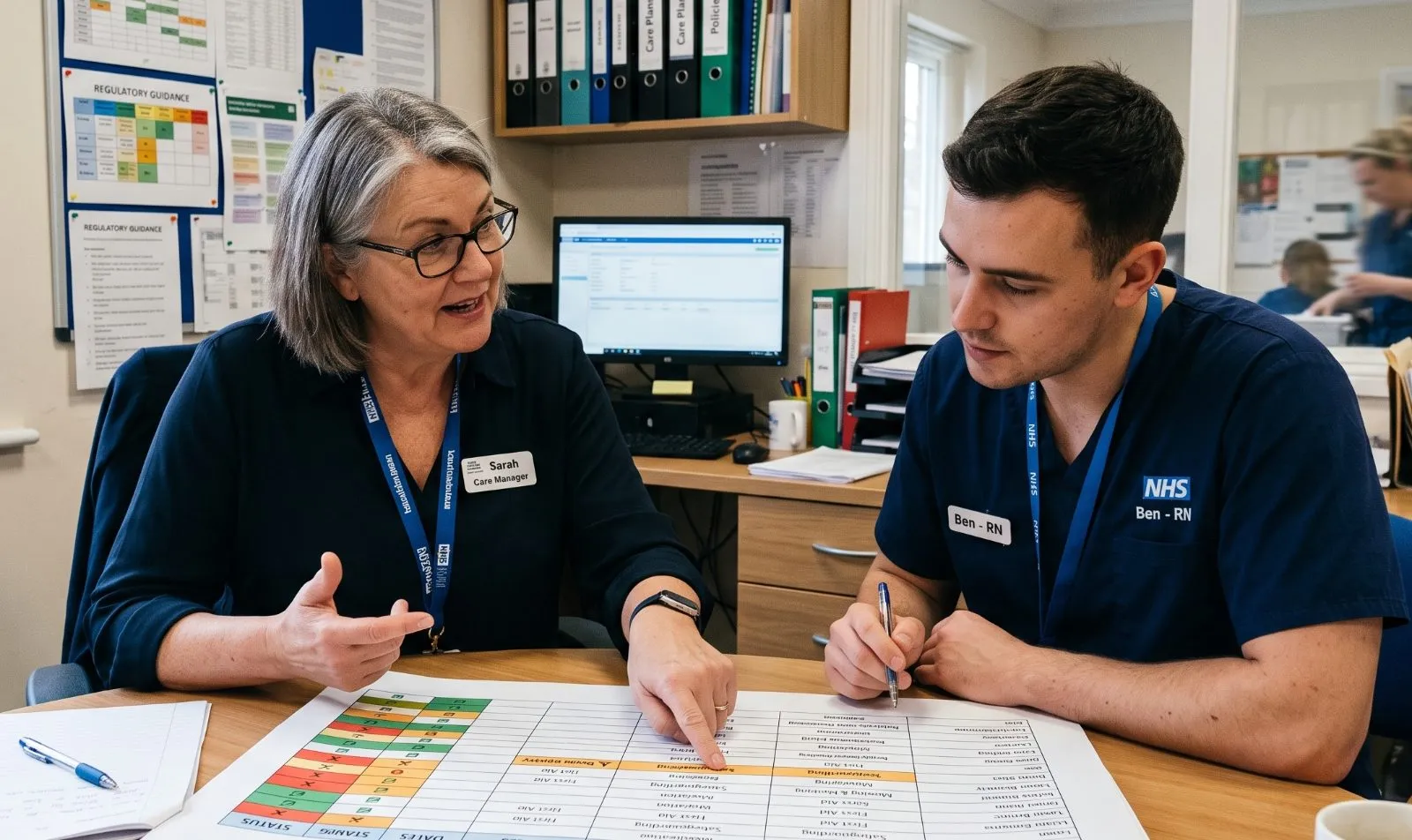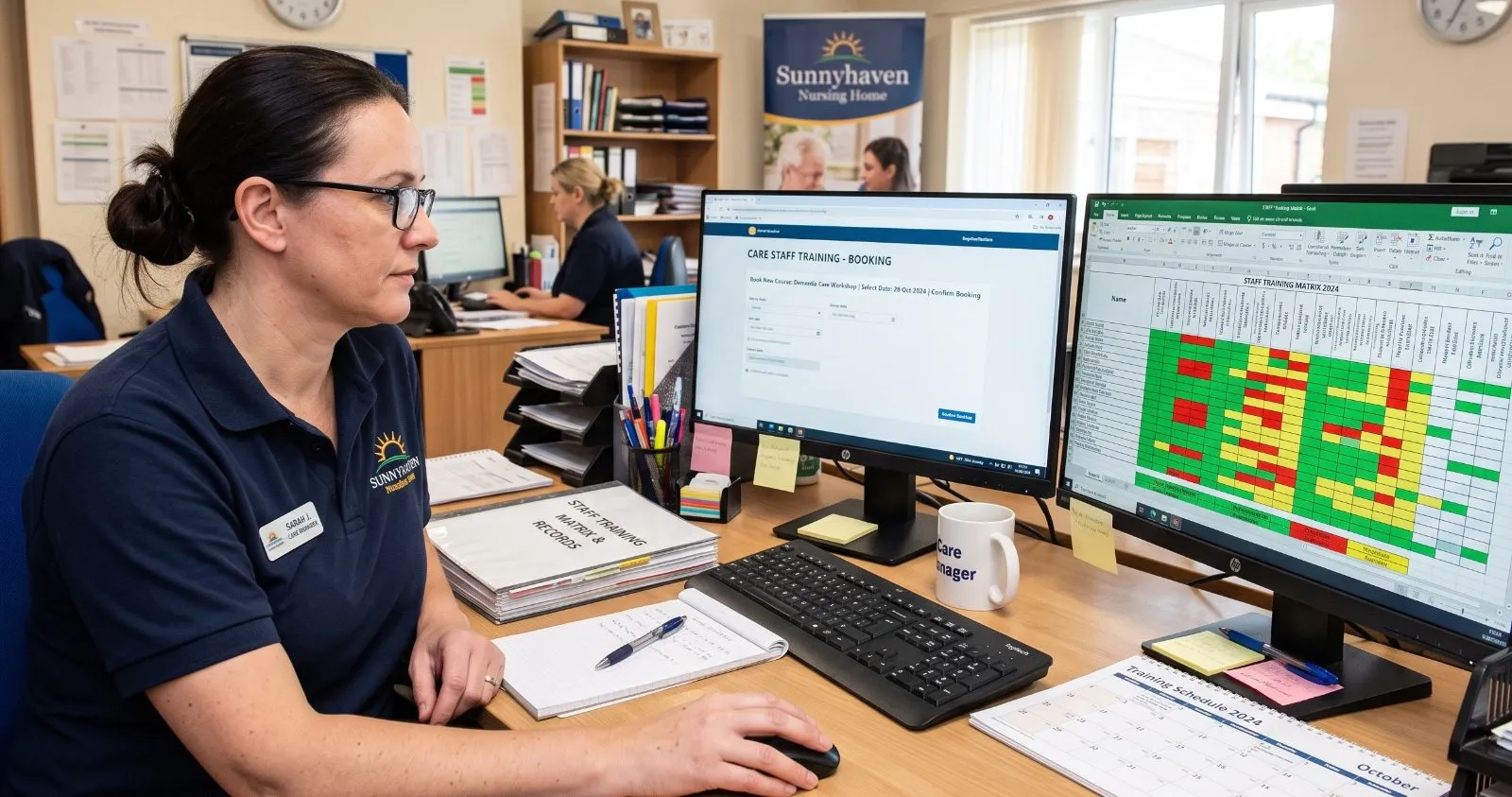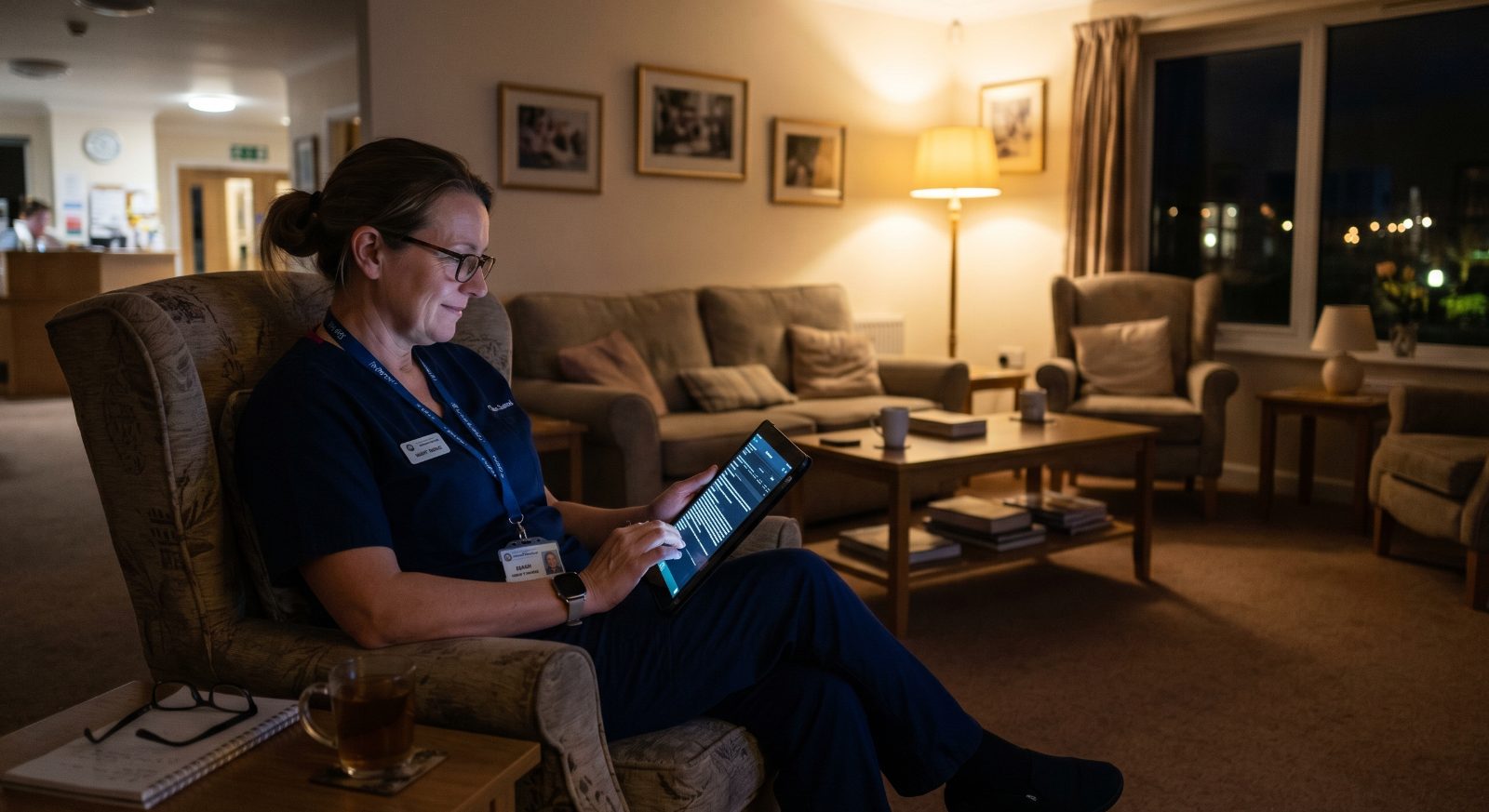
The 3-am Problem: Why Care Homes Need Supported Night Shifts
Most policy access in care homes happens during office hours, when managers are present. But clinical uncertainty does not keep office hours, and staff working at 3am often have fewer resources than they need.
This post is about that gap, why it persists, and what supported night shifts actually look like in practice. It is written for the people who already know that the picture is not as tidy as policy documents suggest: care home managers, registered managers, operators, and owners who carry the responsibility for what happens in their homes overnight, every night.
The 3am problem
Imagine a care worker on a night shift who is unsure whether a resident's observation schedule needs to change after a fall. They have two realistic options: call the manager (who may be asleep) or make a judgment call without full confidence in the procedure.
Both options are suboptimal. The first puts pressure on the manager and is unsustainable as a pattern. The second is a clinical risk and a compliance gap. In the worst case, it is also the kind of decision that ends up being scrutinised much later, when a relative complains, a safeguarding referral is made, or a CQC inspector asks how a particular incident was managed.
This scenario plays out in care and nursing homes every night. Most managers know it happens. Many have normalised it, treating out-of-hours calls as an unavoidable cost of the job. Some managers have learned to sleep with their phone on the pillow. Others have given up trying to log every call because there are too many.
None of that is a failure of leadership. It is the system absorbing a problem that the sector has not yet built a proper answer for.
Why the policy folder is not the answer
Most homes have a policy folder, physical or digital. At 3am, it is unlikely to be consulted. Not because staff are lazy or careless, but because:
- Finding the relevant policy takes time, and staff do not have time during a care emergency
- Policies are often long and written in formal language that is hard to parse under pressure
- Many policies are designed for audit, not for in-the-moment decision support, so even when you find the right one, you often have to read several pages before you reach the bit that answers the actual question they need
- A staff member who is not confident in English may not be able to locate or understand the relevant section at all
- The format itself is wrong: people under pressure want a clear answer, not a document
The result is that the policy folder works well for inspectors and auditors, who have time to read it carefully, and works poorly for the staff who actually need it at the point of decision.
The regulatory frame
This is not just an operational issue. It sits inside a regulatory expectation that is increasingly clear.
CQC's framework expects homes to demonstrate that staff are competent to make decisions across all shifts, not just when management is present. Safe staffing is not just about numbers on a rota. It is about whether the staff on shift can deliver care safely, including out of hours. When inspectors ask how decisions were made in a particular incident, the answer "the care worker tried their best" is rarely sufficient if the home cannot also show that the care worker had access to clear, current guidance at the time.
The same expectation runs through safeguarding processes. When something goes wrong, the question is almost always: did the staff member have access to the right information, was the right procedure followed, and is there a record? Homes that can answer those questions confidently are in a different position than homes that cannot.
This is why the gap between daytime policy access and out-of-hours reality matters so much. It is not just a comfort issue for staff. It is a structural compliance issue for the home.
The questions that actually come up at 3am
It helps to be specific about the kinds of things that drive out-of-hours uncertainty. They are rarely dramatic. The dramatic ones go straight to 999. What fills the in-between space is more like this:
- A resident has fallen but seems well. Should we increase observations, and for how long?
- A resident with dementia is refusing medication. What does the policy say about second offers, refusals, and recording?
- A resident has developed a new skin mark. Is this safeguarding, a pressure area, a reportable incident, or none of the above?
- A relative arrives unexpectedly outside visiting hours and is distressed. What is the home's position on this?
- A resident is showing early signs of a UTI. Are we authorised to start fluids and observations, or do we need to call out of hours?
- A new admission has arrived with a medication chart that does not match what the GP letter says.
- A resident is at the end of life, and the family wants to know whether a specific medication can be given now.
- A staff member has been hurt and is not sure whether the incident counts as a reportable injury.
None of these requires a hospital. All of them require a confident, accurate answer that aligns with the home's policy and the relevant regulations. And all of them are exactly the kinds of questions that should not require the manager to be woken up at 3am.
What supported night shifts look like
The shift towards always-on policy access changes this picture. When a care worker can ask a question in plain language, or their own language, and get an immediate, accurate answer from the approved policy, the dynamics are different:
- The question gets answered correctly, without waking the manager
- The correct procedure is followed
- The query is logged, so the manager sees it in the morning and can review whether a pattern is emerging
- Staff feel supported and confident, rather than isolated
- The home has a contemporaneous record of how a decision was reached, which is meaningful for safeguarding, complaints, and inspection
- The same answer is given consistently across shifts and across staff members, rather than depending on who is on duty
That last point is worth emphasising. In an unsupported home, the answer to a given question can depend entirely on who happens to be on shift, what they remember from their induction, and whether they had a manager available to ask. Supported night shifts remove that variation. Everyone gets the same answer, drawn from the same approved policy, every time.
The retention dimension
Staff who feel unsupported on night shifts are more likely to leave. This is particularly true for new overseas care workers, who are now a significant and growing proportion of the workforce in many parts of the country. These workers are often navigating two things at once: a new role and a new language. A policy folder that is challenging for a native English speaker to parse at speed becomes almost unusable in those circumstances.
The wider picture matters here. Turnover in adult social care is widely acknowledged to be one of the most significant operational pressures in the sector. The cost of replacing a single care worker, when you add up recruitment, induction, paid training, agency cover during gaps, and the slow build of competence in the new starter, is substantial. Anything that reduces the sense of isolation and provides reliable support has an indirect but real impact on retention.
The connection between night shift support and retention is rarely talked about explicitly, but it is real. People do not usually leave because of one bad night. They leave because of an accumulation of nights where they felt out of their depth, unsupported, or alone with decisions they did not feel qualified to make. Removing that accumulation, shift by shift, is one of the more powerful retention levers a home has.
The management value of logging
There is a quieter benefit to supported night shifts that deserves more attention than it usually gets. When every query is logged, the home gains something it has rarely had before: a clear, contemporaneous record of where uncertainty actually lives.
That data is genuinely useful. It tells the manager which policies are unclear, which procedures are creating repeated questions, which staff might benefit from extra support, and where induction may be falling short. It surfaces patterns that no amount of daytime walk-rounds would reveal, because the questions only come up at the moment of decision, and the moment of decision is often at 3am.
Over time, that log becomes a tool for continuous improvement rather than just an audit trail. Patterns inform training. Repeated questions become candidates for policy revision. Confident, well-handled queries become evidence of competence to share with inspectors. The night shift, which has traditionally been the least visible part of the home's operation, becomes one of the better-understood parts.
What care managers report
Managers who have deployed CareStream consistently report the same shift: out-of-hours calls drop significantly in the first month. Night staff report feeling more confident. And managers gain something they rarely had before, a log of exactly what their night team was uncertain about and how those questions were answered.
That last point often comes as a quiet surprise. Many managers expect the value of the tool to be the support it gives to staff overnight. They find that the additional value, sometimes the bigger one, is the visibility it gives them into how their home is actually being run when they are not there.
The bigger picture
Night shifts have always been the hardest shifts in any 24-hour service. In care homes, where the stakes are particularly high, and the staff are often working with fewer resources than their daytime colleagues, the gap between policy and practice gets wider after dark. The 3am problem is not new. What is new is that the technology to close that gap is now mature enough to deploy without disrupting the way a home already operates.
For managers, registered managers, operators, and owners, the question is no longer whether the night shift gap exists. It is whether the home is going to keep absorbing the cost of it, in calls, in turnover, in compliance risk, and in staff confidence, or whether it is going to do something about it.
Supported night shifts are not a luxury. They are increasingly the baseline expectation of a well-run home.
Built for the night shift
CareStreamAI is available 24 hours a day, via email or the web portal, in any language. No setup required for staff.
See what it means for registered managers →Book a demo or start your free trial today.
Sources
- CQC: Fundamental standards · cqc.org.uk
- NICE SC1: Managing medicines in care homes · nice.org.uk
- Mental Capacity Act 2005 · legislation.gov.uk
Frequently asked
How do we know if our home has a night shift support problem?
Is this just a problem for larger homes, or smaller ones too?
Won't supported night shifts just create more work for managers?
How does this affect overseas workers specifically?
How does this fit with our existing CQC compliance and safeguarding processes?
Written by
 Len BurgessSenior Care Advisor
Len Burgess has worked in the care sector for over 8 years, with hands-on experience across residential, nursing and community settings. Having supported teams through CQC inspections and the day-to-day reality of keeping a service compliant, he writes about regulation, quality and best practice in a way that's grounded in what actually happens on the floor, not just what the guidance says.